
Managing Pelvic Girdle Pain in Pregnancy
Learn to assess pregnancy-related pelvic girdle pain and prescribe safe, load-managed exercise to reduce pain, improve mobility and maintain function.
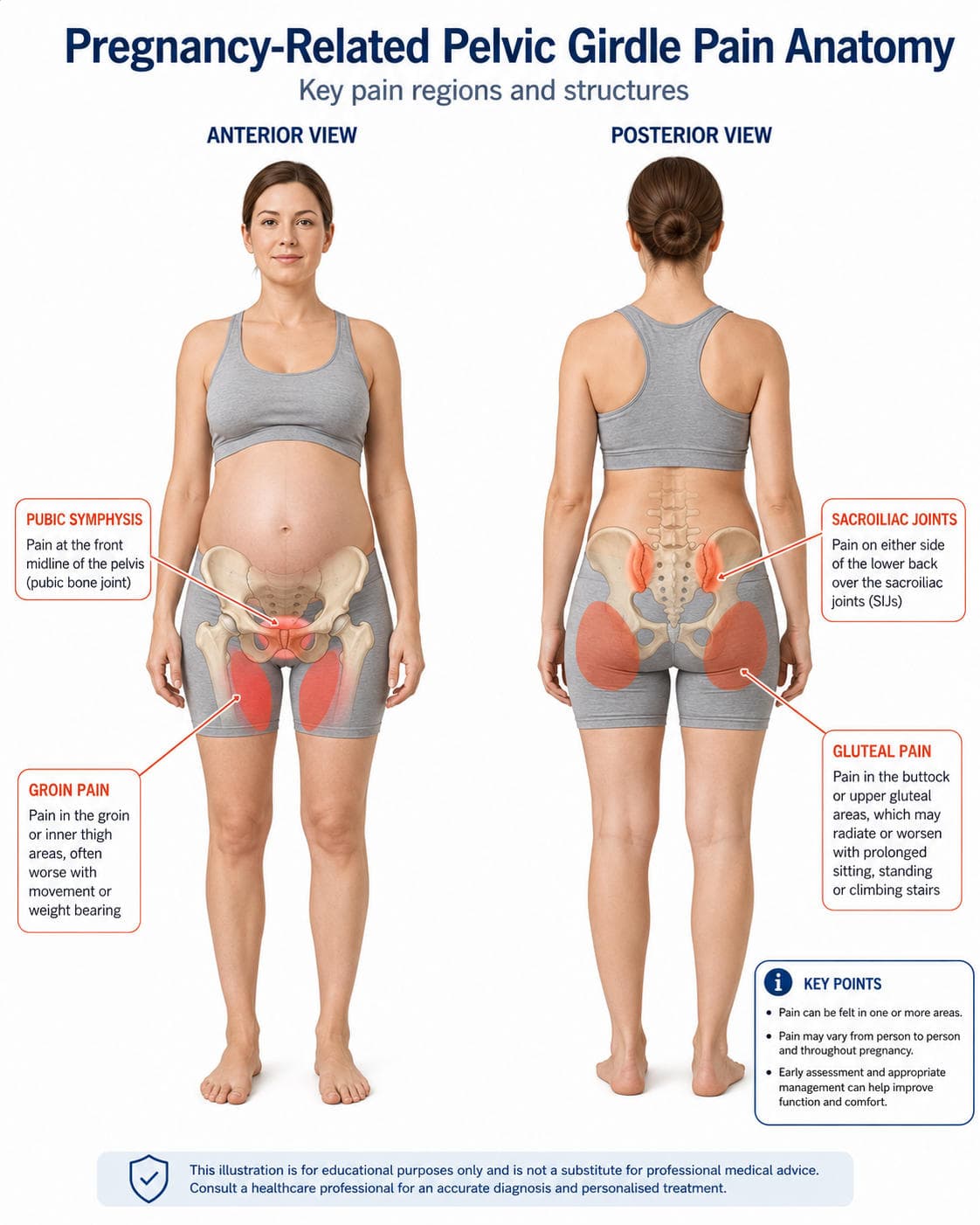
Pelvic girdle pain is a common but treatable musculoskeletal condition during pregnancy. It can considerably restrict walking, stair climbing, bed mobility, dressing and other everyday activities. Although patients may be told that pelvic pain is simply a normal part of pregnancy, significant movement-related pain should be assessed rather than dismissed.
Physiotherapy management is not based on forcing pelvic alignment or prescribing complete rest. The central approach is to identify the patient’s individual pain-provoking loads, temporarily modify them and gradually rebuild tolerance through targeted exercise and functional practice.
Understanding Pregnancy-Related Pelvic Girdle Pain
Pregnancy-related pelvic girdle pain, or PGP, refers to pain arising around the pelvic ring. It may be experienced posteriorly between the posterior iliac crest and gluteal fold, around one or both sacroiliac joints, anteriorly near the pubic symphysis, or across a combination of these regions. Pain may also spread towards the groin, hips or thighs.
Approximately one in five pregnant women experiences PGP. Typical aggravating activities include walking, climbing stairs, standing on one leg, turning in bed, getting into a car and moving the legs apart. These activities increase or asymmetrically transfer load through the pelvis (Royal College of Obstetricians and Gynaecologists [RCOG], 2015).
PGP is considered multifactorial. Pregnancy changes body mass, posture, muscle demand and the mechanical loading of the trunk and pelvis. Hormonal influences may affect ligament behaviour, but increased ligament laxity alone does not explain the severity of pain.(Jakes et al., 2026).
Pain does not necessarily indicate that the pelvic joints are damaged, displaced or “out of alignment". Contemporary management instead considers the interaction between tissue sensitivity, load tolerance, muscle coordination, sleep, stress, fear of movement and the physical demands of daily life. Education should therefore be reassuring and combined with active rehabilitation rather than delivered as a stand-alone intervention (Vesting et al., 2025).
Physiotherapy Assessment of Pelvic Girdle Pain
The diagnosis of PGP is primarily clinical. Assessment should reproduce familiar pain through selected functional and pain-provocation tests while excluding lumbar, hip, neurological, urinary and obstetric causes.

Subjective assessment
The physiotherapist should document:
- Site, onset, nature and irritability of pain
- Gestational age and obstetric history
- Aggravating activities, particularly walking, stairs, turning in bed and single-leg tasks
- Twenty-four-hour pain behaviour and sleep disturbance
- Previous low-back pain, pelvic injury or PGP during an earlier pregnancy
- Occupational, childcare and household demands
- Current physical activity and exercise
- Beliefs about pain, fear of movement and available support
- Effect on mobility, self-care and participation
The Pelvic Girdle Questionnaire may be used to quantify symptoms and activity limitations. A numerical pain rating scale, Patient-Specific Functional Scale or repeated functional tasks can also help monitor progress.
Physical examination

The P4 test and Active Straight Leg Raise test are recommended components of the clinical examination. Several tests are usually interpreted together because no single test confirms every presentation of PGP. Routine pelvic positional palpation and mobility tests have limited clinical value, while imaging is generally unnecessary unless serious pathology is suspected (Vleeming et al., 2008).
Red flags and referral
PGP is usually mechanical: symptoms change with movement or loading and improve with an appropriate change in position or activity. Urgent medical or obstetric review is required when pain is accompanied by vaginal bleeding, amniotic fluid leakage, regular painful contractions, fever, dysuria, reduced fetal movement, acute abdominal pain, trauma, unexplained weakness, saddle sensory loss or bowel or bladder dysfunction.
Calf pain or swelling, chest pain, dizziness and unusual breathlessness also require prompt assessment. Severe constant pain, night pain unrelated to movement or inability to bear weight should not automatically be attributed to PGP.
Load Management: Reducing Irritation Without Complete Rest
Load management means reducing the combination of movements, duration, force and repetition that exceeds the patient’s current capacity. It does not mean eliminating all activity. Prolonged inactivity can contribute to deconditioning, reduced confidence, greater dependence and increased thromboembolic risk in patients with markedly restricted mobility.

The physiotherapist should identify the patient’s highest-load activities and modify them practically. Useful strategies include:
- Taking shorter walks with planned rests rather than one long walk
- Reducing repeated stair use where possible
- Sitting while dressing instead of standing on one leg
- Keeping the knees comfortably closer together when entering a car or turning in bed
- Avoiding repeated heavy lifting, especially with rotation
- Dividing household tasks across the day
- Alternating sitting, standing and walking before symptoms escalate
- Sharing childcare, shopping and lifting tasks
- Using a pillow between the knees and under the abdomen during side-lying
These modifications should be individualised. The aim is to find a tolerable variation, reduce unnecessary repetition and gradually restore the original task.
A practical symptom-response system can guide progression:

RCOG advice similarly encourages patients to remain active while balancing activity with rest and avoiding repetitive movements that substantially worsen symptoms.
Load-Managed Exercise Prescription
Exercise should be selected according to the patient’s presentation rather than prescribed as a fixed antenatal routine. The objective is to improve confidence, movement control and capacity of the trunk, hip and lower-limb muscles without repeatedly provoking symptoms.

Early or irritable stage
Begin with low-load exercises in comfortable positions:
- Breathing and pelvic-floor coordination: Gentle diaphragmatic breathing combined with relaxed pelvic-floor movement, followed by a comfortable submaximal contraction where indicated.
- Pelvic tilting: Small, pain-free pelvic movements in sitting, standing or supported quadruped.
- Hip adductor isometrics: Gentle pillow or ball squeeze without maximal effort.
- Hip abductor isometrics: Light outward pressure into a band, wall or therapist resistance.
- Supported sit-to-stand: Use a higher chair and symmetrical foot position where tolerated.
- Quadruped rocking: Controlled movement towards the heels within a comfortable range.
One or two sets of 6–10 repetitions may be sufficient initially. Exercise should feel controlled rather than exhausting.
Building capacity
As irritability reduces, treatment can progress towards:
- Bridge variations if supine positioning is comfortable and medically appropriate
- Standing hip abduction or extension with support
- Shallow squats or chair squats
- Low step-ups
- Resistance-band rows
- Modified bird-dog exercises
- Controlled carrying and lifting practice
- Walking, stationary cycling, swimming or aquatic exercise
Progress one variable at a time: repetitions, resistance, range, time or task complexity. Bilateral exercises may initially be better tolerated, but asymmetrical tasks should not be avoided indefinitely. Since stair climbing, walking and dressing require single-leg control, graded exposure to these activities is usually necessary.
For uncomplicated pregnancies, general guidance supports at least 150 minutes of moderate-intensity aerobic activity per week. However, this is a population-level target rather than an immediate prescription for every patient with symptomatic PGP. Activity may need to be divided into shorter sessions and adjusted according to pain, pregnancy status and previous exercise experience (American College of Obstetricians and Gynecologists [ACOG], 2020).
Evidence suggests that exercise can reduce pregnancy-related lumbopelvic pain and disability, although no single programme is superior for every patient. Individualisation, adherence and symptom-guided progression are therefore more important than prescribing a rigid group of “stabilisation” exercises (Kokic et al., 2017; Santos et al., 2023).
Belts, Manual Therapy and Reassessment
A non-rigid lumbopelvic belt may be trialled during activities such as walking, standing or household work. The belt should produce an immediate functional benefit and should not restrict breathing or cause discomfort. It is an adjunct for selected activities rather than a substitute for progressive exercise.
NICE recommends considering referral to physiotherapy for exercise advice and/or provision of a non-rigid lumbopelvic belt. Evidence suggests that a belt combined with education and ergonomic advice may reduce pain, although improvements in daily function are less certain (National Institute for Health and Care Excellence [NICE], 2021).
Manual therapy may provide short-term symptom relief when directed towards painful muscles or restricted neighbouring regions. Heat, hydrotherapy, taping, crutches or other mobility aids may also be used when they support safe movement and participation.
Reassessment should consider more than pain intensity. Useful indicators include walking tolerance, stair performance, sleep, turning in bed, work participation, exercise confidence and next-day response to loading. Persistent severe pain, rapidly declining mobility or symptoms continuing after childbirth require further evaluation.
Viva-Ready Summary
- Pregnancy-related PGP affects the anterior and/or posterior pelvic ring and is commonly aggravated by walking, stairs, bed mobility and single-leg activities.
- Diagnosis is clinical and requires exclusion of obstetric, neurological, hip and lumbar pathology.
- The P4 and Active Straight Leg Raise tests are commonly used alongside functional assessment.
- Management begins with education, pacing and modification of provocative loads—not complete rest.
- Exercise should gradually improve trunk, hip and lower-limb capacity while respecting symptom response.
- A non-rigid pelvic belt may help selected patients during provoking activities.
- Manual therapy is an adjunct and should not replace education, exercise and graded functional loading.
- Progression depends on function and recovery after activity rather than pain during a single exercise alone.
One-line recall point: Pregnancy-related pelvic girdle pain is managed by excluding red flags, modifying excessive pelvic load and progressively rebuilding functional capacity.
References
American College of Obstetricians and Gynecologists. (2020). Physical activity and exercise during pregnancy and the postpartum period: ACOG Committee Opinion No. 804. Obstetrics & Gynecology, 135(4), e178–e188.
Jakes, A., Chadha, K., & Igualada-Martinez, P. (2026). Identifying and managing pregnancy-related pelvic girdle pain. BMJ, 393, e088930.
Kisner, C., Colby, L. A., & Borstad, J. (2018). Therapeutic exercise: Foundations and techniques (7th ed.). F. A. Davis.
Kokic, I. S., Ivanisevic, M., Uremovic, M., Kokic, T., Pisot, R., & Simunic, B. (2017). Effect of therapeutic exercises on pregnancy-related low back pain and pelvic girdle pain: Secondary analysis of a randomized controlled trial. Journal of Rehabilitation Medicine, 49(3), 251–257.
National Institute for Health and Care Excellence. (2021). Antenatal care (NICE Guideline NG201; updated 2025).
Royal College of Obstetricians and Gynaecologists. (2015). Pelvic girdle pain and pregnancy.
Santos, F. F., Lourenço, B. M., Souza, M. B., Maia, L. B., Oliveira, V. C., & Oliveira, M. X. (2023). Prevention of low back and pelvic girdle pain during pregnancy: A systematic review and meta-analysis of randomised controlled trials with GRADE recommendations. Physiotherapy, 118, 1–11.
Vesting, S., Gutke, A., & de Baets, L. (2025). Educating women to prevent and treat low back and pelvic girdle pain during and after pregnancy: A systematized narrative review. Annals of Medicine, 57(1), 2476046.
Vleeming, A., Albert, H. B., Östgaard, H. C., Sturesson, B., & Stuge, B. (2008). European guidelines for the diagnosis and treatment of pelvic girdle pain. European Spine Journal, 17(6), 794–819.


