
Safe Exercise During Pregnancy: Clinical Guidelines and Prescription Principles
Learn which exercises are safe during pregnancy, how to apply the FITT principle, screen for contraindications and modify exercise across each trimester.
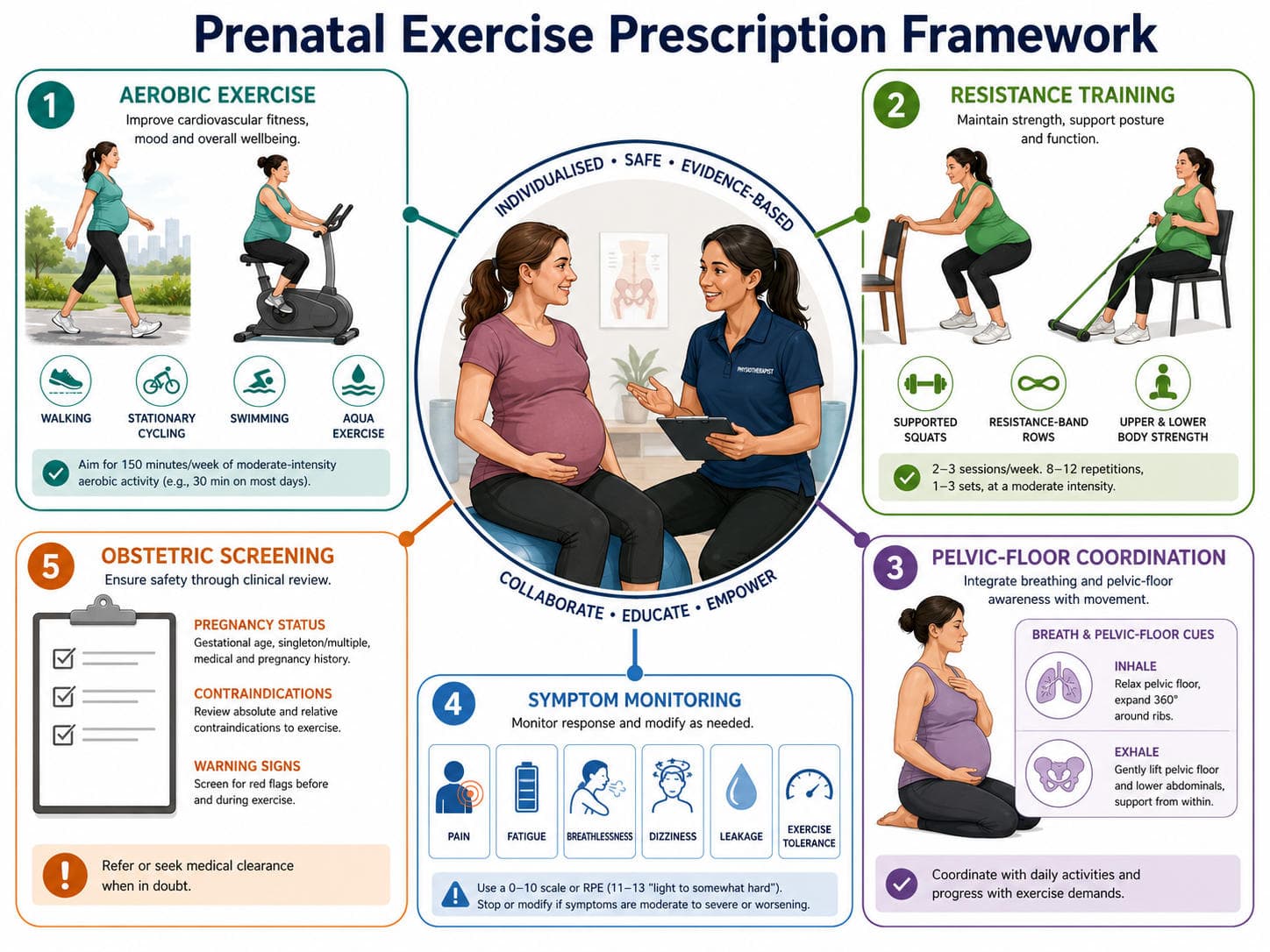
Pregnancy is not a disease state, and an uncomplicated pregnancy is not an indication for rest. Physical activity includes any bodily movement that increases energy expenditure, whereas exercise is planned and structured activity performed to improve fitness, health or physical function.
For most pregnant women without contraindications, regular exercise is safe and should be encouraged throughout pregnancy. The programme may need to be modified—not automatically stopped—as maternal anatomy, symptoms, balance and exercise tolerance change.
Why Exercise Belongs in Routine Antenatal Care
Regular prenatal exercise helps maintain cardiorespiratory fitness, muscular strength, mobility and psychological wellbeing. It is associated with lower risks of excessive gestational weight gain, gestational diabetes and hypertensive disorders, while also reducing sedentary behaviour and supporting sleep, mood and functional independence.
In healthy, uncomplicated pregnancies, moderate exercise does not increase the risk of miscarriage, preterm birth or low birth weight. Consequently, current international guidelines recommend regular physical activity during pregnancy unless an obstetric or medical contraindication is present (American College of Obstetricians and Gynaecologists [ACOG], 2020; World Health Organization [WHO], 2020).
Recent evidence also suggests possible benefits for labour. A 2025 meta-analysis of 16 randomised controlled trials involving 3,387 women found that prenatal exercise was associated with a higher likelihood of vaginal birth, a lower caesarean-delivery rate and a shorter first stage of labour. There were no clinically meaningful differences in birth weight or Apgar scores between exercise and control groups (Andargie et al., 2025).
These findings support exercise as part of routine antenatal care, but they do not remove the need for individual obstetric assessment.

Screen Before Prescribing Exercise
Before prescribing exercise, the physiotherapist should determine whether the pregnancy is uncomplicated and whether the patient was previously active, intermittently active or sedentary.
Assessment should include:
- Gestational age and current obstetric status
- Previous pregnancies, complications and pregnancy losses
- Pre-pregnancy and current exercise participation
- Cardiovascular, respiratory, endocrine and neurological conditions
- Medications, anaemia, nutritional status and fatigue
- Low-back pain, pelvic girdle pain and other musculoskeletal symptoms
- Pelvic-floor symptoms, including leakage, heaviness, pain or voiding difficulty
- Balance, falls risk, functional demands and patient goals
- Advice or restrictions provided by the obstetric team
Exercise should not be initiated or progressed in the presence of an absolute contraindication. Important examples include ruptured membranes, premature labour, unexplained persistent vaginal bleeding, placenta previa after 28 weeks, pre-eclampsia, cervical insufficiency, intrauterine growth restriction, high-order multiple pregnancy and uncontrolled serious cardiovascular, respiratory, hypertensive, endocrine or systemic disease (Mottola et al., 2018).
Relative concerns—such as symptomatic anaemia, malnutrition, recurrent pregnancy loss, poorly controlled seizure disorder, twin pregnancy after the second trimester or significant musculoskeletal pain—require individualised medical review rather than a generic exercise programme.
Exercise must be stopped and urgent assessment arranged if the patient develops:
- Vaginal bleeding or leakage of amniotic fluid
- Regular painful contractions
- Chest pain
- Severe or persistent shortness of breath
- Dizziness, faintness or severe headache
- Calf pain or swelling
- Muscle weakness affecting balance
- Markedly reduced fetal movement
- Any sudden feeling that something is not right
These warning signs must be clearly explained to the patient before beginning the programme.

Apply the FITT Principle
Most guidelines recommend that pregnant women accumulate at least 150 minutes of moderate-intensity physical activity per week. Activity should be spread across at least three days, although daily movement is encouraged. A combination of aerobic exercise, resistance training and pelvic-floor muscle training provides broader benefits than relying on one exercise mode alone (Mottola et al., 2018; WHO, 2020).

Previously inactive patients should begin below the final target. A suitable starting point may be 10–15 minutes of light walking three times per week. Duration should usually be increased before intensity.
Patients who exercised regularly before pregnancy may generally continue familiar activities, including some vigorous exercise, provided the pregnancy remains uncomplicated and the programme is reviewed as pregnancy progresses. Starting unfamiliar vigorous training during pregnancy is not usually appropriate.
A practical resistance-training prescription is the following:
- One to three sets per exercise
- Approximately 8–15 controlled repetitions
- Moderate resistance that permits normal breathing
- Two to three sessions per week
- Emphasis on functional, whole-body movement patterns
Suitable exercises include sit-to-stand, supported squats, rows, heel raises, step-ups, hip strengthening and modified trunk-control exercises. The patient should exhale during effort, avoid prolonged breath-holding or repeated Valsalva manoeuvres and stop the set before technique deteriorates.
Heart rate should not be used as a rigid universal ceiling because resting heart rate and cardiovascular responses change during pregnancy. The talk test, perceived exertion and symptom response are usually more practical methods of monitoring intensity. Each session should also include a gradual warm-up and cool-down, comfortable clothing, adequate hydration and avoidance of excessive heat (American College of Sports Medicine [ACSM], 2025).
Choose Safe Activities and Modify Them Across Pregnancy
Walking, swimming, stationary cycling, low-impact aerobics and supervised resistance training are suitable starting options for most patients. Aquatic exercise may be particularly useful when weight-bearing pain, swelling or heat intolerance limits land-based exercise.
Pelvic-floor muscle training may help prevent urinary incontinence and severe third- or fourth-degree perineal tears when the patient can correctly contract and relax the muscles (Zhang et al., 2024).
However, repeated strengthening exercises are not appropriate for every pelvic-floor presentation. Pelvic pain, dyspareunia, difficulty emptying the bladder or bowel, or evidence of an overactive pelvic floor may require relaxation, breathing and coordination training rather than additional maximal contractions.

Activities with a high risk of abdominal trauma, collision or falling should be avoided. These include:
- Contact and collision sports
- Horse riding
- Downhill skiing
- Gymnastics
- Outdoor cycling when balance is impaired
- Activities involving uncontrolled jumping or rapid direction changes
Scuba diving is contraindicated. Hot yoga, hot Pilates and exercise in extreme environmental heat should also be avoided. Unaccustomed exercise at high altitude requires medical guidance.
After the first trimester, prolonged exercise while lying flat in the supine position should be modified, particularly if it causes nausea, dizziness, pallor or breathlessness. Inclined, side-lying, quadruped, seated or standing positions can be used instead.
As pregnancy advances, the programme may require:
- A wider base of support
- Slower direction changes
- Reduced impact or step height
- Additional external support
- Shorter exercise intervals
- More frequent recovery periods
- Modified range of motion
These adaptations account for changes in the centre of mass, abdominal size, joint loading and balance strategy.
Monitor the Immediate and Next-Day Response
A safe programme is both progressive and symptom-led. During exercise, the physiotherapist should monitor perceived exertion, breathing, pain, balance, pelvic pressure, urinary leakage, contractions and unusual fatigue.
Blood pressure, heart rate and oxygen saturation may also be relevant in patients who are deconditioned, have cardiopulmonary conditions or are exercising under closer clinical supervision.
Progress only one major variable at a time. Duration is usually increased before intensity. Resistance exercises may then be advanced through repetitions, load, lever arm, range, speed or task complexity.

The programme should also change in response to nausea, sleep loss, anaemia, fatigue, musculoskeletal pain and trimester-related tolerance. The clinical target is consistent, safe participation, not maintenance of pre-pregnancy performance at all costs.

Physiotherapy Role and Example Session
Physiotherapists translate broad physical-activity recommendations into programmes that are safe, individualised and functionally relevant. Their role includes:
- Screening for contraindications and warning signs
- Assessing baseline exercise capacity and functional limitations
- Selecting and progressing aerobic and resistance exercises
- Assessing pelvic-floor contraction, relaxation and coordination
- Teaching breathing and pressure-management strategies
- Managing pregnancy-related low-back or pelvic girdle pain
- Providing pacing, posture and daily-activity education
- Communicating with the obstetric and multidisciplinary teams
A simple 30-minute session may include:
- Five minutes of easy walking and mobility exercises
- Fifteen minutes of moderate walking or stationary cycling
- Two sets each of supported squats, rows, heel raises and side-lying hip abduction
- Breathing and pelvic-floor coordination exercises
- Five minutes of gradual cool-down
The exact prescription should reflect the patient’s previous activity, trimester, symptoms, goals and medical status.
Viva-Ready Summary
Exercise is recommended during an uncomplicated pregnancy after appropriate obstetric and medical screening. The usual target is at least 150 minutes of moderate-intensity activity per week, spread over three or more days.
The programme should combine aerobic activity, resistance training and appropriate pelvic-floor muscle training. Exercise intensity is best monitored through the talk test, rating of Perceived Exertion and symptom response rather than one universal heart-rate limit.
Exercise should begin gradually and be modified for changing balance, heat tolerance, musculoskeletal loading and prolonged supine positioning. It must be stopped immediately if obstetric, cardiopulmonary or neurological warning signs develop.
One-line recall point: Screen first, prescribe 150 minutes of moderate mixed exercise, monitor symptoms and modify—not automatically stop—activity as pregnancy progresses.
References
American College of Obstetricians and Gynaecologists. (2020). Physical activity and exercise during pregnancy and the postpartum period: ACOG Committee Opinion No. 804. Obstetrics & Gynaecology, 135(4), e178–e188. DOI: 10.1097/AOG.0000000000003772
American College of Sports Medicine. (2025). ACSM’s guidelines for exercise testing and prescription (12th ed.). Wolters Kluwer.
Andargie, B. A., Legas, A., W/Sellassie, A., Abuhay, H., & Angaw, D. A. (2025). Effects of physical exercise during pregnancy on delivery outcomes: Systematic review and meta-analysis of randomised controlled trials. PLOS ONE, 20(7), e0326868. DOI: 10.1371/journal.pone.0326868
Mottola, M. F., Davenport, M. H., Ruchat, S. M., Davies, G. A., Poitras, V. J., Gray, C. E., Jaramillo Garcia, A., Barrowman, N., Adamo, K. B., Duggan, M., Barakat, R., Chilibeck, P., Fleming, K., Forte, M., Korolnek, J., Nagpal, T., Slater, L. G., Stirling, D., & Zehr, L. (2018). 2019 Canadian guideline for physical activity throughout pregnancy. British Journal of Sports Medicine, 52(21), 1339–1346. DOI: 10.1136/bjsports-2018-100056
World Health Organization. (2020). WHO guidelines on physical activity and sedentary behaviour. World Health Organization.
Zhang, D., Bø, K., Montejo, R., Sánchez-Polán, M., Silva-José, C., Palacio, M., & Barakat, R. (2024). Influence of pelvic floor muscle training alone or as part of a general physical activity programme during pregnancy on urinary incontinence, episiotomy and third- or fourth-degree perineal tear: Systematic review and meta-analysis of randomised clinical trials. Acta Obstetricia et Gynecologica Scandinavica, 103(6), 1015–1027. DOI: 10.1111/aogs.14744


