
Introduction to Sports Rehabilitation: Principles and Return-to-Sport Decision Making
Learn the core principles of sports rehabilitation, including tissue healing, criteria-based progression, return-to-sport testing and sport-specific reconditioning.
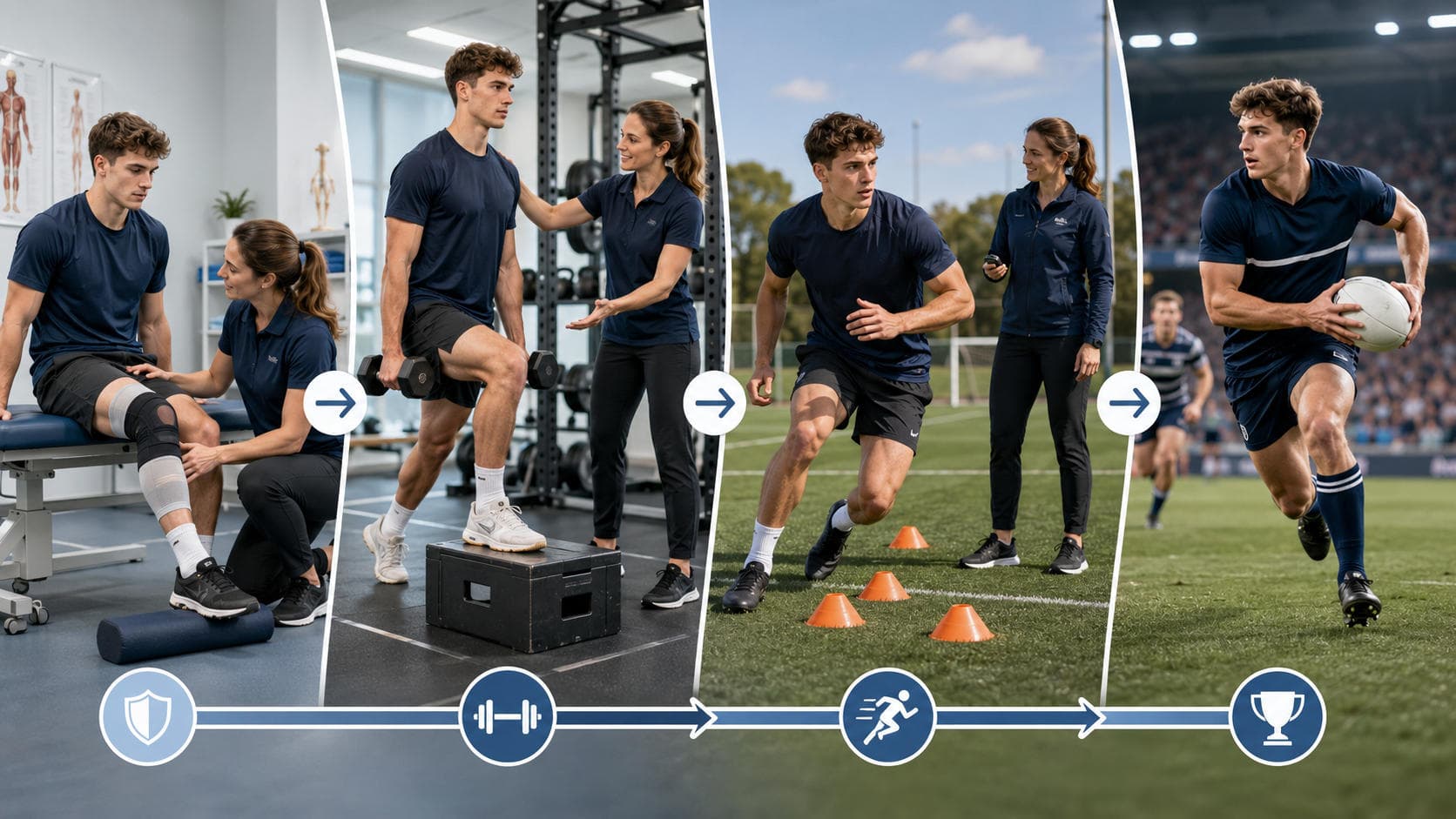
Sports rehabilitation is the structured process of restoring an injured athlete from the initial clinical presentation to safe participation and, ultimately, preinjury or higher-level performance. It is not simply the treatment of pain or the completion of a standard exercise sheet. The physiotherapist must continuously decide what the athlete can tolerate now, which capacities remain deficient and how closely rehabilitation reflects the demands of the sport.
Brukner and Khan’s clinical approach places the athlete—not only the injured tissue—at the centre of assessment and management. Diagnosis matters, but so do training history, playing position, competition level, previous injury, psychological response, recovery resources and the consequences of returning too early or too late. Sports rehabilitation is therefore best understood as progressive risk management rather than a fixed protocol. (Brukner & Khan, 2024, 2026).
Core Principles of Sports Rehabilitation
Effective rehabilitation begins with a clear diagnosis and a baseline profile. The physiotherapist identifies the involved tissue, injury severity, irritability, functional limitations and red flags while also documenting the athlete’s preinjury demands. A recreational runner, fast bowler and football goalkeeper may have the same anatomical diagnosis but require very different end-stage preparation.
Four principles guide the programme:
- Protect the injured structure without unnecessarily deconditioning the athlete.
- Apply progressive and specific loading to restore tissue and physical capacity.
- Use measurable criteria to guide progression rather than relying only on elapsed time.
- Rebuild confidence, decision-making ability and tolerance to the unpredictable demands of sport.
Exercise is not merely a way to strengthen muscles after healing has occurred. Through mechanotransduction, appropriately dosed mechanical loading stimulates cellular responses that contribute to repair and remodelling in muscle, tendon, bone and cartilage. The clinical challenge is to provide enough load to promote adaptation without exceeding the tissue’s current capacity (Khan & Scott, 2009).
Tissue Healing Phases and Rehabilitation Priorities
Most musculoskeletal tissues heal through overlapping inflammatory, repair and remodelling phases. The duration and quality of each phase vary according to tissue vascularity, injury severity, age, surgery, systemic health and loading exposure. These phases should therefore guide clinical reasoning rather than being treated as rigid calendar blocks.

The phases overlap. An athlete may feel clinically improved while biological repair remains incomplete. Conversely, complete rest may protect symptoms but reduce tissue capacity, muscle strength and confidence. Contemporary soft-tissue management therefore favours education and optimal loading when safe rather than prolonged passive care (Dubois & Esculier, 2020).
Load response should be judged across the whole system. Pain, swelling, stiffness, fatigue, movement quality and next-day recovery are all relevant. The intensity, volume and frequency of loading must be adjusted according to the injured tissue and the athlete’s recovery response (Gabbett & Oetter, 2025).
Criteria-Based Versus Time-Based Progression
A time-based protocol progresses the athlete because a certain number of days or weeks have passed. Time remains important because biological tissues require minimum healing periods, particularly after fractures, surgery or major ligament and tendon injuries. However, time alone cannot show whether the athlete has recovered range, strength, power, coordination or confidence.
Criteria-based rehabilitation progresses the athlete after predefined clinical and performance milestones have been achieved. For example, beginning running may require acceptable pain and swelling, sufficient range of motion, adequate strength, repeated single-leg loading and sound movement quality. Later progression to cutting may require high-speed running exposure, braking capacity, multidirectional strength and tolerance to reactive drills.
The most appropriate approach combines both:
Minimum biological time + objective criteria + acceptable load response + sporting context
Criterion-based milestones have become central to modern rehabilitation guidelines because they individualise progression and reveal deficits that may be hidden by symptom resolution. Current ACL rehabilitation guidance, for example, supports separate criteria for running, sprinting, plyometrics, agility, cutting, competition and secondary injury prevention rather than one general clearance date (Brinlee et al., 2022).

Criteria should not, however, be reduced to one number. An athlete may achieve a satisfactory limb symmetry index while both limbs remain below preinjury capacity. Absolute strength, sport norms, quality of movement and fatigue response should therefore accompany side-to-side comparisons.
A practical progression decision asks the following:
- Is the tissue medically and biologically ready for this load?
- Has the athlete met the entry criteria?
- Can the task be performed with acceptable quality and confidence?
- Is the immediate and 24-hour response acceptable?
- Does the next stage prepare the athlete for a real sporting demand?
Return to Sport Is a Continuum, Not a Single Test
Return to sport should not be viewed as one clearance appointment. The Bern consensus describes it as a continuum from return to participation to, to return to sport and, and finally return to performance (Ardern et al., 2016).
- Return to participation: The athlete is active in modified training but is not yet ready for unrestricted sport.
- Return to sport: The athlete resumes the sport, although performance may not yet equal the preinjury level.
- Return to performance: The athlete has recovered or exceeded the required performance level and can tolerate normal training and competition demands.

Return-to-sport testing informs this decision but does not eliminate risk. A useful test battery should examine several domains:

The PAASS framework for lateral ankle sprains illustrates this multidimensional approach. It evaluates pain, ankle impairments, athlete perception, sensorimotor control and sport or functional performance (Smith et al., 2021).
The exact tests should change with the injury and sport. A single hop test, manual muscle grade or pain-free jog is rarely sufficient to represent competitive readiness. Test results must be interpreted together with clinical examination, training exposure, psychological readiness and the athlete’s anticipated role.
Sport-Specific Reconditioning
General rehabilitation restores foundational capacity. Sport-specific reconditioning reconnects that capacity to the environment in which injury risk and performance occur. This stage should reproduce the sport’s movement patterns, intensity, work-to-rest ratio, technical skills, perceptual demands and fatigue profile.
Progression usually moves from predictable to unpredictable conditions:
- Controlled linear movement and rehearsed technical drills
- Increased speed, force and movement variability
- Planned acceleration, deceleration and change of direction
- Reactive drills involving an opponent, ball, cue or decision
- Position-specific training and normal team integration
- Match-like exposure followed by unrestricted competition
The control-chaos continuum provides a useful model. Early drills are highly controlled, while later drills progressively introduce speed, reactive decisions and unpredictable sporting situations (Taberner et al., 2019).
For a footballer, this may progress from straight-line running to planned cutting, reactive pressing and position-specific match scenarios. For a badminton player, it may progress from shadow footwork to externally cued multidirectional movement, stroke execution and repeated rallies. For a fast bowler, rehabilitation must eventually include run-up speed, repeated bowling loads, trunk rotation, landing forces and recovery between overs.
Recent hamstring consensus work similarly emphasises individualised rehabilitation based on the athlete, injured muscle, injury type and sporting demands, with graded exposure to running and sprinting before returning to sport (Paton et al., 2023).
Sport-specific reconditioning should therefore be designed backwards from competition demands rather than by simply adding cones or a ball to generic strengthening exercises.
A Practical Decision-Making Framework
At every stage, the physiotherapist can use the following cycle:
Assess → identify the limiting capacity → prescribe an appropriate load → monitor the response → retest → progress, maintain or regress
Progress when symptoms are stable, movement quality is acceptable, objective criteria have been achieved and the athlete tolerates the current workload. Maintain the stage when adaptation is occurring but criteria are not yet consistent. Regress or modify when pain, swelling, apprehension, altered technique or delayed recovery suggests that demand has exceeded current capacity.
Communication is equally important. Return-to-sport decisions should be shared among the athlete, physiotherapist, doctor, coach, strength and conditioning staff and, where relevant, the athlete’s family. The athlete must understand that medical clearance, readiness for training and readiness for full performance are related but not identical decisions.
Viva-Ready Summary
- Sports rehabilitation is a progressive, athlete-centred process extending from injury management to return to performance.
- Tissue healing includes overlapping inflammatory, repair and remodelling phases.
- Optimal loading promotes tissue adaptation through mechanotransduction.
- Time protects biological healing, while criteria demonstrate functional readiness.
- Return to sport is a continuum involving participation, sport and performance.
- Testing should cover symptoms, impairments, movement, sport performance, psychological readiness and workload.
- Sport-specific reconditioning progresses from controlled drills to unpredictable, competition-like demands.
One-line recall point: Sports rehabilitation progresses the athlete by matching tissue healing and objective capacity to the specific physical, psychological and contextual demands of sport.
References
Ardern, C. L., Glasgow, P., Schneiders, A., et al. (2016). 2016 consensus statement on return to sport from the First World Congress in Sports Physical Therapy, Bern. British Journal of Sports Medicine, 50(14), 853–864.
Brinlee, A. W., Dickenson, S. B., Hunter-Giordano, A., & Snyder-Mackler, L. (2022). ACL reconstruction rehabilitation: Clinical data, biologic healing, and criterion-based milestones to inform a return-to-sport guideline. Sports Health, 14(5), 770–779.
Brukner, P., & Khan, K. (Eds.). (2024). Brukner & Khan’s clinical sports medicine: Foundations of clinical practice (6th ed.). McGraw Hill.
Brukner, P., & Khan, K. (Eds.). (2026). Brukner & Khan’s clinical sports medicine: Managing injuries (6th ed.). McGraw Hill.
Dubois, B., & Esculier, J. F. (2020). Soft-tissue injuries simply need PEACE and LOVE. British Journal of Sports Medicine, 54(2), 72–73.
Gabbett, T. J., & Oetter, E. (2025). From tissue to system: What constitutes an appropriate response to loading? Sports Medicine, 55(1), 17–35.
Khan, K. M., & Scott, A. (2009). Mechanotherapy: How physical therapists’ prescription of exercise promotes tissue repair. British Journal of Sports Medicine, 43(4), 247–252.
Paton, B. M., Read, P., van Dyk, N., Wilson, M. G., Pollock, N., Court, N., Giakoumis, M., Head, P., Kayani, B., Kelly, S., Kerkhoffs, G. M. M. J., Moore, J., Moriarty, P., Murphy, S., Plastow, R., Stirling, B., Tulloch, L., Wood, D., & Haddad, F. (2023). London International Consensus and Delphi study on hamstring injuries, part 3: Rehabilitation, running and return to sport. British Journal of Sports Medicine, 57(5), 278–291.
Smith, M. D., Vicenzino, B., Bahr, R., Bandholm, T., Cooke, R., Mendonça, L. D. M., Fourchet, F., Glasgow, P., Gribble, P. A., Herrington, L., Hiller, C. E., Lee, S. Y., Macaluso, A., Meeusen, R., Owoeye, O. B. A., Reid, D., Tassignon, B., Terada, M., Thorborg, K., . . . Delahunt, E. (2021). Return to sport decisions after an acute lateral ankle sprain injury: Introducing the PAASS framework—An international multidisciplinary consensus. British Journal of Sports Medicine, 55(22), 1270–1276.
Taberner, M., Allen, T., & Cohen, D. D. (2019). Progressing rehabilitation after injury: Consider the control-chaos continuum. British Journal of Sports Medicine, 53(18), 1132–1136.