
Paediatric Physiotherapy: Conditions, Milestones and Assessment
Learn the foundations of paediatric physiotherapy, including cerebral palsy, DMD, developmental delay, torticollis, developmental milestones, family-centred care and common assessment scales.
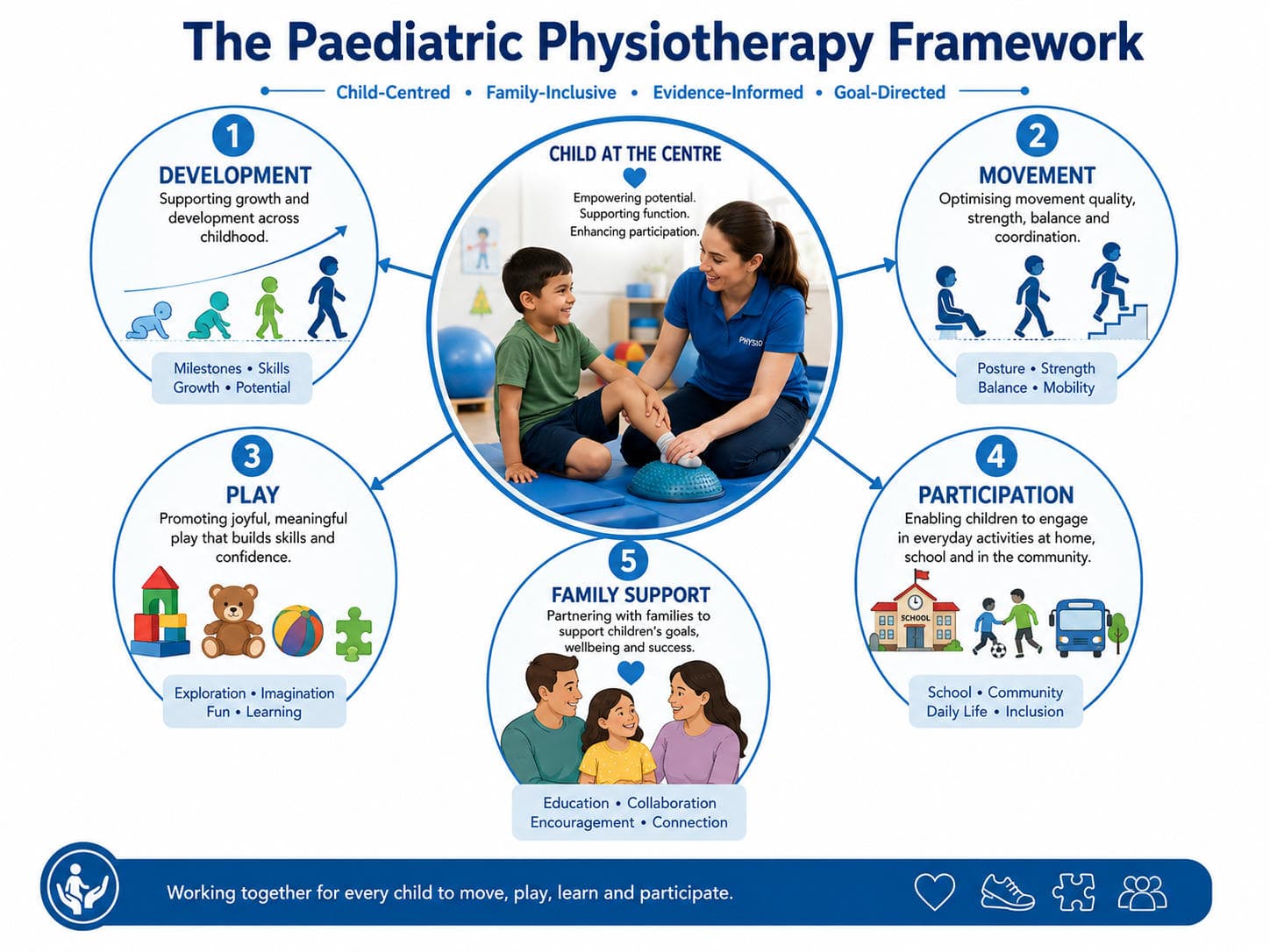
Paediatric physiotherapy supports infants, children and adolescents whose movement, posture, physical development or participation is affected by neurological, neuromuscular, developmental, musculoskeletal or cardiorespiratory conditions. Unlike adult rehabilitation, paediatric practice must account for continuing growth, nervous-system development, play, family routines and changing school and community demands.
The physiotherapist therefore treats more than an isolated impairment. The wider aim is to help the child explore the environment, develop movement skills, participate in meaningful activities and achieve the greatest possible independence.
What Makes Paediatric Physiotherapy Different?
Children are not simply small adults. Their nervous, skeletal and muscular systems are developing, while their functional abilities may change rapidly with age. Assessment must compare the child with age-related expectations while also examining the child’s individual developmental trajectory.
A paediatric physiotherapist commonly evaluates posture, muscle tone, range of motion, strength, selective motor control, balance, coordination, gait, endurance and gross motor function. Assessment must also consider activity and participation. For example:
- Can the child sit during classroom activities?
- Can the child transfer safely from the floor?
- Can they climb stairs or walk within school?
- Can they keep up with peers during play?
- What support is required from the family or environment?
This approach is consistent with the International Classification of Functioning, Disability and Health, which describes functioning through body structures and functions, activities, participation and environmental factors rather than diagnosis alone (World Health Organization [WHO], 2001).
Treatment should be active, meaningful and enjoyable. Reaching for a toy, climbing onto a chair or walking to the playground may provide more useful motor practice than performing the same movement without a functional purpose.
Developmental Milestones: A Practical Motor Map
Developmental milestones are skills achieved by most children within a broad age range. They provide useful screening landmarks but should not be treated as rigid deadlines. Development must be considered across gross motor, fine motor, communication, cognitive and social-emotional domains.

Current CDC milestone checklists describe abilities achieved by at least 75% of children by the stated age. Rolling from the abdomen to the back and supporting oneself sitting with the hands are listed by 6 months. Pulling to stand and cruising are expected by approximately 12 months, while independent walking is included by 18 months. These checklists support developmental surveillance but do not replace standardized testing or clinical judgement (Centers for Disease Control and Prevention [CDC], 2026).
Features that warrant further assessment include marked movement asymmetry, persistent stiffness or floppiness, limited head control, inability to sit independently by approximately 9 months, failure to bear weight through the legs, absence of independent walking by 18 months or loss of a previously acquired skill. Developmental regression is particularly important and requires prompt medical evaluation.
Major Conditions Seen in Paediatric Physiotherapy
Cerebral palsy
Cerebral palsy is a group of permanent disorders affecting the development of movement and posture and causing activity limitation. It results from a non-progressive disturbance occurring in the developing foetal or infant brain. Although the original brain disturbance does not progressively worsen, its musculoskeletal and functional consequences may change as the child grows (Rosenbaum et al., 2007).
Clinical presentations include spasticity, dyskinesia, ataxia, weakness, impaired selective motor control, poor balance, contractures and altered gait. Some children also experience associated sensory, communication, cognitive, visual or seizure-related problems.
Physiotherapy may include:
- Goal-directed and task-specific movement practice
- Development of sitting, standing and mobility
- Strength, balance and fitness training
- Contracture and deformity prevention
- Gait training, orthoses and mobility equipment
- Participation in family, school and community activities
Current early-intervention guidance favours active, child-initiated and goal-directed practice in enriched environments rather than relying primarily on passive handling techniques (Morgan et al., 2021).

Duchenne muscular dystrophy
Duchenne muscular dystrophy is a progressive X-linked neuromuscular condition associated with deficient dystrophin production. Children commonly develop proximal muscle weakness, delayed motor abilities, frequent falls, difficulty climbing stairs, Gowers’ sign and an increasingly wide-based or lordotic gait.
Physiotherapy does not reverse the underlying disease. Its purpose is to preserve safe function, mobility, comfort and participation while anticipating secondary complications. Management may include gentle range-maintenance exercises, positioning, contracture prevention, appropriate physical activity, energy conservation, mobility equipment, respiratory monitoring and caregiver education.
High-resistance exercise, heavy eccentric loading and activity that produces marked fatigue or muscle soreness should be avoided. Rehabilitation should be coordinated with neurological, cardiac, respiratory, orthopaedic and psychosocial management throughout ambulatory and non-ambulatory stages (Birnkrant et al., 2018).
Developmental delay
Developmental delay describes slower-than-expected acquisition of developmental abilities. 'Global developmental delay' is generally used in children younger than five years when significant delay affects at least two developmental domains, such as:
- Gross or fine motor function
- Speech and language
- Cognition
- Social and personal abilities
- Adaptive functioning or activities of daily living
It is a descriptive diagnosis rather than a single disease and may be associated with genetic, neurological, metabolic, sensory or environmental factors (Juneja et al., 2022).
Physiotherapy identifies the child’s current abilities, movement strategies and barriers to exploration. Intervention may include postural control, transitions, strengthening through play, balance, mobility, caregiver coaching and environmental adaptation. Referral for neurological, hearing, vision, genetic or developmental evaluation may also be required.
Congenital muscular torticollis
Congenital muscular torticollis commonly presents with a preferred head tilt towards one side and rotation towards the opposite side. It may be accompanied by restricted cervical movement, positional cranial asymmetry and delayed symmetrical movement experiences.
Assessment includes cervical range, head posture, cranial shape, visual tracking, symmetrical limb movement, developmental abilities and screening for neurological, skeletal or visual causes.
Management usually combines caregiver education, positioning, environmental modification, active symmetrical movement, supervised prone play and appropriate stretching. The 2024 clinical practice guideline emphasises early referral, standardized examination, severity classification and integration of the home programme into daily routines (Sargent et al., 2024).
Structured Paediatric Physiotherapy Assessment
A practical assessment pathway is the following:
- History: Pregnancy, birth, medical diagnosis, developmental course, feeding, sleep, pain, fatigue, falls, regression and family concerns.
- Observation through play: Spontaneous movement, symmetry, preferred positions, interaction and movement variability.
- Body functions and structures: Tone, joint range, strength, posture, reflexes, alignment and selective motor control.
- Functional abilities: Rolling, sitting, transitions, standing, walking, running, stairs and transfers.
- Participation and environment: Home layout, school requirements, family routines, transport, equipment and opportunities for activity.
- Standardized measurement: Selection of a suitable outcome measure based on age, diagnosis and the clinical question.
The assessment should answer three questions:
- What can the child do?
- How does the child perform the activity?
- What personal or environmental factors help or restrict performance?
Repeated observation is often necessary because fear, tiredness, unfamiliar surroundings or limited motivation may affect a child’s performance during a single clinical session.
Common Paediatric Assessment Scales
Gross Motor Function Measure
The Gross Motor Function Measure is a criterion-referenced outcome measure designed to document change in gross motor ability, particularly in children with cerebral palsy. The GMFM-88 contains 88 items, while the GMFM-66 uses Rasch analysis to provide an interval-level score.
The GMFM must not be confused with the Gross Motor Function Classification System. The GMFM measures change, whereas the GMFCS classifies a child’s usual gross motor function into one of five levels (Russell et al., 2000).
Alberta Infant Motor Scale
The Alberta Infant Motor Scale is a norm-referenced, observational measure used from birth until independent walking. Its 58 items examine weight-bearing, posture and antigravity movement in prone, supine, sitting and standing positions (Piper et al., 1992).
The AIMS is play-based, relatively quick and requires little direct handling. It is useful for identifying atypical motor development and monitoring progression. However, percentile scores should be interpreted carefully because recent reviews have identified possible cross-cultural differences in normative performance (Mendonça et al., 2024).
Peabody Developmental Motor Scales
The current edition is the Peabody Developmental Motor Scales–Third Edition, or PDMS-3. It assesses early gross and fine motor development through Body Control, Body Transport, Object Control, Hand Manipulation and Eye–Hand Coordination subtests.
The PDMS-3 produces separate gross motor, fine motor and total motor indices and may support eligibility decisions, intervention planning and progress monitoring. Students should confirm which edition is being used because the PDMS-2 remains present in older research, textbooks and clinical records.

Family-Centred Care and Goal Setting
Family-centred care recognises that families understand the child’s routines, preferences, strengths and everyday challenges. The physiotherapist contributes clinical expertise, but assessment priorities, goals and treatment decisions should be developed collaboratively.
Important principles include:
- Respectful and non-judgemental communication
- Recognition of family strengths
- Clear and accessible information
- Shared decision-making
- Flexibility according to family routines and resources
- Coordination between home, school and healthcare services
- Goals based on activities that matter to the child and family
Families should not be treated merely as people who carry out the therapist’s instructions. They are active partners in identifying priorities and determining which strategies are practical and meaningful (King et al., 2004).
An exercise is unlikely to be effective if it cannot be integrated into family life. Instead of prescribing movements without context, practice may be incorporated into dressing, reaching for toys, floor play, getting onto a chair or walking within the community.
A useful functional goal is the following:
“The child will rise from the floor using nearby furniture with supervision.”
This is more meaningful and measurable than the following:
“The child will improve lower-limb strength.”

Viva-Ready Summary
- Paediatric physiotherapy addresses development, movement, function and participation from infancy through adolescence.
- Milestones are screening landmarks and should be interpreted as developmental ranges rather than rigid deadlines.
- Cerebral palsy is non-progressive in origin, whereas Duchenne muscular dystrophy is progressive.
- Developmental delay is a descriptive term that requires investigation of the underlying cause.
- Congenital muscular torticollis commonly produces cervical and postural asymmetry.
- Assessment combines clinical observation, impairment testing, functional abilities, participation and standardized measures.
- The GMFM measures gross motor change, the AIMS assesses infant motor maturation and the PDMS-3 examines gross and fine motor development.
- Effective treatment is active, play-based, goal-directed and family-centred.
One-line recall point: Paediatric physiotherapy follows development, measures function and builds meaningful movement into the child’s everyday life.
References
Birnkrant, D. J., Bushby, K., Bann, C. M., et al. (2018). Diagnosis and management of Duchenne muscular dystrophy, part 1: Diagnosis, and neuromuscular, rehabilitation, endocrine, and gastrointestinal and nutritional management. The Lancet Neurology, 17(3), 251–267.
Centers for Disease Control and Prevention. (2026). CDC’s developmental milestones: Learn the signs. Act early.
Juneja, M., Gupta, A., Sairam, S., & Jain, R. (2022). Diagnosis and management of global development delay: Consensus guidelines of the Indian Academy of Paediatrics. Indian Paediatrics, 59, 367–378.
King, S., Teplicky, R., King, G., & Rosenbaum, P. (2004). Family-centred service for children with cerebral palsy and their families: A review of the literature. Seminars in Paediatric Neurology, 11(1), 78–86.
Mendonça, B., Sargent, B., Fetters, L., et al. (2024). Psychometric properties of the Alberta Infant Motor Scale and culturally adapted or translated versions when used for infant populations internationally: A systematic review. Developmental Medicine & Child Neurology.
Morgan, C., Fetters, L., Adde, L., et al. (2021). Early intervention for children aged 0 to 2 years with or at high risk of cerebral palsy: International clinical practice guideline based on systematic reviews. JAMA Paediatrics, 175(8), 846–858.
Palisano, R. J., Orlin, M., & Schreiber, J. (Eds.). (2022). Campbell’s physical therapy for children (6th ed.). Elsevier.
PAR, Inc. (n.d.). Peabody Developmental Motor Scales–Third Edition.
Piper, M. C., Pinnell, L. E., Darrah, J., Maguire, T., & Byrne, P. J. (1992). Construction and validation of the Alberta Infant Motor Scale. Canadian Journal of Public Health, 83(Suppl. 2), S46–S50.
Rosenbaum, P., Paneth, N., Leviton, A., et al. (2007). A report: The definition and classification of cerebral palsy, April 2006. Developmental Medicine & Child Neurology, 49(Suppl. 109), 8–14.
Russell, D. J., Avery, L. M., Rosenbaum, P. L., Raina, P. S., Walter, S. D., & Palisano, R. J. (2000). Improved scaling of the Gross Motor Function Measure for children with cerebral palsy: Evidence of reliability and validity. Physical Therapy, 80(9), 873–885.
Sargent, B., Coulter, C., Cannoy, J., & Kaplan, S. L. (2024). Physical therapy management of congenital muscular torticollis: A 2024 evidence-based clinical practice guideline from the American Physical Therapy Association's Academy of Paediatric Physical Therapy. Paediatric Physical Therapy, 36(4), 375–424.
Spearing, E. M. (Ed.). (2023). Tecklin’s Paediatric Physical Therapy (6th ed.). Wolters Kluwer.
World Health Organization. (2001). International Classification of Functioning, Disability and Health.