
Staying Steady: A Practical Guide to Geriatric Physiotherapy and Falls Prevention
Learn geriatric physiotherapy assessment, frailty, sarcopenia, fall risk, TUG, Berg Balance Scale, SPPB and adapted exercise prescription.
Ageing is associated with changes in muscle strength, balance, cardiovascular reserve, cognition and sensory function. However, reduced mobility should not be accepted as an unavoidable consequence of becoming older. Geriatric physiotherapy aims to preserve functional ability, prevent avoidable disability and help older adults participate safely in meaningful daily activities.
Unlike rehabilitation focused on a single injury, geriatric physiotherapy frequently involves interacting problems such as multimorbidity, polypharmacy, frailty, sarcopenia, cognitive impairment and fear of falling. Assessment must therefore move beyond isolated muscle testing and consider the person’s physical capacity, environment, goals, support system and ability to perform daily activities.
What Is Geriatric Physiotherapy?
Geriatric physiotherapy is the assessment and management of movement and functional problems affecting older adults. Treatment may be delivered in hospitals, rehabilitation units, outpatient departments, residential care facilities or the person’s home.
The main objectives are to:
- Maintain mobility and independence.
- Improve strength, balance, endurance and gait.
- Prevent falls and fall-related injuries.
- Reduce the consequences of frailty and sarcopenia.
- Restore function after illness, surgery or hospitalisation.
- Recommend appropriate walking aids and environmental modifications.
- Educate patients, families and caregivers.
- Support participation in self-care, domestic and community activities.
The World Health Organization’s Integrated Care for Older People framework emphasises maintaining intrinsic capacity—the combined physical and mental abilities of the person—and functional ability within their environment. Important domains include locomotion, cognition, vitality, psychological health, vision and hearing. This person-centred model is particularly suitable for physiotherapy because mobility is influenced by several interconnected systems rather than a single impairment (World Health Organization [WHO], 2017).
A Comprehensive Geriatric Assessment Framework
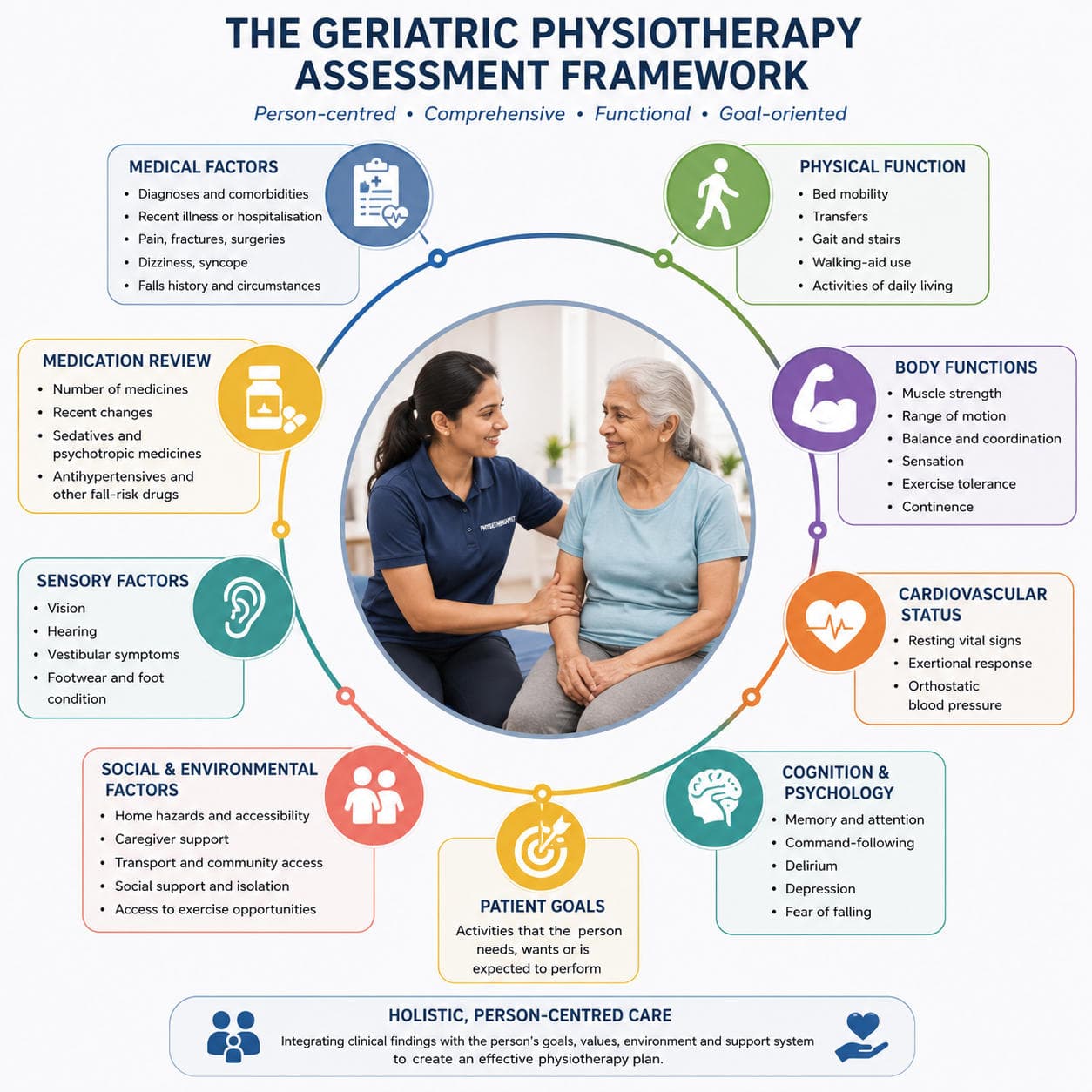
Assessment begins with the patient’s priorities. An older adult may be less concerned about improving an isolated strength score than being able to reach the bathroom safely, climb the entrance steps or return to a social activity.
A practical physiotherapy assessment includes the following domains:

A comprehensive geriatric assessment is a multidisciplinary process used to identify medical, functional, psychological and social problems and develop a coordinated care plan. Physiotherapists contribute detailed information about movement, physical capacity, mobility safety, equipment needs and rehabilitation potential.
The 2025 NICE falls guideline recommends asking about falls within the previous year and assessing the circumstances, frequency, injuries and ability to rise from the floor. A comprehensive falls assessment is particularly important after recurrent falls, fall-related injury, loss of consciousness, inability to get up independently or in a person living with frailty.
Frailty, Sarcopenia and Falls
Frailty, sarcopenia and falls frequently overlap but are not interchangeable.

Frailty
Frailty may present with weakness, slowed mobility, fatigue, low activity, weight loss and reduced ability to recover from illness. A minor infection or short period of bed rest may produce a disproportionate decline in independence.
Frailty should not automatically lead to therapeutic inactivity. Carefully prescribed multicomponent exercise can improve strength, mobility and functional reserve. Sessions may initially need to be shorter, less complex and more closely supervised, with slower progression and additional recovery time.
Sarcopenia
The European Working Group on Sarcopenia in Older People describes low muscle strength as the primary indicator of probable sarcopenia. Low muscle quantity or quality confirms the diagnosis, while poor physical performance indicates severe sarcopenia. Grip strength, the five-times chair-stand test, gait speed and the Short Physical Performance Battery may contribute to assessment (Cruz-Jentoft et al., 2019).
Falls
A fall is usually produced by several interacting factors. Common contributors include lower-limb weakness, impaired balance, unsafe gait, postural hypotension, visual impairment, cognitive impairment, urgency or nocturia, unsuitable footwear, environmental hazards and medicines that cause sedation or hypotension.
Importantly, fear of falling can lead to activity avoidance. This produces further weakness and deconditioning, creating a cycle of reduced activity and increasing fall risk.

Key Mobility and Balance Assessment Scales
Performance-based measures provide objective information and help monitor change. They should complement—not replace—clinical reasoning. NICE specifically advises against using a falls prediction tool alone to predict whether a person will fall.

Timed Up and Go
The Timed Up and Go test is quick and suitable for many clinical settings. The patient should normally use their usual footwear and walking aid. In addition to recording time, the therapist should observe push-off from the chair, step length, foot clearance, turning strategy, balance loss and control while sitting down.
The CDC STEADI framework uses a completion time of 12 seconds or more as an indicator requiring further fall-risk assessment. However, performance is influenced by age, diagnosis, pain, cognition and walking-aid use; therefore, the result should not be interpreted in isolation (Podsiadlo & Richardson, 1991).
Berg Balance Scale
The Berg Balance Scale examines functional balance through progressively challenging tasks. It is useful for identifying specific difficulties and measuring change over time. However, it has limited assessment of gait adaptability, reactive stepping and performance under dual-task conditions. A relatively high Berg score does not exclude falls caused by environmental hazards, syncope or impaired attention (Berg et al., 1992).
Short Physical Performance Battery
The SPPB provides a broader measure of lower-extremity function by combining static balance, walking speed and repeated chair stands. Its total score is useful for documenting functional limitation and monitoring change in older adults with frailty, sarcopenia or general deconditioning (Guralnik et al., 1994).
Adapting Exercise Prescription for Older Adults
Older adults should receive the same fundamental exercise components as younger adults—strength, aerobic conditioning, balance, flexibility and functional training—but the starting level and progression must reflect their health, reserve and goals.
Resistance and functional training
Progressive resistance exercise is central to managing weakness and sarcopenia. Useful exercises include:
- Sit-to-stand practice.
- Supported squats.
- Heel raises.
- Step-ups.
- Hip abduction and extension.
- Rows and pushing exercises.
- Loaded and carried where appropriate.
A frail or previously inactive person may begin with one set using body weight, light resistance or approximately 40–60% of their estimated one-repetition maximum. Resistance, repetitions or task difficulty can then be increased according to movement quality and recovery.
Balance and falls-prevention exercise
Balance training should be challenging enough to produce adaptation while remaining safe. Progression may involve reducing upper-limb support, narrowing the base of support, stepping in different directions, changing speed, reaching, turning, negotiating obstacles and practising functional tasks.
Falls-prevention programmes should be progressive, individualised and directed towards balance, coordination, strength and power. Exercise reviews are required so that activities do not remain too easy. Evidence indicates that programmes emphasising balance and functional exercise can reduce falls among community-dwelling older adults (Sherrington et al., 2019).

Aerobic conditioning
The general target for adults aged 65 years and older is at least 150 minutes of moderate-intensity aerobic activity each week, together with muscle strengthening on at least two days and regular balance activity. People unable to meet these targets should remain as active as their abilities and medical conditions allow.
Walking, stationary cycling, aquatic exercise and repeated functional circuits may be used. For a deconditioned patient, exercise can begin in five- to ten-minute periods with monitoring of symptoms, blood pressure, heart rate, oxygen saturation where indicated and rating of perceived exertion.
Special Considerations in Cognitive Impairment
Cognitive impairment can affect attention, memory, safety awareness, motor planning and the ability to follow instructions. It may also reduce the validity of performance tests when the patient does not understand or remember the task.
Physiotherapy remains appropriate, but communication and delivery should be adapted:
- Use brief, one-step instructions.
- Demonstrate the movement rather than relying only on verbal explanation.
- Maintain a predictable routine and familiar environment.
- Use the same terminology and cues across sessions.
- Allow additional processing time.
- Minimise distractions during new or difficult tasks.
- Practise meaningful activities repeatedly.
- Introduce dual-task challenges only after basic task safety is established.
- Involve family members or caregivers in education and home practice.
- Record the amount of cueing and assistance provided during outcome measures.
The therapist should distinguish chronic cognitive impairment from acute confusion or delirium. A sudden change in attention, behaviour or mobility requires medical evaluation rather than routine progression of exercise.
Consent, dignity and patient preferences remain essential. Cognitive impairment does not mean that the person should automatically be excluded from rehabilitation. Information should be presented in a format the individual can understand, and carers should be involved when appropriate. NICE also recommends considering physical, sensory and communication difficulties when interpreting assessment scales in people living with dementia.
Viva-Ready Summary
- Geriatric physiotherapy aims to maintain mobility, independence, safety and participation.
- Assessment must include medical, functional, cognitive, psychological, social and environmental factors.
- Frailty represents reduced physiological reserve, while sarcopenia primarily involves impaired muscle strength and muscle health.
- Falls are multifactorial and should not be predicted using one scale alone.
- TUG assesses functional mobility, Berg assesses functional balance and SPPB assesses lower-extremity performance.
- Exercise should combine progressive resistance, balance, aerobic and task-specific training.
- Cognitive impairment requires simple instructions, demonstration, repetition, environmental consistency and caregiver involvement.
- The treatment plan should be based on functional goals and reassessed regularly.
One-line recall point: Geriatric physiotherapy combines comprehensive assessment with progressive, person-centred exercise to preserve independence and reduce modifiable fall risk.
References
Avers, D., & Wong, R. A. (Eds.). (2019). Guccione’s geriatric physical therapy (4th ed.). Elsevier.
Berg, K. O., Wood-Dauphinee, S. L., Williams, J. I., & Maki, B. (1992). Measuring balance in the elderly: Validation of an instrument. Canadian Journal of Public Health, 83(Suppl. 2), S7–S11.
Cruz-Jentoft, A. J., Bahat, G., Bauer, J., Boirie, Y., Bruyère, O., Cederholm, T., Cooper, C., Landi, F., Rolland, Y., Sayer, A. A., Schneider, S. M., Sieber, C. C., Topinkova, E., Vandewoude, M., Visser, M., & Zamboni, M. (2019). Sarcopenia: Revised European consensus on definition and diagnosis. Age and Ageing, 48(1), 16–31. https://doi.org/10.1093/ageing/afy169
Guralnik, J. M., Simonsick, E. M., Ferrucci, L., Glynn, R. J., Berkman, L. F., Blazer, D. G., Scherr, P. A., & Wallace, R. B. (1994). A short physical performance battery assessing lower extremity function: Association with self-reported disability and prediction of mortality and nursing home admission. Journal of Gerontology, 49(2), M85–M94. https://doi.org/10.1093/geronj/49.2.M85
Kisner, C., Borstad, J., & Colby, L. A. (2023). Therapeutic exercise: Foundations and techniques (8th ed.). F. A. Davis.
National Institute for Health and Care Excellence. (2018). Dementia: Assessment, management and support for people living with dementia and their carers (NG97).
National Institute for Health and Care Excellence. (2025). Falls: Assessment and prevention in older people and in people 50 and over at higher risk (NG249).
Podsiadlo, D., & Richardson, S. (1991). The timed “Up & Go”: A test of basic functional mobility for frail elderly persons. Journal of the American Geriatrics Society, 39(2), 142–148. https://doi.org/10.1111/j.1532-5415.1991.tb01616.x
Sherrington, C., Fairhall, N. J., Wallbank, G. K., Tiedemann, A., Michaleff, Z. A., Howard, K., Clemson, L., Hopewell, S., & Lamb, S. E. (2019). Exercise for preventing falls in older people living in the community. Cochrane Database of Systematic Reviews, 2019(1), CD012424. https://doi.org/10.1002/14651858.CD012424.pub2
World Health Organization. (2017). Integrated care for older people: Guidelines on community-level interventions to manage declines in intrinsic capacity. World Health Organization.