
Identifying Your Body Pain Reason: Clinical Guide to Etiology
Understanding body pain origins across muscular, neurological, and systemic categories enables targeted diagnosis and effective recovery. Learn how clinicians systematically evaluate pain etiology to rule out serious conditions and guide appropriate treatment.
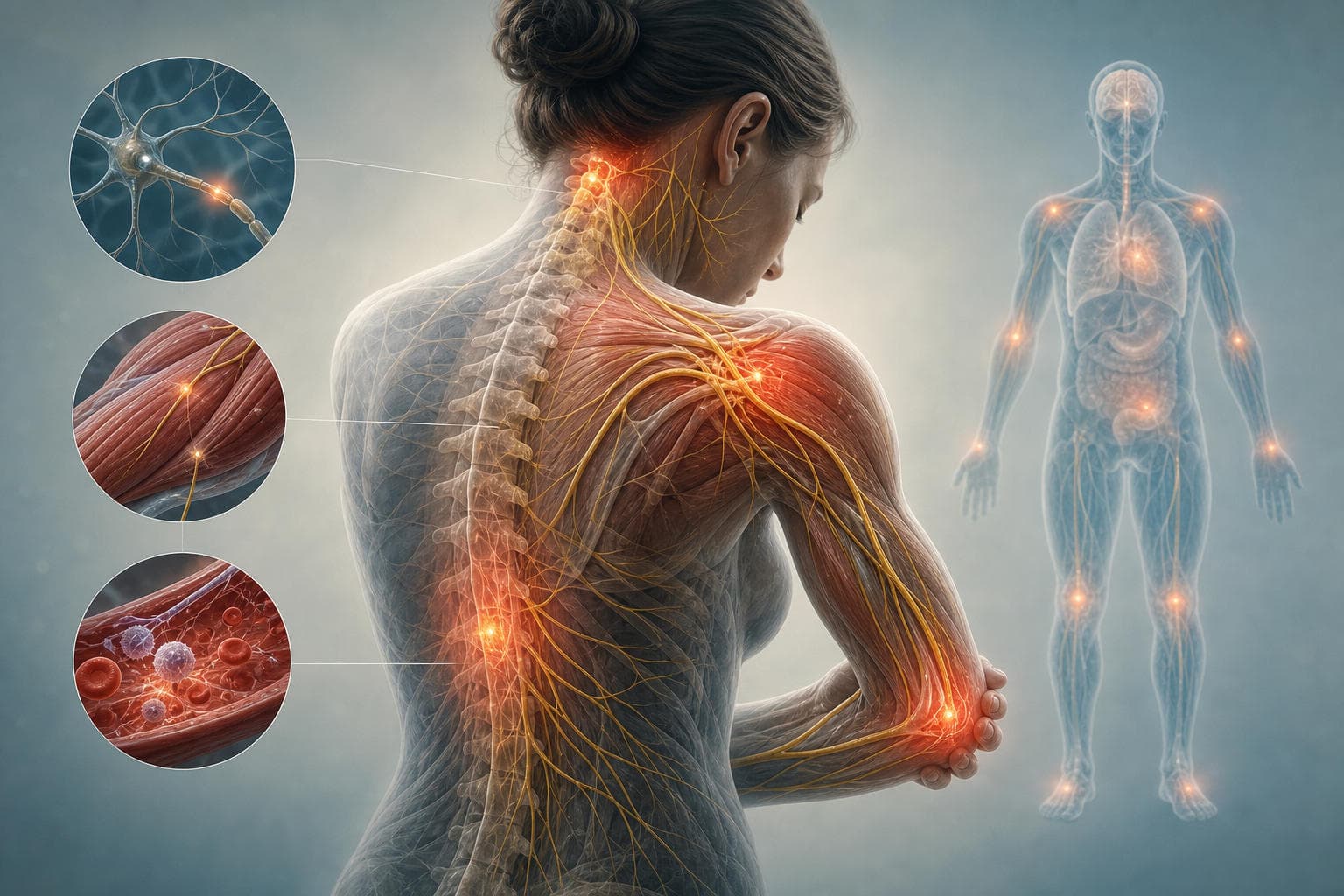
Understanding the underlying body pain reason is essential for finding lasting relief, protecting your mobility, and ruling out serious health conditions. Physical discomfort can stem from an isolated muscle strain, an irritated spinal nerve, or widespread inflammation linked to an internal illness. When pain interferes with your day-to-day routine, identifying its exact root cause enables a targeted recovery plan rather than temporary symptom management.
Pain serves as your body's primary warning system, alerting you to mechanical injury, tissue damage, or physiological imbalances. Because different tissues produce distinctive sensations, doctors use a systematic diagnostic strategy to evaluate symptoms. Breaking down pain into its core biological mechanisms helps clarify what is happening and points you toward appropriate medical care.
The Three Main Categories of Body Pain
Clinical practice categorizes physical discomfort into three primary origins: muscular, neurological, and systemic.
Understanding these distinct classifications provides a structured diagnostic framework.
| Pain Category | Type | Common Examples |
|---|---|---|
| Muscular | Nociceptive | Strains, DOMS, Tension |
| Neurological | Neuropathic | Sciatica, Neuropathy, Radiculitis |
| Systemic | Widespread | Infections, Autoimmune, Metabolic |
Muscular pain, or nociceptive somatic pain, originates in muscles, tendons, ligaments, and surrounding fascia. It typically presents as an aching, throbbing, or stiff sensation confined to a specific mechanical region, such as a pulled hamstring or tight shoulder muscles.
Neurological pain, or neuropathic pain, arises from damage, inflammation, or compression affecting peripheral nerves or the central nervous system. It feels sharp, burning, shooting, or electric, often accompanied by numbness or tingling that follows a distinct nerve pathway.
Systemic pain involves generalized bodily processes, metabolic dysfunctions, or internal organ pathology. Rather than staying confined to one joint or muscle group, it often manifests as diffuse body aches, multi-joint inflammation, or deep visceral pain felt far from the affected organ.
A comprehensive pain assessment clinical approach evaluates whether these categories appear alone or together. For example, an underlying systemic disorder like rheumatoid arthritis can trigger secondary muscular spasms and localized peripheral nerve compression.
Muscular Pain: Strain, Tension, and Injury
Skeletal muscle accounts for a major portion of total body mass, making musculoskeletal injury one of the most frequent causes of body pain seen in general clinical settings. Muscular discomfort occurs when muscle fibers experience structural tears, continuous mechanical tension, or cellular fatigue.
Acute Muscle Strains and Overuse
An acute muscle strain develops when tissue stretches beyond its normal capacity, causing partial or complete fiber disruption. This happens suddenly during heavy lifting, sudden acceleration, or awkward twists. Patients experience sudden, localized pain accompanied by swelling, weakness, and immediate stiffness.
Overuse injuries arise gradually over weeks or months. Repetitive daily motions without sufficient recovery cause micro-trauma in muscle bellies and tendon insertions. Overuse pain begins as a low-grade ache following activity, but it steadily advances to continuous pain that disrupts normal physical movement.
Delayed Onset Muscle Soreness (DOMS)
Delayed Onset Muscle Soreness represents a normal, temporary response to novel physical exertion, particularly eccentric exercises where muscles lengthen under load (such as downhill running or lowering weights).
- Discomfort emerges 12 to 24 hours after physical exertion and peaks between 24 and 72 hours.
- Symptoms include diffuse tenderness, mild swelling, and stiffness without sharp, localized structural defects.
- It stems from microscopic structural disruptions at the sarcomere level, followed by local inflammatory tissue remodeling.
- DOMS resolves spontaneously within 5 to 7 days without leaving lasting structural damage.
Chronic Muscle Tension and Trigger Points
Poor workplace ergonomics, postural habits, and sustained emotional stress cause involuntary, prolonged muscle contractions. Constant tension reduces capillary blood flow, depriving tissue of oxygen and allowing metabolic waste products to accumulate.
This cycle leads to myofascial trigger points, which are hyperirritable nodules within a taut band of muscle tissue. Applying pressure to these points reproduces local tenderness and sends referred pain to predictable adjacent areas. For instance, upper trapezius trigger points frequently refer pain into the neck, base of the skull, and temples, producing tension-type headaches.
| The Muscle Tension and Pain Cycle | |
|---|---|
| Poor Posture / Stress > Sustained Muscle Contraction | |
| Pain and Movement Restriction < Ischemia and Metabolic Waste Buildup |
Why Muscular Pain Responds to Rest and Movement
Muscular tissues have a rich blood supply that facilitates tissue repair when properly supported. Initial relative rest limits further mechanical damage during the acute inflammatory phase. Once acute inflammation settles, gentle stretching and gradual movement restore tissue flexibility, stimulate circulation, and prevent joint stiffness.
Neurological Pain: Nerve Compression and Neuropathy
Neurological pain occurs when the nervous system misfires or suffers physical compression, chemical irritation, or metabolic damage. Distinguishing muscle pain vs nerve pain is critical for timely medical treatment and preventing permanent nerve damage.
Radiculopathy and Nerve Root Compression
Radiculopathy occurs when a spinal nerve root becomes inflamed or compressed as it exits the vertebral column. Common structural drivers include herniated intervertebral discs, degenerative disc disease, and bony spurs (osteophytes).
Cervical radiculopathy produces sharp, electric pain starting in the neck and radiating through the shoulder down into the forearm and fingers. Lumbar radiculopathy (commonly known as sciatica) compresses the L4, L5, or S1 nerve roots, sending shooting, burning pain from the buttock down the posterior leg to the foot.
Unlike localized muscular aches, radiculopathy follows precise dermatomal and myotomal distributions, matching the specific sensory and motor pathways of the compressed nerve.
| Spinal Level | Radiation Pathway | Neurological Deficit |
|---|---|---|
| C6 (Cervical) | Neck to thumb and index finger | Weak wrist extension, reduced biceps reflex |
| C7 (Cervical) | Neck to middle finger | Weak triceps extension, reduced triceps reflex |
| L5 (Lumbar) | Buttock to lateral leg and top of foot | Weak big toe dorsiflexion (foot drop risk) |
| S1 (Lumbar) | Buttock to posterior calf and sole of foot | Weak ankle plantarflexion, absent reflex |
Peripheral Neuropathies and Entrapment Syndromes
Peripheral neuropathy involves widespread or localized damage to peripheral nerves outside the spinal canal. Metabolic conditions, particularly diabetes mellitus, frequently damage microvascular capillaries that nourish long nerve fibers, leading to symmetrical "glove and stocking" numbness, burning sensations, and hypersensitivity (allodynia).
Nerve entrapment syndromes occur where nerves travel through narrow anatomic tunnels:
- Carpal tunnel syndrome involves compression of the median nerve at the wrist, causing tingling and weakness in the thumb, index, and middle fingers.
- Cubital tunnel syndrome compresses the ulnar nerve at the elbow, triggering numbness and weakness in the ring and little fingers.
- Tarsal tunnel syndrome involves the posterior tibial nerve at the ankle, producing burning sole pain.
- Meralgia paresthetica involves entrapment of the lateral femoral cutaneous nerve, generating burning sensations over the outer thigh without motor weakness.
Differentiating Neurological from Muscular Pain
Understanding tissue-specific symptoms helps pinpoint the underlying issue:
- Sensation quality: Muscular pain feels dull, aching, sore, or cramping; nerve pain feels electric, shooting, burning, prickling, or ice-cold.
- Distribution: Muscular pain stays within a muscle group; nerve pain travels along precise, linear paths down an extremity.
- Sensory changes: Neurological conditions often involve numbness, pins and needles (paresthesia), and heightened skin sensitivity.
- Motor signs: Nerve compression can cause true muscle weakness, reduced deep tendon reflexes, and muscle wasting over time.
Systemic and Organ-Related Pain
When pain is diffuse, migratory, or unrelated to physical movement, clinical suspicion shifts toward systemic causes of pain. These conditions include inflammatory autoimmune diseases, infectious illnesses, endocrine disorders, and referred pain from internal organs.
Visceral and Referred Pain Patterns
Internal organs possess sensory receptors that respond to distension, ischemia, and inflammation. Visceral sensory nerves enter the spinal cord at the same levels as somatic sensory nerves from the skin and muscles. The brain frequently misinterprets visceral distress as originating from the corresponding somatic area.
Classic referred pain presentations include:
- Cardiac ischemia: Crushing retrosternal chest pain referring to the left jaw, neck, shoulder, or inner left arm.
- Gallbladder inflammation (cholecystitis): Right upper quadrant abdominal pain referring to the right shoulder tip or inferior angle of the scapula.
- Diaphragmatic irritation: Blood or air under the diaphragm sending pain to the top of the shoulder via the phrenic nerve (C3-C5).
- Renal colic: Kidney stones producing flank pain that radiates down into the groin and inner thigh.
| Organ Involved | Underlying Trigger | Somatic Referred Site |
|---|---|---|
| Heart | Myocardial ischemia | Left jaw, neck, left arm |
| Gallbladder | Cholecystitis/gallstones | Right shoulder, right upper scapular border |
| Diaphragm | Subdiaphragmatic fluid | Ipsilateral shoulder crest |
| Kidney / Ureter | Nephrolithiasis | Flank radiating to groin |
Inflammatory and Autoimmune Disorders
Autoimmune and chronic inflammatory conditions cause widespread pain through systemic immune dysregulation. Rheumatoid arthritis produces symmetrical inflammatory synovitis, especially in the small joints of the hands and feet, accompanied by prominent morning stiffness lasting over an hour.
Polymyalgia rheumatica causes severe morning aching and stiffness across the bilateral shoulder and pelvic girdles in older adults, frequently associated with elevated systemic inflammatory markers.
Fibromyalgia represents a centralized pain amplification disorder (nociplastic pain) characterized by widespread musculoskeletal tenderness, unrefreshing sleep, cognitive fatigue, and abnormal pain modulation.
Infections trigger acute systemic body aches through the release of pyrogenic cytokines (such as interleukin-1 and tumor necrosis factor), which stimulate prostaglandin synthesis in muscle and joint tissues.
Pain Diagnosis by Location
Systematic regional assessment allows clinicians to narrow down diagnostic possibilities by cross-referencing anatomical structures with specific symptoms.
| Region | Common Muscular Culprit | Common Neurological Culprit | Clinical Red Flags |
|---|---|---|---|
| Neck and Shoulder | Trapezius strain, rotator cuff tendinopathy | Cervical radiculopathy, brachial plexus irritation | Progressive weakness, gait ataxia, fever |
| Lower Back | Lumbar paraspinal strain, quadratus lumborum spasm | Lumbar disc herniation, sciatica, spinal stenosis | Saddle anesthesia, bowel/bladder loss |
| Upper Extremity | Lateral epicondylitis (tennis elbow), bicep tear | Carpal tunnel syndrome, ulnar neuropathy | Unilateral swelling, color changes, pulse loss |
| Lower Extremity | Hamstring or calf strain, plantar fasciitis | Peroneal nerve palsy, diabetic distal neuropathy | Asymmetrical swelling, calf warmth, redness |
Evaluating symptoms by anatomical region remains an effective pain diagnosis by location method. Pinpointing the exact site helps differentiate regional muscle tears from radiating radicular syndromes and vascular emergencies.
Acute vs Chronic Pain: Timelines and Implications
Clinical diagnosis relies heavily on the temporal profile of symptoms. Understanding acute vs chronic pain etiology alters diagnostic workups and long-term care plans.
| Acute Pain (<6 Weeks) | Subacute (6-12 Weeks) | Chronic (>12 Weeks) |
|---|---|---|
|
|
|
Acute Pain Dynamics (<6 Weeks)
Acute pain lasts fewer than six weeks and serves as a protective warning signal directly tied to tissue damage, such as fractures, lacerations, burns, or acute infections. During this phase, peripheral nociceptors release inflammatory mediators like bradykinin, prostaglandins, and substance P. These chemicals lower the activation threshold of local pain fibers (peripheral sensitization), making the injured area tender to protect it from further stress. As structural tissue repair occurs, inflammatory signaling subsides and acute pain naturally resolves.
Chronic Pain Transformation (>12 Weeks)
Pain lasting beyond twelve weeks moves past normal physiological healing timelines. At this stage, discomfort often shifts from being a symptom of tissue injury to an independent condition driven by nervous system changes.
Through persistent nociceptive firing, dorsal horn neurons in the spinal cord and sensory processing centers in the brain undergo neuroplastic changes. This central sensitization amplifies pain signaling, lowers thresholds, and causes normal, non-painful sensory inputs to register as painful (allodynia).
Because the nervous system remains in a sensitized state, managing chronic pain requires a multimodal approach involving physical rehabilitation, neurological modulators, and behavioral strategies rather than relying solely on acute rest and anti-inflammatory therapies.
When to Seek Professional Diagnosis
While mild, transient muscle soreness usually settles with simple home care, certain clinical warning signs require prompt medical evaluation to rule out serious underlying conditions.
| Clinical Red Flag Checklist |
|---|
|
You should seek immediate medical assessment if you develop any of the following symptoms:
- Sudden loss of bowel or bladder control, or numbness around the groin and buttocks, which can indicate cauda equina syndrome requiring emergency spinal decompression.
- Progressive muscular weakness, such as an inability to lift the foot while walking (foot drop) or dropping objects unexpectedly.
- Pain accompanied by high fever, chills, unexplained weight loss, or night sweats, which may suggest systemic infection or malignancy.
- Intractable pain that is severe at rest and wakes you from sound sleep, unrelated to body position or movement.
- Pain accompanied by asymmetrical swelling, redness, and warmth in an extremity, which raises concern for deep vein thrombosis.
Depending on clinical findings, your doctor may recommend plain radiography, MRI imaging, electromyography (EMG) nerve conduction studies, or specialized blood panels to evaluate your symptoms. Working with rheumatologists, neurologists, orthopedists, and pain specialists ensures you receive a clear diagnosis and an effective recovery plan.
Frequently Asked Questions
Can muscle pain feel like nerve pain?
Severe muscle spasms and myofascial trigger points can cause sharp, radiating discomfort that mimics nerve pain. However, true nerve pain typically includes distinct tingling, numbness, or loss of motor strength along a specific nerve pathway.
How long does body pain usually last?
Normal acute muscle soreness and minor strains generally resolve within a few days to six weeks as tissues heal. Pain lasting longer than twelve weeks is categorized as chronic and requires a broader medical evaluation.
Is body pain worse in the morning?
Morning stiffness and pain that ease with movement are classic features of inflammatory arthritis and muscle tension. Conversely, mechanical pain from joint wear or disc problems often worsens later in the day after sustained physical activity.
Can stress cause body pain?
Psychological stress triggers sustained, involuntary muscle contraction and raises circulating stress hormones, which lowers systemic pain thresholds and amplifies discomfort across the neck, shoulders, and lower back.
What foods help reduce body pain?
Diets rich in anti-inflammatory nutrients, including oily fish with omega-3 fatty acids, leafy greens, berries, nuts, and olive oil, can help lower systemic inflammatory markers that contribute to chronic body aches.


