
The in-basket is the new pager
Patient messages surged, algorithms pile on more, and the inbox never closes. The evidence on the EHR in-basket, and why answering faster is not the fix
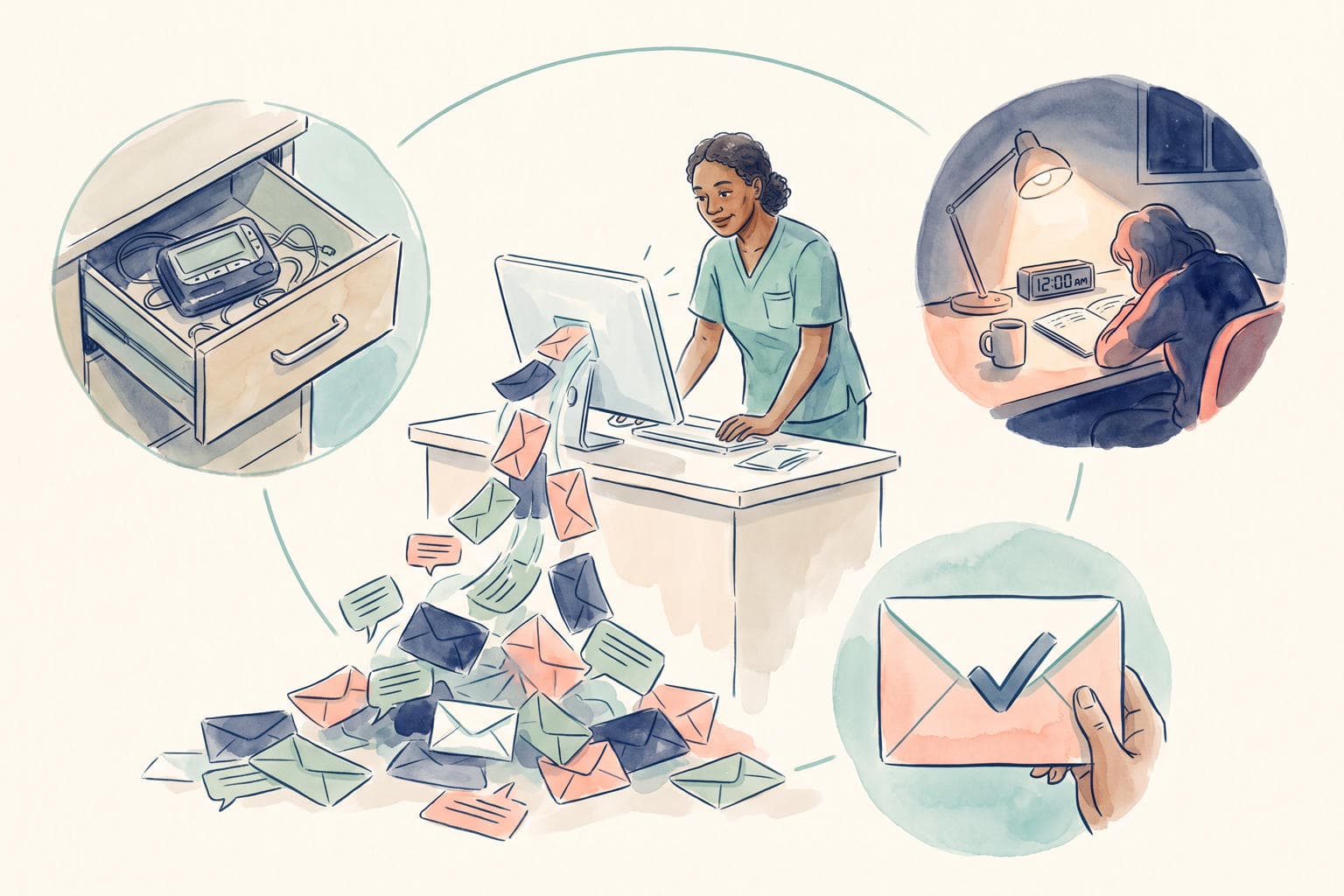
Older clinicians remember the pager as the thing that owned them: a device that could interrupt any moment, any meal, any sleep, and demand a response. The pager has mostly gone. Its psychological role has been inherited by something quieter and, in aggregate, far larger: the electronic health record in-basket.
The in-basket is the stream of messages that lands in a clinician's EHR account. Lab results to acknowledge, prescription renewals, referrals, notes from colleagues, system-generated reminders, and, increasingly, direct messages from patients. Individually each is small. Together they have become one of the most reliable predictors of who burns out and who wants to leave. This piece follows the opening overview by looking closely at the message pile, because it is where the administrative tax is growing fastest.
The pandemic turned a stream into a flood
Patient messaging was rising before 2020, but the pandemic changed its scale permanently. When in-person visits became difficult, the patient portal filled the gap, and it never emptied again.
A 2021 study in JAMA Network Open tracked an ambulatory network in New England and found that patient medical advice request messages, the ones asking a clinician to actually decide something, rose sharply once the pandemic began: up about 105 percent in primary care, 108 percent in medical specialties, and 206 percent in surgical specialties compared with the pre-pandemic baseline. A larger analysis in the Journal of the American Medical Informatics Association, covering ambulatory clinicians across 366 health systems on a single EHR platform, found that patient messages climbed to 157 percent of their pre-pandemic level, in other words a 57 percent increase, and stayed there.
That second study also priced the load in time. Each additional patient message was associated with about 2.3 extra minutes of EHR time per day. Multiply a modest rise in daily messages across a full panel of patients and a full year, and you have absorbed the equivalent of many extra working days, none of them scheduled.
Most of the noise is not from patients
Here is the finding that reframes the whole problem. It is easy to assume the inbox is heavy because patients now message freely. But when researchers broke the in-basket down by source, patients turned out to be a minority of it.
A 2019 study in Health Affairs counted the weekly in-basket for physicians in a large system: an average of 243 messages a week. Of those, 114, almost half, were generated by the EHR's own algorithms: automated results, reminders, and system notifications. Messages from colleagues (53) and from patients (30) each made up a much smaller share. In short, the software is the single biggest sender in the inbox it created.
And the source matters for well-being. The same study found that physicians receiving an above-average volume of system-generated messages had a 40 percent higher probability of burnout and a 38 percent higher probability of intending to cut their clinical hours. It is a striking result: not the patients, but the automated notifications, tracked most closely with burning out. When we get to automation later in the series, keep this in mind. Technology is quite capable of manufacturing the very burden it is later sold to relieve.
How much of the day it really takes
Put a clock on it and the in-basket alone is a meaningful chunk of the working day. A 2021 study of primary care physicians in JAMIA found they spent an average of about 52 minutes a workday on inbox management, of which roughly 19 minutes fell outside working hours. So more than a third of inbox work is pyjama time, done after the clinic has closed. The heaviest categories were results to review and patient-initiated messages, followed by administrative requests.
An hour a day, much of it unpaid and after hours, on a single administrative channel. That is not a workflow annoyance. It is a structural feature of the modern clinical job.
Why "just answer faster" is the wrong fix
The instinctive response is to tell clinicians to be more efficient, or to answer messages between patients. Both misunderstand the problem. A portal message asking whether to stop a blood thinner before surgery is not administrative overhead to be cleared quickly; it is clinical work, requiring the chart, a decision, and often documentation, but without the time, structure, or payment of a visit. Speeding through it is how mistakes happen.
The more promising responses are structural: routing messages to the right team member rather than defaulting everything to the physician, turning off low-value automated notifications, and giving clinical messaging the staffing and, where appropriate, the reimbursement of the clinical work it actually is. Some of these are workflow changes, not purchases, which is a theme we return to in the playbook.
Where AI fits, honestly
Naturally, the in-basket is now a prime target for AI. Large language models can draft replies to patient messages inside the EHR, and the early evidence is worth reading carefully. A 2024 study at Stanford Health Care piloted AI-generated draft replies with 162 clinicians. The headline result was not what the marketing would predict: there was no statistically significant reduction in the time spent reading or replying to messages. What did change, and significantly, was how the work felt. Clinician task load dropped sharply and work exhaustion fell.
That is a genuinely useful finding, and an honest one. Sometimes the win from automation is not minutes on a stopwatch but the removal of the blank-page dread of starting each reply. It is a real benefit. It is just not the benefit usually promised, and knowing the difference is how you avoid paying for the wrong thing. We take that distinction apart in the next piece on what automation actually fixes.
Browse the full Admin Tax series.
References
- Nath B, Williams B, Jeffery MM, et al. Trends in Electronic Health Record Inbox Messaging During the COVID-19 Pandemic in an Ambulatory Practice Network in New England. JAMA Network Open. 2021;4(10):e2131490. https://doi.org/10.1001/jamanetworkopen.2021.31490
- Holmgren AJ, Downing NL, Tang M, et al. Assessing the impact of the COVID-19 pandemic on clinician ambulatory electronic health record use. Journal of the American Medical Informatics Association. 2022;29(3):453-460. https://doi.org/10.1093/jamia/ocab268
- Tai-Seale M, Dillon EC, Yang Y, et al. Physicians' Well-Being Linked To In-Basket Messages Generated By Algorithms In Electronic Health Records. Health Affairs. 2019;38(7):1073-1078. https://www.healthaffairs.org/doi/10.1377/hlthaff.2018.05509
- Akbar F, Mark G, Warton EM, et al. Physicians' electronic inbox work patterns and factors associated with high inbox work duration. Journal of the American Medical Informatics Association. 2021;28(5):923-930. https://doi.org/10.1093/jamia/ocaa229
- Garcia P, Ma SP, Shah S, et al. Artificial Intelligence-Generated Draft Replies to Patient Inbox Messages. JAMA Network Open. 2024;7(3):e243201. https://jamanetwork.com/journals/jamanetworkopen/fullarticle/2816494


