
The admin tax: the hours clinicians lose to paperwork
Clinicians did not train for data entry, yet it fills much of the day. The numbers behind the admin tax are worse, and more fixable, than most assume.
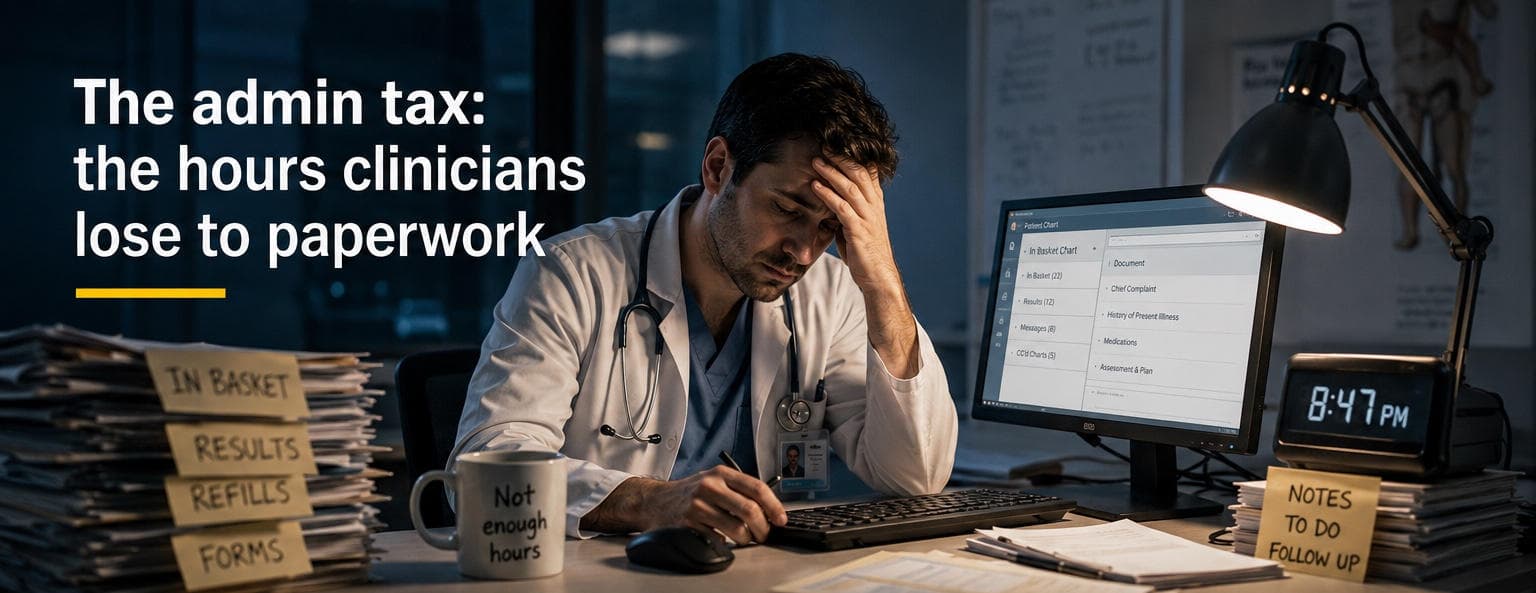
Nobody goes into medicine to type. Yet if you follow a physician through a normal clinic day and time what they actually do, a large share of it is spent not with patients but with a screen: writing notes, chasing results, clearing an inbox, satisfying a form. This is the administrative tax on clinical work, and it is the subject of this series.
The word "tax" is deliberate. Some administrative work is genuinely useful, the same way some tax buys roads and hospitals. But a tax is also a cost you pay whether or not you see the benefit, and much of the clinical admin load has quietly grown past the point where anyone can explain what it buys. This opening piece lays out what the evidence says the tax actually costs, in hours and in people. The rest of the series looks at where it comes from and what technology can, and cannot, do about it.
The two-to-one problem
Start with the single most cited number in this field. In a 2016 time and motion study published in Annals of Internal Medicine, researchers followed 57 physicians across family medicine, internal medicine, cardiology, and orthopaedics for 430 hours. During the office day, physicians spent 27.0 of their time on direct clinical face time with patients and 49.2% on the electronic health record and desk work. Even inside the exam room, with the patient sitting right there, only about half the time (52.9 %) was direct face time; more than a third went to the EHR and paperwork.
A companion study in Annals of Family Medicine the following year measured the same thing a different way, using the EHR's own event logs plus direct observation of primary care physicians. It found that clinicians spent 5.9 hours of an 11.4-hour workday inside the EHR, and it summarised the ratio in a line that has since been quoted everywhere: nearly two hours of EHR work for every hour of direct patient care. Of that EHR time, clerical and administrative tasks took 44 % and inbox management took another 24 %.

Two independent studies, two methods, the same uncomfortable finding. The desk has become the main workplace, and the patient is the visitor.
The work that follows you home
The tax does not stop when the clinic closes. The same time and motion study found that physicians who kept after-hours diaries reported one to two hours of work each night, devoted mostly to EHR tasks. The event-log study put the after-clinic portion at about 1.4 hours a day. Clinicians have a name for this, and it is not affectionate: pyjama time, the stretch after dinner spent finishing notes and clearing the inbox on a laptop.
This matters beyond fairness. Work that spills into the evening is invisible to most workload planning. It does not show up on a schedule, it is rarely paid, and it is exactly the kind of chronic, boundaryless demand that predicts exhaustion. When people say the job has changed, this is often what they mean: not that the medicine is harder, but that the medicine now comes with a second unpaid shift of data entry.
The tool everyone blames scores an F
It is fair to ask whether the software is the problem or the process. The evidence points at both, but the software does not come out well. A 2020 study in Mayo Clinic Proceedings asked physicians to rate their EHR using the System Usability Scale, a standard 0 to 100 instrument used across the technology industry. The mean score was 45.9, which sits in the bottom 9% of products ever measured and lands, on the scale's letter-grade equivalent, at an F.
That would be a footnote if usability were only about annoyance. It is not. The same study found a clear dose-response relationship between how usable physicians found their EHR and their odds of burnout: each single point of better usability was associated with about 3% lower odds of burnout. In other words, the interface is not just unpleasant, it is measurably connected to whether clinicians burn out. A system built to record care is quietly shaping who stays in the profession.
The burnout link, told honestly
It is tempting to draw a straight line from paperwork to a burnout epidemic, but the real data is more interesting than the slogan. The long-running physician surveys led by researchers at Mayo Clinic tracked burnout symptoms across a decade: 45.5% in 2011, rising to 54.4% in 2014, then falling to 43.9% in 2017 and 38.2 % in 2020, before spiking to 62.8% at the end of 2021 under the weight of the pandemic.
Two honest observations follow. First, burnout is not a simple upward line; it fell for several years before COVID-19 pushed it to a record high. Anyone who tells you it only ever gets worse is not reading the data. Second, even the "good" years sat around four in ten physicians reporting at least one symptom of burnout, which is not a healthy baseline by any standard.
Crucially, the field has moved past blaming individuals. The National Academy of Medicine's 2019 report, *Taking Action Against Clinician Burnout*, framed the problem squarely as a systems issue rooted in workload, regulation, and the design of health IT, not a personal failure of resilience. That reframing is the foundation for everything practical in this series. You do not fix a systems problem with a wellness webinar.
Why leaders should care, in one sentence
If the human argument is not enough, there is a financial one, and we devote a whole piece to it later: administrative work is one of the largest cost centres in healthcare, most of it hidden in staff time rather than shown on any invoice. The influential "Quadruple Aim" argument makes the link explicit: you cannot deliver better care at lower cost if the people delivering it are drowning. Care of the patient, it argues, requires care of the provider.
What this series does
Over the next five pieces we get specific. We look at the in-basket, the message stream that has grown into a second job. We follow the money and put verified numbers on what admin costs. We examine what today's automation honestly fixes , and where the wins are quieter than the sales deck. We look hard at the new risks that automation introduces. And we finish with a practical playbook for cutting the tax without buying magic.
The through-line is simple. The administrative burden is real, it is measurable, and a meaningful part of it is fixable, as long as you are honest about which part. That honesty is the whole point.
Browse the full Admin Tax series.
References
- Tethered to the EHR: Primary Care Physician Workload Assessment Using EHR Event Log Data and Time-Motion Observations. Annals of Family Medicine. 2017;15(5):419-426. https://doi.org/10.1370/afm.21213. Melnick ER, Dyrbye LN, Sinsky CA, et al.
- Sinsky C, Colligan L, Li L, et al. Allocation of Physician Time in Ambulatory Practice: A Time and Motion Study in 4 Specialties. Annals of Internal Medicine. 2016;165(11):753-760. https://www.acpjournals.org/doi/10.7326/M16-09612. Arndt BG, Beasley JW, Watkinson MD, et al.
- The Association Between Perceived Electronic Health Record Usability and Professional Burnout Among US Physicians. Mayo Clinic Proceedings. 2020;95(3):476-487. https://doi.org/10.1016/j.mayocp.2019.09.0244. Shanafelt TD, West CP, Sinsky C, et al.
- Changes in Burnout and Satisfaction With Work-Life Integration in Physicians and the General US Working Population Between 2011 and 2020. Mayo Clinic Proceedings. 2022;97(3):491-506. https://doi.org/10.1016/j.mayocp.2021.11.0215. Shanafelt TD, West CP, Dyrbye LN, et al.
- Changes in Burnout and Satisfaction With Work-Life Integration in Physicians During the First 2 Years of the COVID-19 Pandemic. Mayo Clinic Proceedings. 2022;97(12):2248-2258. https://doi.org/10.1016/j.mayocp.2022.09.0026.
- National Academies of Sciences, Engineering, and Medicine. Taking Action Against Clinician Burnout: A Systems Approach to Professional Well-Being. Washington, DC: The National Academies Press; 2019. https://nap.nationalacademies.org/catalog/255217. Bodenheimer T, Sinsky C.
- From Triple to Quadruple Aim: Care of the Patient Requires Care of the Provider. Annals of Family Medicine. 2014;12(6):573-576. https://ik.imagekit.io/assistencialabs/blog/content/12/6/573


