Femoroacetabular Impingement: Conservative Management Evidence
This article describes how the syndrome is defined, how it is assessed, and what the evidence shows about physiotherapist-led conservative management, including how a structured non-operative programme compares with surgery.
Femoroacetabular impingement syndrome is a motion-related condition of the hip. Abnormal contact between the femoral head-neck junction and the acetabular rim produces pain and functional limitation, typically in a young and active population. The management question that most often arises is whether to pursue arthroscopic surgery or conservative care. This article describes how the syndrome is defined, how it is assessed, and what the evidence shows about physiotherapist-led conservative management — including how a structured non-operative programme compares with surgery.
What Is Femoroacetabular Impingement Syndrome?
The Warwick Agreement defines the syndrome as a triad, and it is not diagnosed on imaging alone. Diagnosis requires all three of:
- Motion- or position-related hip or groin pain;
- Consistent clinical signs on examination;
- Corresponding morphology on imaging.
The reason the imaging finding cannot stand alone is that cam or pincer morphology — extra bone at the femoral head-neck junction, or over-coverage at the acetabular rim — is common in people with no symptoms at all. Morphology in the absence of symptoms and signs, therefore, does not constitute the syndrome. Framing the condition as a triad guards against two errors: overdiagnosis and the attribution of a patient's pain to an incidental radiographic finding.
How Does It Present, and How Is It Assessed?
Patients typically describe pain in the groin or anterolateral hip. It is often related to positions and activities that bring the hip into flexion and rotation, such as prolonged sitting, squatting, or pivoting. Clicking, catching, or stiffness may accompany the pain.
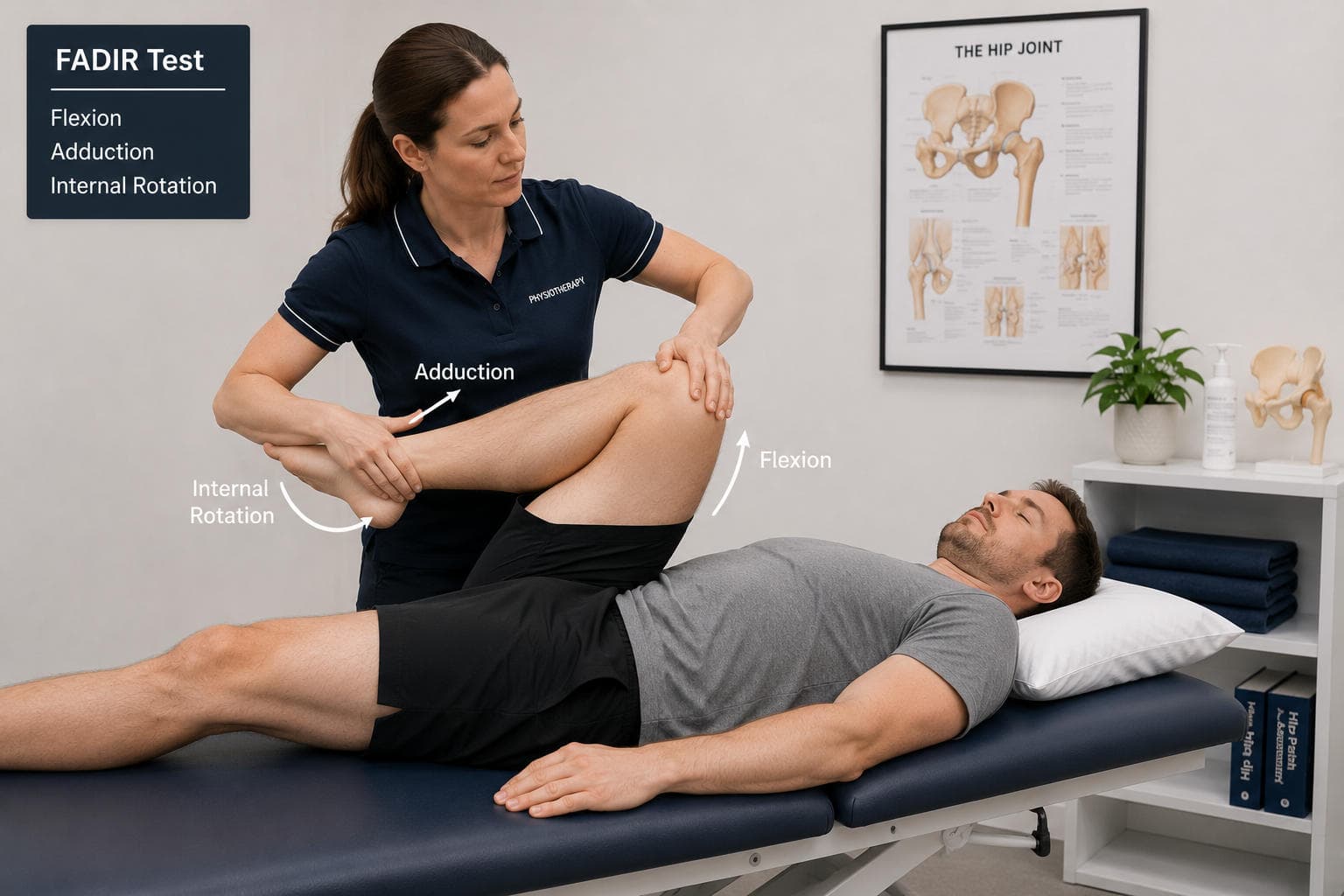
On examination, the impingement sign is sought with the flexion-adduction-internal-rotation manoeuvre. The supine patient's hip is flexed, adducted, and internally rotated to reproduce the characteristic pain; the patient may be asked to draw the knee toward the chest and then rotate the leg. Range of motion, particularly internal rotation in flexion, is frequently reduced. Because this manoeuvre reproduces symptoms in many hip conditions, it is sensitive but not specific. The diagnosis therefore rests on integrating the history, the examination, and appropriate imaging, rather than on any single test.
What Is the Role of Conservative Management?
Conservative management is a legitimate first-line option for many patients with the syndrome. The non-operative arm of the principal trial in this field was a structured, physiotherapist-led programme termed personalised hip therapy, developed specifically to standardise conservative care while allowing individual tailoring. Its components are:
- Thorough assessment
- Patient education and advice on activity and load modification
- Help with pain control
- Individualised, progressive exercise programme aimed at improving the control and strength of the muscles around the hip and trunk, alongside attention to movement patterns that provoke impingement
The intent is to optimise how the hip is loaded and controlled through range, reducing symptomatic contact and improving function. It is not to alter the underlying bony morphology.
What Does the Evidence Show Compared With Surgery?
A large multicentre randomised controlled trial compared arthroscopic hip surgery with personalised hip therapy in patients with the syndrome. Both groups improved over twelve months, which is itself an important message: structured conservative care produced meaningful gains. The trial found a greater improvement in hip-related quality of life in the surgical group, measured with the validated International Hip Outcome Tool (iHOT-33), and the between-group difference exceeded the threshold the investigators judged clinically significant.
The evidence therefore supports surgery as effective, while also showing that many patients improve substantially with conservative care alone. The reasonable clinical reading follows from this:
- Personalised hip therapy is an appropriate initial strategy for a large proportion of patients.
- Surgery is considered when conservative management has been given a fair trial and has not delivered an acceptable result.
- The decision is made with the individual patient, in light of their symptoms, goals, and preferences.
How Should a Conservative Programme Be Structured?
A conservative programme begins with education. It explains the condition in non-threatening terms and identifies the specific positions and loads that provoke the patient's symptoms, so that aggravating exposures can be modified without unnecessarily restricting activity.
Exercise then targets the strength and control of the hip and pelvic musculature, with particular attention to:
- Abductors
- Deep hip stabilisers
- Trunk control
This progresses from foundational control work toward the strength and functional demands relevant to the patient. Movement retraining addresses habitual patterns, such as deep, repeated hip flexion or poor pelvic control, that increase symptomatic contact. As with other hip presentations, progression is guided by symptom response, and the programme is sustained long enough to build genuine capacity rather than to settle symptoms briefly.
The exercise load is advanced as the hip's tolerance improves, and there is periodic review of which movements and activities still provoke symptoms. Outcomes are tracked with a hip-specific patient-reported measure so progress can be judged objectively. The threshold for considering a surgical opinion is reached only once this active programme has been delivered properly and given a fair period to take effect.
What Are Cam and Pincer Morphology?
The bony basis of impingement is described in terms of two morphologies that frequently coexist:
- Cam morphology is extra bone at the femoral head-neck junction, so the head is not perfectly round. The non-spherical portion is forced into the acetabulum during flexion and rotation, generating abnormal contact and shear.
- Pincer morphology is over-coverage of the femoral head by the acetabular rim, so contact between the neck and the rim occurs earlier in range.
These shapes are typically quantified on imaging, for example, by the alpha angle for cam morphology and by measures of acetabular coverage for pincer morphology. But the morphology alone does not constitute the diagnosis. Cam and pincer morphology are common in people without any hip symptoms, including in a high proportion of athletes, and are often found incidentally. Further, treating an asymptomatic radiographic finding as though it were a disease risks unnecessary intervention.
The syndrome is diagnosed only when the morphology is accompanied by congruent symptoms and clinical signs. Even then, the relationship between shape and pain is not simple, because the symptoms arise from how the hip is loaded and controlled as much as from the static anatomy. The practical consequence for the clinician is that conservative management does not need to alter the bony shape to be effective.
A programme can reduce symptoms and improve function while the morphology remains unchanged, and it does so by three routes:
- Improving the strength and control of the muscles around the hip and trunk;
- Modifying the loads and positions that provoke symptomatic contact;
- Retraining provocative movement patterns.
This is an important point to convey to patients, who often assume that an abnormal-looking radiograph mandates surgery. In athletic populations, the aim is usually to keep the person participating where possible while managing load: temporarily reducing the volume of deep-flexion or repetitive pivoting tasks, addressing movement strategies that increase impingement, and progressively building the hip's capacity to tolerate sport-specific demands. The same principles apply to people whose symptoms are provoked by prolonged occupational sitting or squatting, for whom adjusting the duration and frequency of provocative postures forms part of the treatment.
When Should Impingement Prompt Further Assessment or Referral?
Certain features should prompt onward assessment rather than continued conservative treatment:
- History of significant trauma
- Mechanical symptoms such as true locking that interfere materially with function
- Rapidly progressive pain
- Constitutional features
- Any suggestion of an alternative intra-articular or systemic diagnosis
A patient whose symptoms fail to improve with a well-delivered course of conservative management is an appropriate candidate for surgical opinion, and the threshold for that referral should be informed by the patient's functional demands and goals.
What Is the Prognosis, and What Should the Patient Understand?
The prognosis is reasonable with either pathway, and the patient should understand that both have evidence of benefit. Conservative management avoids the risks and recovery of surgery and improves symptoms and function for many, though the average improvement in hip-related quality of life has been shown to be smaller than that achieved with arthroscopy in the trial setting. Surgery offers a greater average improvement but carries operative risk and a defined rehabilitation period.
Communicating this balance honestly allows a shared decision. It also frames an initial trial of conservative care not as a delay to definitive treatment, but as a reasonable and evidence-based first step for many patients.
KineticFlow for Femoroacetabular Impingement
KineticFlow helps you:
- Document the diagnostic triad: Symptoms, examination findings such as the impingement test, and the relevant imaging are recorded together, so the diagnosis rests on the full picture rather than on morphology alone.
- Structure the conservative programme: Education, load modification, and the progressive strength and control work are tracked, so the components of personalised hip therapy are explicit and consistently delivered.
- Track outcomes against baseline: A hip-specific patient-reported outcome and a pain score are stored at each visit, demonstrating whether conservative care is producing meaningful change.
- Support the surgical decision: Because the response to a fair trial of conservative management is documented, the case for onward referral can be made on the basis of the record rather than from memory.
Try KineticFlow for your next patient assessment!