Low Back Pain in Pregnancy: Safe First-Line Exercise and Advice
Learn how pregnancy-related low back pain is assessed and managed using safe first-line exercises, activity modification, red-flag screening and physiotherapy advice.
Low back pain is one of the most frequently reported musculoskeletal complaints during pregnancy. Symptoms may range from a mild ache after prolonged standing to pain that significantly limits walking, sleep, household activities and work. Although pregnancy-related low back pain is usually mechanical and benign, it should not automatically be dismissed as a “normal” part of pregnancy.
The first-line approach is based on appropriate screening, reassurance, activity modification and individually graded exercise. Exercise programmes combining movement, strengthening and education appear more effective than education alone for reducing pregnancy-related pain and disability (Diez-Buil et al., 2024). A recent systematic review also found that most studied exercise interventions produced reductions in pregnancy-related back pain, although programme design and study quality remain variable (Chen et al., 2026).
Why Does Low Back Pain Develop During Pregnancy?
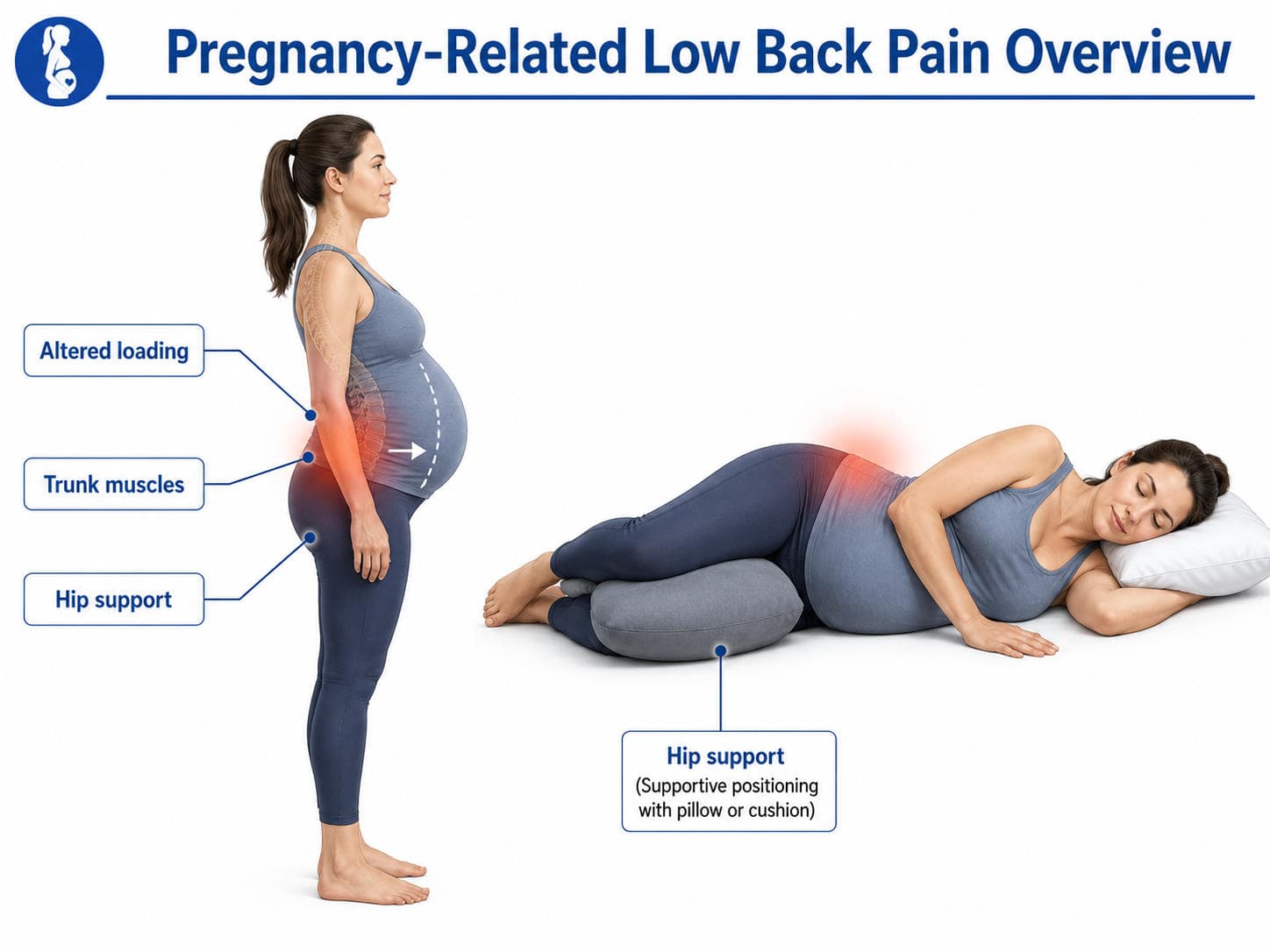
Pregnancy-related low back pain is multifactorial rather than being caused by a single postural abnormality. As the uterus enlarges, body mass and the centre of gravity shift anteriorly. The trunk, pelvis and lower limbs must adapt to maintain balance during standing and walking. At the same time, the abdominal wall lengthens, loading patterns change and some women adopt more sustained lumbar extension or a wider-based gait.
Hormonal, mechanical and behavioural factors may interact with:
- previous episodes of low back or pelvic pain;
- reduced trunk and hip muscle endurance;
- prolonged standing, sitting or bending;
- repetitive lifting and household work;
- poor sleep, fatigue and psychological stress;
- reduced physical activity because of fear of harming the pregnancy.
Low back pain should also be differentiated from pregnancy-related pelvic girdle pain. Lumbar pain is usually felt around the lumbar spine and paraspinal muscles, whereas pelvic girdle pain is commonly experienced around the sacroiliac joints, buttocks, groin or pubic symphysis. Pelvic girdle pain is often aggravated by walking, stairs, standing on one leg, getting into a car or turning in bed.
Both conditions may coexist, but their movement modifications and exercise tolerance can differ. This distinction is therefore more clinically useful than assuming that every pregnant patient needs the same generic “back exercises".
Screen Before Starting Exercise
Before treatment, the physiotherapist should establish whether the presentation is consistent with uncomplicated mechanical pain. Assessment should include the location and behaviour of symptoms, gestational age, obstetric history, previous back pain, neurological symptoms, functional limitations and the immediate and next-day response to activity.
Exercise should be stopped and appropriate medical or obstetric assessment arranged if the patient reports the following:
- vaginal bleeding or leakage of amniotic fluid;
- regular painful contractions or suspected preterm labour;
- severe abdominal pain;
- dizziness, faintness, chest pain or breathlessness before exercise;
- severe headache, visual disturbance or sudden swelling;
- fever, urinary pain or flank pain;
- calf pain or unilateral swelling;
- progressive weakness, altered sensation or difficulty walking;
- saddle anaesthesia or loss of bladder or bowel control;
- severe, unremitting or rapidly worsening pain.
ACOG similarly advises discontinuing exercise when symptoms such as vaginal bleeding, abdominal pain, painful contractions, amniotic fluid leakage, dizziness, chest pain, calf pain or significant weakness occur (American College of Obstetricians and Gynaecologists [ACOG], 2020).
A patient with a high-risk pregnancy, an obstetric complication or a medical restriction should receive individual clearance and recommendations from the obstetric team rather than being placed directly into a routine antenatal exercise programme.

First-Line Advice: Keep Moving, but Modify the Load
Complete rest is rarely the best answer for uncomplicated mechanical low back pain. Prolonged inactivity may further reduce muscle capacity and make ordinary tasks feel more demanding. The aim is to maintain comfortable activity while temporarily changing the range, duration, speed or repetition of aggravating tasks.
Practical advice includes the following:
- Change position regularly. Alternate sitting, standing and walking rather than remaining in one posture until pain becomes severe. A small lumbar support may improve comfort during prolonged sitting.
- Break activities into shorter bouts. Ten minutes of walking performed several times may be better tolerated than one prolonged walk. Household tasks can similarly be divided throughout the day.
- Use efficient lifting strategies. Bring the object close to the body, widen the stance, bend through the hips and knees and exhale during the effort. Avoid combining heavy lifting with rapid twisting.
- Modify bed mobility. Side-lying with a pillow between the knees may reduce strain. Roll onto the side before pushing through the arms to sit up. When pelvic girdle symptoms are present, keeping the knees relatively together while rolling may be more comfortable.
- Avoid unnecessary asymmetrical loading. Repeatedly carrying a child or heavy bag on one hip may aggravate symptoms. Alternate sides or distribute the load across both hands.
- Use heat cautiously. A comfortably warm pack over the lumbar muscles may provide temporary relief, but excessive heat, prolonged high-temperature exposure and direct heating over the abdomen should be avoided.
Footwear, work setup and sleeping support should be selected for comfort rather than according to rigid ideas of “perfect posture". The patient should be encouraged to find several comfortable postures instead of holding one corrected position throughout the day.
Safe First-Line Exercise Programme
There is no single exercise that is universally best for pregnancy-related low back pain. A useful programme combines comfortable spinal movement, trunk control, hip strengthening and general physical activity. Core-stability programmes targeting the deep abdominal and pelvic floor muscles may improve pain and disability when added to usual prenatal care (Mamipour et al., 2023). Modified Pilates-based exercise may also be beneficial when supervised by a professional trained in antenatal exercise (Ferraz et al., 2023).

Pelvic floor contractions may be included, but the emphasis should be on coordination rather than continuous maximal gripping. The patient should gently contract during effort and allow complete relaxation between repetitions.
After the first trimester, prolonged flat supine exercise may cause dizziness or discomfort in some individuals because of compression of major blood vessels. Supine positions should therefore be shortened, modified with a wedge or replaced with side-lying, sitting, standing or quadruped alternatives if symptoms occur.

Exercise Dosage, Monitoring and Progression
In an uncomplicated pregnancy, general recommendations support at least 150 minutes of moderate-intensity aerobic activity per week, distributed across several days (ACOG, 2020). However, a patient currently limited by pain may need to begin below this target and gradually build tolerance.
A practical starting prescription is:
- mobility and trunk-control exercise on most days
- strengthening two or three days per week;
- one or two sets of 8–12 controlled repetitions;
- aerobic activity in 10–20-minute bouts;
- moderate effort, approximately 11–13 on the 6–20 Borg scale;
- normal breathing without prolonged breath-holding or straining.
Progression should be based on symptoms and function rather than gestational age alone. Increase only one variable at a time—for example, repetitions before resistance, or walking duration before speed.
A small amount of familiar discomfort during exercise may be acceptable when it settles shortly afterwards. The programme should be maintained or reduced if pain clearly increases during the session. Exercise load should be regressed and the patient reassessed when there is marked pain, altered gait or symptoms remaining above baseline the following day.
The objective is not to exercise through progressively worsening pain. It is to identify a tolerable level of movement and gradually expand the patient’s capacity.

When Is Physiotherapy or Additional Support Needed?
Referral to a physiotherapist is appropriate when pain affects sleep, walking, transfers, work or self-care; when symptoms continue despite basic advice; or when the diagnosis between lumbar pain, pelvic girdle pain and neurological involvement is unclear.
Physiotherapy may include:
- individual movement and functional assessment;
- graded trunk, hip and lower-limb strengthening;
- gait, lifting and transfer retraining;
- modification of work and household activities;
- manual therapy as an adjunct to active management;
- advice regarding walking aids when mobility is substantially limited;
- trial of a non-rigid lumbopelvic support belt for pelvic girdle pain.
NICE recommends considering physiotherapy referral for exercise advice and/or a non-rigid lumbopelvic belt in pregnancy-related pelvic girdle pain (National Institute for Health and Care Excellence [NICE], 2021). A belt should be fitted around the pelvis, below the abdomen, and used selectively for aggravating activities rather than as a substitute for progressive rehabilitation.
Medication decisions remain under the obstetric or medical team. Pregnant patients should not independently begin analgesics or anti-inflammatory medication simply because the pain appears musculoskeletal.
Viva-Ready Summary
Pregnancy-related low back pain is commonly influenced by altered loading, reduced muscular endurance, previous pain and changes in daily activity. It must be differentiated from pelvic girdle pain and screened for obstetric, systemic and neurological red flags.
For uncomplicated mechanical pain, the first-line approach is reassurance, continued activity, pacing, ergonomic modification and graded exercise. Safe exercises include pelvic tilting, gentle spinal mobility, deep abdominal control, modified bird dog, hip strengthening, sit-to-stand practice and moderate aerobic activity.
Exercise should remain symptom-guided. The programme progresses when symptoms remain stable and regresses when pain, gait or next-day function deteriorates.
One-line recall point: Pregnancy-related low back pain is managed first with red-flag screening, load modification and graded pain-tolerable exercise—not routine bed rest.
References
American College of Obstetricians and Gynaecologists. (2020). Physical activity and exercise during pregnancy and the postpartum period: ACOG Committee Opinion No. 804. Obstetrics & Gynaecology, 135(4), e178–e188. doi:10.1097/AOG.0000000000003772
Chen, J., Yu, H., Damps, D., & Szumilewicz, A. (2026). Exercise interventions and pregnancy-related back pain: Evidence and gaps from a systematic review. International Journal of Public Health, 71, 1608730. doi:10.3389/ijph.2026.1608730
Davenport, M. H., Marchand, A. A., Mottola, M. F., Poitras, V. J., Gray, C. E., Jaramillo Garcia, A., et al. (2019). Exercise for the prevention and treatment of low back, pelvic girdle and lumbopelvic pain during pregnancy: A systematic review and meta-analysis. British Journal of Sports Medicine, 53(2), 90–98. doi:10.1136/bjsports-2018-099400
Diez-Buil, H., Hernández-Lucas, P., Leirós-Rodríguez, R., & Echeverría-García, O. (2024). Effects of the combination of exercise and education in the treatment of low back and/or pelvic pain in pregnant women: Systematic review and meta-analysis. International Journal of Gynaecology & Obstetrics, 164(3), 811–822. doi:10.1002/ijgo.15000
Ferraz, V. S., Peixoto, C., Resstel, A. P. F., de Paula, Y. T. C., & Pegorare, A. B. G. S. (2023). Effect of the Pilates method on pain and quality of life in pregnancy: A systematic review and meta-analysis. Journal of Bodywork and Movement Therapies, 35, 220–227. doi:10.1016/j.jbmt.2023.04.076
Kisner, C., Colby, L. A., & Borstad, J. (2023). Therapeutic exercise: Foundations and techniques (8th ed.). F. A. Davis.
Mamipour, H., Farazmehr, S., Negahban, H., Nazary-Moghadam, S., Dehghan-Manshadi, F., Navi Nezhad, M., Jafari, S., & Sharifzadeh, M. (2023). Effect of core stabilization exercises on pain, functional disability, and quality of life in pregnant women with lumbar and pelvic girdle pain: A randomised controlled trial. Journal of Manipulative and Physiological Therapeutics, 46(1), 27–36. doi:10.1016/j.jmpt.2023.05.005
National Institute for Health and Care Excellence. (2021). Antenatal care (NICE Guideline NG201). NICE.
Vesting, S., Gutke, A., & De Baets, L. (2025). Educating women to prevent and treat low back and pelvic girdle pain during and after pregnancy: a systematised narrative review. Annals of Medicine, 57(1), 2476046. doi:10.1080/07853890.2025.2476046