Postnatal Pelvic Floor Rehabilitation: A Progressive Guide for the First 12 Weeks
Learn how to assess and progressively rehabilitate the pelvic floor during the first 12 weeks after childbirth, including exercise progression and referral signs.
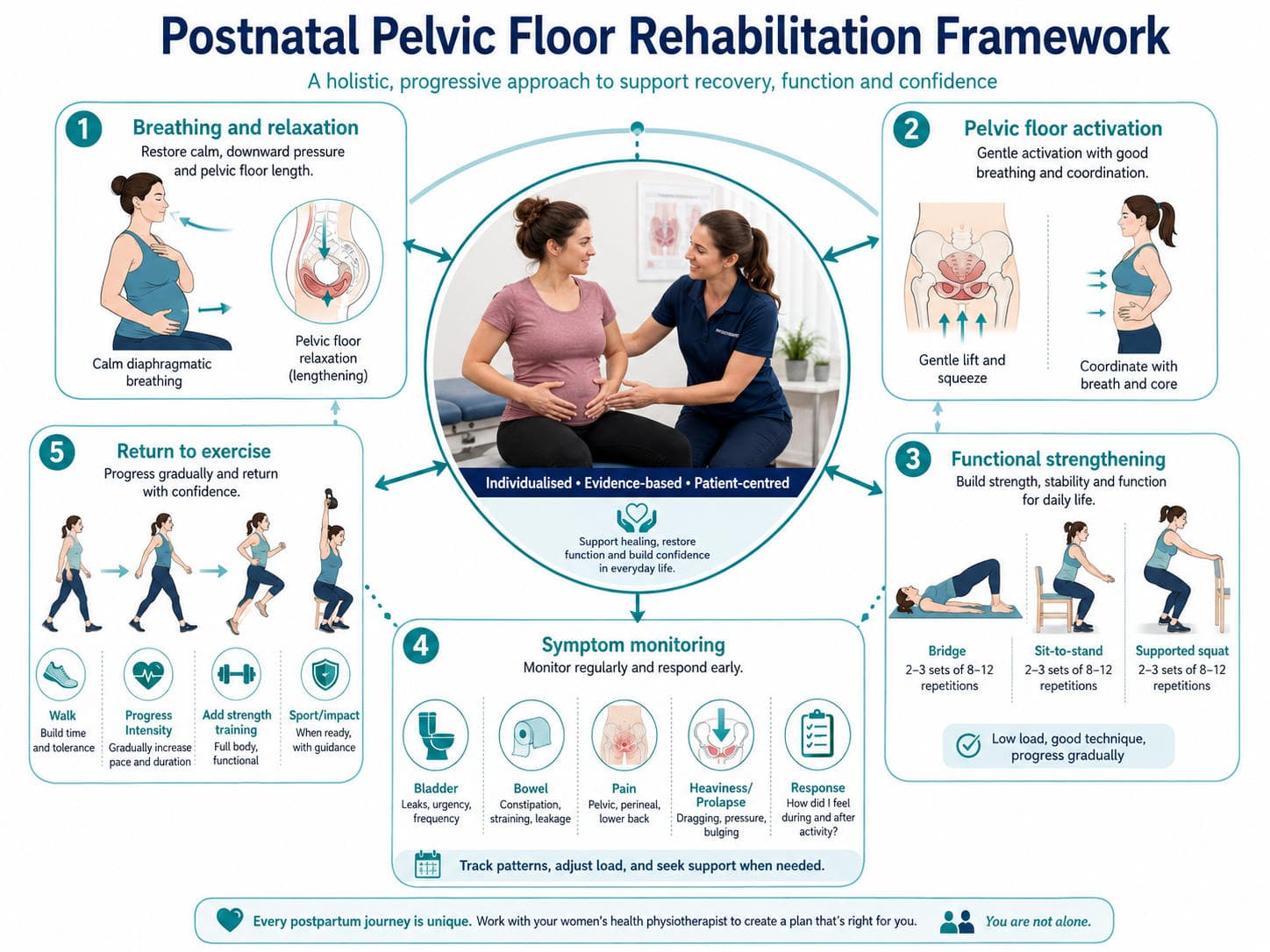
Pelvic floor rehabilitation after childbirth is not simply a programme of repeated "Kegels". The postnatal pelvic floor must recover its ability to contract, relax, coordinate with breathing and tolerate increasing functional load. Pregnancy itself affects the abdominal wall, connective tissues, bladder support and pressure-management system. Rehabilitation may therefore be relevant after both vaginal and caesarean birth.
Why the First 12 Weeks Matter
The first 12 weeks after childbirth are often called the fourth trimester. During this period, perineal and abdominal tissues are healing, hormonal changes continue, sleep is frequently disrupted and everyday tasks—feeding, lifting, carrying and repeated transfers—already create substantial physical load.
Pelvic floor symptoms during this period may include urinary or faecal leakage, urgency, vaginal heaviness, difficulty emptying the bladder or bowel, pelvic pain and painful sexual activity. These symptoms should not be dismissed as an inevitable consequence of childbirth.
Pelvic floor muscle training, or PFMT, may begin gently during the immediate postpartum period when medically safe. However, exercise should be resumed gradually according to the mode of birth, tissue healing, medical or surgical complications and symptom response. Current postpartum movement guidance recommends daily PFMT while emphasising that the wider return to exercise must be individualised and progressive. A randomised controlled trial also found that supervised postpartum PFMT reduced urinary incontinence and related bother while improving muscle strength and endurance at six months postpartum (American College of Obstetricians and Gynaecologists [ACOG], 2020; Davenport et al., 2025; Sigurdardottir et al., 2020).

Assessment Before Loading the Pelvic Floor
A physiotherapy assessment begins with the pregnancy and birth history. Relevant information includes the mode of delivery, assisted vaginal delivery, duration of pushing, perineal tears or episiotomy, caesarean wound healing, postpartum haemorrhage and any current medical restrictions.
The subjective examination should explore:
- Urinary leakage, frequency or urgency
- Faecal urgency or loss of bowel control
- Vaginal heaviness, pressure or bulging
- Difficulty emptying the bladder or bowel
- Perineal, pelvic, abdominal or scar pain
- Pain during sexual activity
- Confidence with walking, lifting and exercise
Observation and functional testing may include breathing pattern, abdominal-wall control, scar or perineal comfort, posture, coughing, walking, sit-to-stand and lifting technique.
Pelvic floor assessment must examine both contraction and relaxation. A postnatal patient may demonstrate weakness, delayed activation, reduced endurance, excessive resting tone, tenderness or an inability to release the muscles after contraction. More strengthening is therefore not always the correct starting point.

For women undergoing supervised PFMT for urinary incontinence, NICE recommends confirming that an effective pelvic floor contraction can be performed and tailoring the programme according to the person’s ability to contract and relax, any discomfort and individual goals. An internal vaginal examination can provide information about tone, tenderness, strength and endurance but requires informed consent and should only be performed when tissue healing and medical status make it appropriate (National Institute for Health and Care Excellence [NICE], 2019, 2021).
This multidimensional approach is consistent with contemporary pelvic-health physiotherapy, in which muscle performance, coordination, pain, continence and functional loading are assessed rather than treating the pelvic floor as an isolated muscle group (Bø et al., 2024).
Weeks 0–2: Reconnect, Relax and Protect Healing Tissues
The earliest phase prioritises tissue healing, circulation, comfortable breathing, bowel and bladder habits and gentle neuromuscular reconnection. Exercise should not increase bleeding, wound pain, pelvic pressure or general fatigue.
Begin with relaxed diaphragmatic breathing. During inhalation, the lower ribs and abdomen expand while the pelvic floor is allowed to soften. During exhalation, a gentle pelvic floor lift may be introduced, as if preventing wind and urine. The patient should avoid squeezing the buttocks, holding the breath or pulling forcefully upward.
A reasonable starting dose is the following:

This is primarily a motor-control dose rather than strength training. If contraction is painful, produces downward pressure or cannot be released fully, the emphasis should remain on breathing, relaxation and reassessment.
Short walks, ankle movements and comfortable bed mobility may be added as tolerated. After a caesarean birth, supported coughing, rolling through side-lying and avoiding unnecessary breath-holding can reduce strain around the abdominal incision. After significant perineal trauma, exercise positions may need to be modified to minimise direct pressure and discomfort.
Weeks 2–6: Build Control and Daily-Life Coordination
As bleeding, pain and wound sensitivity settle, training can progress from awareness to controlled endurance. Pelvic floor contractions may initially be practised in side-lying or supported sitting before progressing to standing.
A typical session may include six to eight slow contractions, gradually building the hold toward five or six seconds, followed by five to ten quicker contractions. Rest should be at least as long as the contraction so that each repetition remains controlled and the muscles return to their resting position.
Coordination must then be incorporated into daily activities. The patient exhales and gently activates the pelvic floor before coughing, sneezing, standing from a chair or lifting the baby. This anticipatory strategy is commonly called “the knack". It should support pressure management rather than create rigid abdominal bracing or breath-holding.
Low-load whole-body exercises may include the following:
- Heel slides or bent-knee fallout with relaxed breathing
- Bridge preparation or a small-range bridge
- Supported sit-to-stand
- Side-lying hip abduction or clamshell exercise
- Light resistance-band rowing
- Gradually longer symptom-free walks

Progression is appropriate only when the pelvic floor relaxes after each effort and there is no increase in leakage, heaviness, pain or bleeding later that day or the following morning.
A 2025 randomised study involving women who were six to eight weeks postpartum found that both supervised and telerehabilitation PFMT improved pelvic floor muscle function, symptoms and quality of life. This suggests that structured follow-up may be effective through either in-person or appropriately delivered remote rehabilitation (Razak Ozdincler et al., 2025).
Weeks 6–12: Develop Strength, Endurance and Functional Capacity
The six-week postnatal review is a clinical checkpoint, not automatic clearance for unrestricted exercise. Rehabilitation should now become more specific to the patient’s symptoms, childcare demands, occupation and activity goals.
For stress or mixed urinary incontinence, NICE describes PFMT programmes containing at least eight contractions performed three times daily and recommends supervised training for at least three months. This represents a treatment benchmark for urinary incontinence rather than a universal starting dose. Contraction duration, speed, position and training volume should match the assessed deficit and should not compromise relaxation or increase pain (NICE, 2019).
Functional strengthening may progress to:
- Deeper sit-to-stands or supported squats
- Step-ups
- Split-stance exercises
- Hip hinges
- Loaded carries
- Resistance-band or cable rows
- Modified planks
- Gradually increased walking speed and distance
The pelvic floor should respond automatically during exhalation and increasing effort rather than remain maximally contracted throughout an exercise. Constant gripping can contribute to fatigue, poor relaxation and pelvic pain.
Only one loading variable should be progressed at a time: repetitions, resistance, range, duration or exercise complexity. Low-impact cardiovascular exercise, such as stationary cycling, may be introduced when wounds are healed, sitting is comfortable and relevant medical restrictions have been addressed.
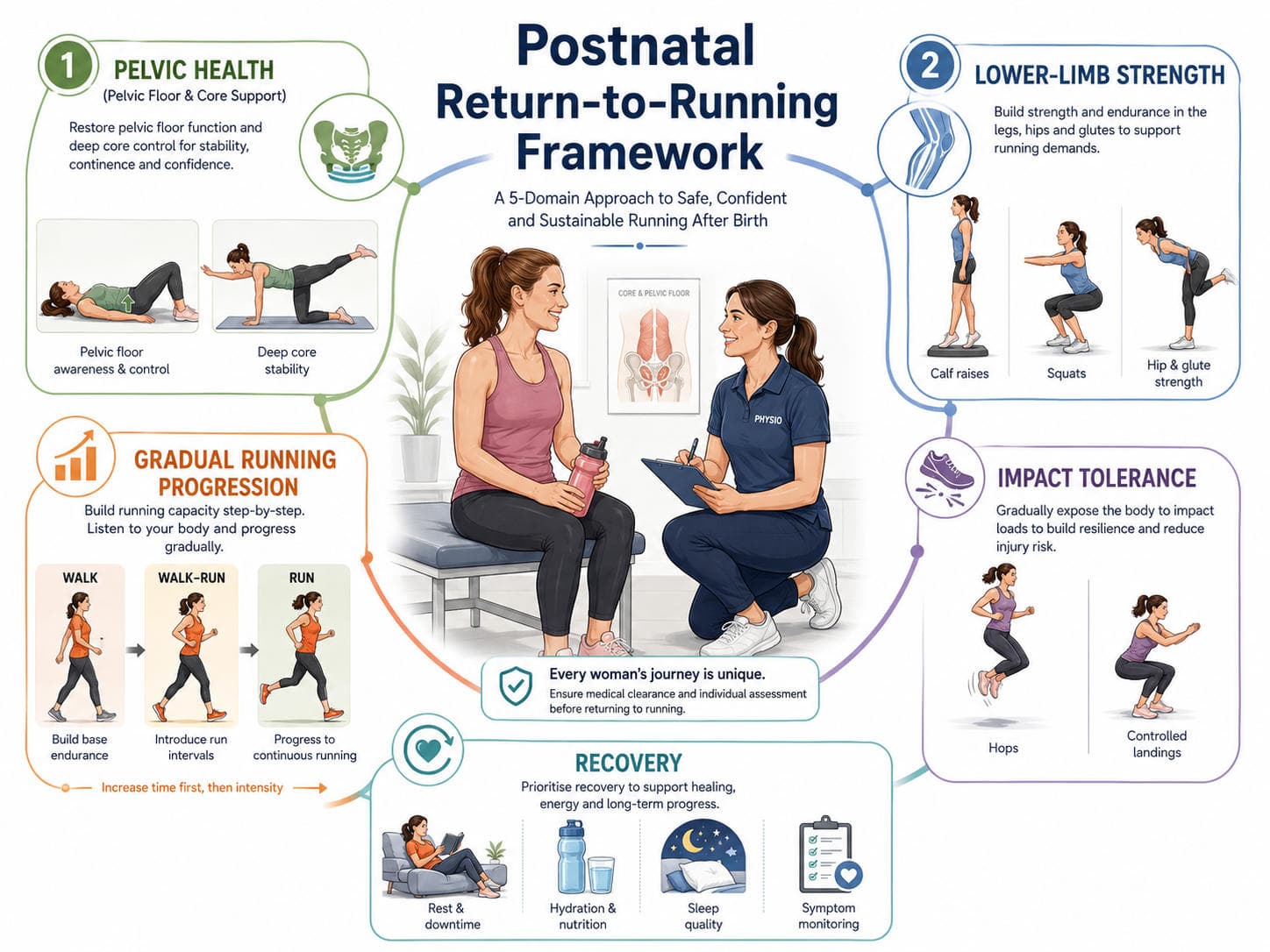
Running, jumping and other impact activities should not begin merely because 12 weeks have passed. Current return-to-running consensus recommends screening pelvic floor symptoms, musculoskeletal pain, strength, fatigue, sleep, previous training and tolerance to progressive loading. Running should then be reintroduced gradually rather than treated as a date-based milestone (Christopher et al., 2024).
Urinary leakage, vaginal heaviness or pelvic pain during impact indicates insufficient readiness or the need for a pelvic-health assessment.
Progression, Symptom Monitoring and Referral

Urgent medical assessment is required if the patient develops heavy or increasing vaginal bleeding, fever, foul-smelling discharge, wound opening, chest pain, severe breathlessness, unilateral calf swelling, severe headache with visual symptoms, acute inability to pass urine or rapidly worsening pelvic or abdominal pain. Early postnatal monitoring remains important because significant medical complications can occur during the first weeks after birth.

Referral to a pelvic health physiotherapist should be considered when the patient:
- Cannot identify either pelvic floor contraction or relaxation
- Has persistent urinary or faecal leakage
- Reports vaginal bulging or heaviness
- Experiences painful sexual activity
- Has significant scar, perineal or pelvic pain
- Demonstrates worsening symptoms with progressive exercise
- Does not improve despite an appropriately performed programme
Biofeedback, electrical stimulation or other adjuncts may be considered when an effective contraction cannot be achieved. However, these approaches supplement rather than replace individual assessment, education and active training (NICE, 2021).
Viva-Ready Summary
Postnatal pelvic floor rehabilitation is a criteria-based process that restores relaxation, contraction, endurance, anticipatory control and tolerance to functional load.
During weeks 0–2, treatment emphasises healing, breathing and gentle neuromuscular reconnection. During weeks 2–6, controlled contractions are integrated with coughing, lifting, transfers and low-load whole-body exercise. During weeks 6–12, the programme progresses toward pelvic floor endurance, functional strengthening and aerobic conditioning.
Exercise is progressed only when immediate and next-day symptoms remain stable. Persistent leakage, vaginal heaviness, pelvic pain, bowel dysfunction or inability to contract and relax requires specialist assessment.
One-line recall point: Reconnect first, coordinate next, strengthen progressively and delay impact until the pelvic floor is symptom-free under load.
References
American College of Obstetricians and Gynaecologists. (2020). Physical activity and exercise during pregnancy and the postpartum period. Obstetrics & Gynaecology, 135(4), e178–e188.
Bø, K., Berghmans, B., Mørkved, S., & Van Kampen, M. (Eds.). (2024). Evidence-based physical therapy for the pelvic floor: Bridging science and clinical practice (3rd ed.). Elsevier.
Christopher, S. M., Donnelly, G., Brockwell, E., Bø, K., Davenport, M. H., De Vivo, M., Dufour, S., Forner, L., Mills, H., Moore, I., Olson, A., & Deering, R. E. (2024). Clinical and exercise professional opinion of return-to-running readiness after childbirth: an international Delphi study and consensus statement. British Journal of Sports Medicine, 58(6), 299–312.
Davenport, M. H., Ruchat, S.-M., Jaramillo Garcia, A., Ali, M. U., Forte, M., Beamish, N., Fleming, K., Adamo, K. B., Brunet-Pagé, É., Chari, R., Lane, K. N., Mottola, M. F., & Neil-Sztramko, S. E. (2025). 2025 Canadian guideline for physical activity, sedentary behaviour and sleep throughout the first year postpartum. British Journal of Sports Medicine, 59(8), 515–526.
National Institute for Health and Care Excellence. (2019). Urinary incontinence and pelvic organ prolapse in women: Management (NICE Guideline NG123).
National Institute for Health and Care Excellence. (2021). Pelvic floor dysfunction: Prevention and non-surgical management (NICE Guideline NG210).
Razak Ozdincler, A., Korkmaz Dayican, D., & Ozyurek, B. (2025). The effects of pelvic floor muscle training applied via telerehabilitation during the postpartum period: A randomised controlled study. Telemedicine and e-Health, 31(7), 902–913.
Sigurdardottir, T., Steingrimsdottir, T., Geirsson, R. T., Halldorsson, T. I., Aspelund, T., & Bø, K. (2020). Can postpartum pelvic floor muscle training reduce urinary and anal incontinence? An assessor-blinded randomised controlled trial. American Journal of Obstetrics and Gynaecology, 222(3), 247.e1–247.e8.