
Swimming Injuries: Swimmer's Shoulder and Subacromial Pain
Swimming carries a low overall injury rate and a high shoulder-specific one, which is an unusual combination and the thing to hold onto when planning care. The shoulder generates most of the propulsion, absorbs most of the volume, and accounts for most of the caseload.
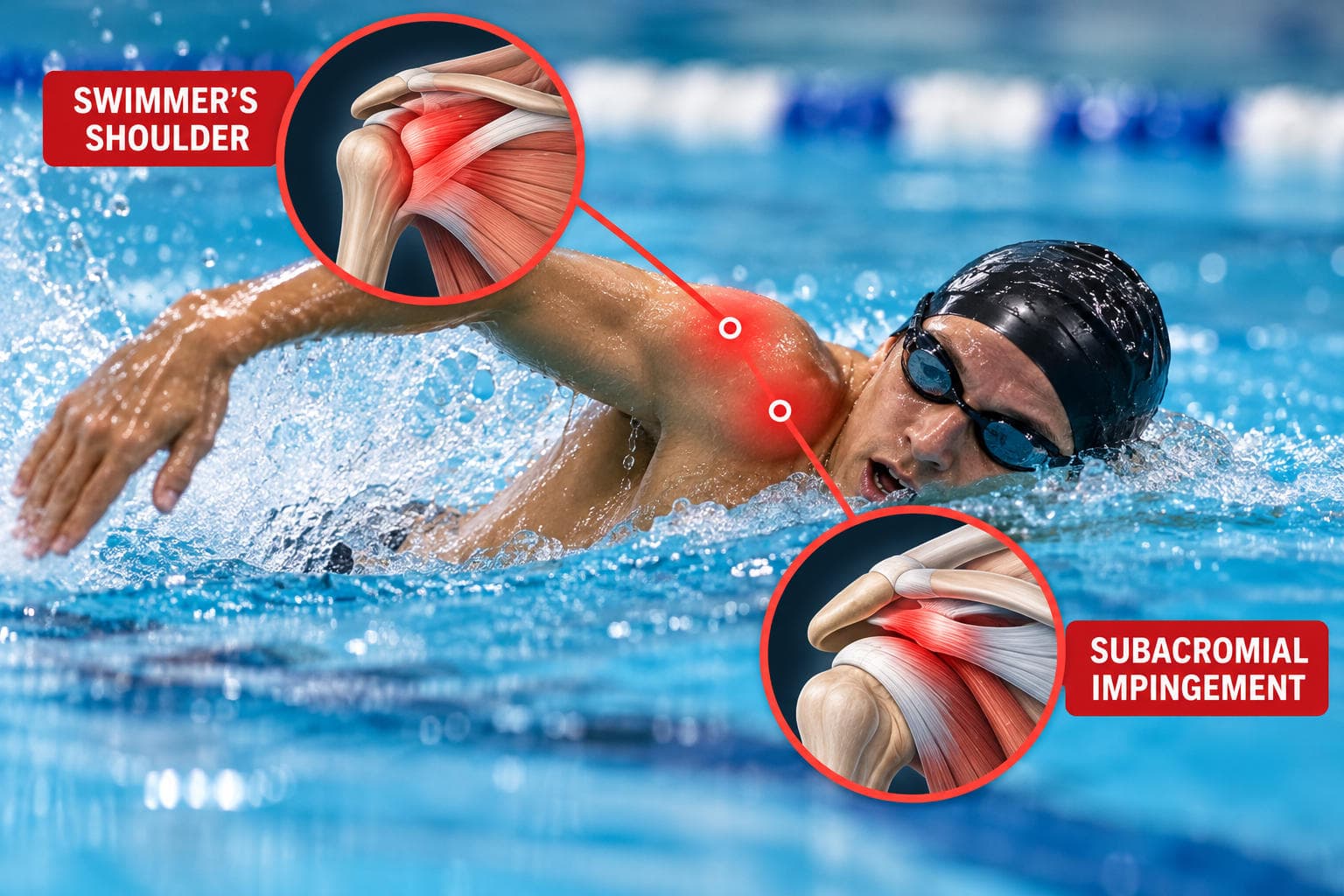
Swimming carries a low overall injury rate and a high shoulder-specific one, which is an unusual combination and the thing to hold onto when planning care. The shoulder generates most of the propulsion, absorbs most of the volume, and accounts for most of the caseload.
What are the Most Common Swimming Injuries?
A systematic review of shoulder pain and risk factors in competitive swimmers gives the clearest picture, and the following are reported the most:
- Shoulder pain: The dominant presentation by a wide margin. Shoulder-specific injury prevalence ran 23 to 51% in men and 33 to 41% in women, against a total-body injury incidence of only 2.6 to 3.0 injuries per 1000 hours of swimming
- Recurrence risk: Swimmers with a history of shoulder pain were 4.1 times more likely to sustain a future shoulder injury, which makes previous pain the finding worth acting on
- Spine and knee: Secondary sites, with thoracolumbar complaints concentrated in butterfly and breaststroke swimmers and knee complaints in breaststroke
Headline prevalence figures for shoulder pain in this population range from 3% to over 90% depending on how the question is asked. Point prevalence of interfering pain, career history of pain, and pain during strenuous effort are three different measures and are frequently quoted interchangeably. Pin whichever you use to its definition.
Swimmer's Shoulder
Load-related shoulder pain arising from repetitive overhead flexion, abduction and internal rotation through the stroke. The label covers several overlapping presentations, and the mechanism is more often secondary than primary.
Assessment
- Load history: Weekly distance and any recent increase, since volume is the most consistently implicated variable
- Range: Glenohumeral internal rotation, total rotational arc, and posterior capsule tightness
- Laxity and instability: Sulcus sign and load-and-shift, since sport-related instability with fatigue of the static and dynamic stabilisers is the more common driver in swimmers than true subacromial compression
- Scapular control: Dyskinesis under load and through repeated elevation rather than at rest
- Cuff strength: External rotation at end of range, and the external to internal rotation ratio
- Pectoralis minor length and core endurance, both of which differed between symptomatic and asymptomatic collegiate swimmers
Physiotherapy management
- Manage volume as the primary intervention, since it is the load variable with the most consistent association
- Progressive cuff and scapular loading through range rather than low-level activation work
- Build external rotation strength at end of range, where the stroke loads it
- Restore posterior capsule and internal rotation range where limited, without forcing end range in an irritable shoulder
- Treat previous shoulder pain as an active risk factor rather than a resolved episode, and keep those swimmers on maintenance loading
- Review stroke mechanics and breathing side, but after load and capacity have been addressed
Tip: Ask about kick sets and paddle use separately from total distance. Paddles increase load per stroke without changing the number in the training log.
Distinguishing the Presentations
Subacromial pain, supraspinatus tendinopathy, biceps tendinopathy, subacromial bursitis and multidirectional hypermobility all sit under the swimmer's shoulder heading, and imaging findings are common in asymptomatic swimmers.
Assessment
- Instability versus compression: Establish which pattern dominates, since the secondary instability-driven mechanism is more common in swimmers and responds to stability and capacity work rather than to decompression
- Imaging caution: Subacromial bursal thickening and tendon changes appear frequently in swimmers without pain, so imaging findings do not establish the source of symptoms
- Neurological screen: Isolated external rotation weakness disproportionate to pain, which points away from tendinopathy
Physiotherapy management
- Do not pursue subacromial decompression, since it was no better than placebo surgery at 10 years
- Do not add dry needling expecting benefit, since it gave no added effect over sham at one year in subacromial pain
- Load the shoulder progressively, which remains the primary intervention across all of these presentations
- Use isometrics for symptom modulation when irritable, accepting the effect is inconsistent
- Where instability dominates, prioritise control through range over range gains
Before You Clear a Swimmer
Swimming asks for sustained overhead loading at volume rather than peak force, so clearance rests on tolerating the intended weekly distance rather than on a single strength test. Rebuild distance by increments, reintroduce paddles and kick sets as separate progressions, and treat any swimmer with a previous episode as needing ongoing maintenance loading rather than discharge.


