Cycling Injuries: Anterior Knee Pain, Low Back and Neck Load
Cycling injuries are almost entirely of gradual onset, which makes them a load problem rather than an incident to reconstruct from a history.
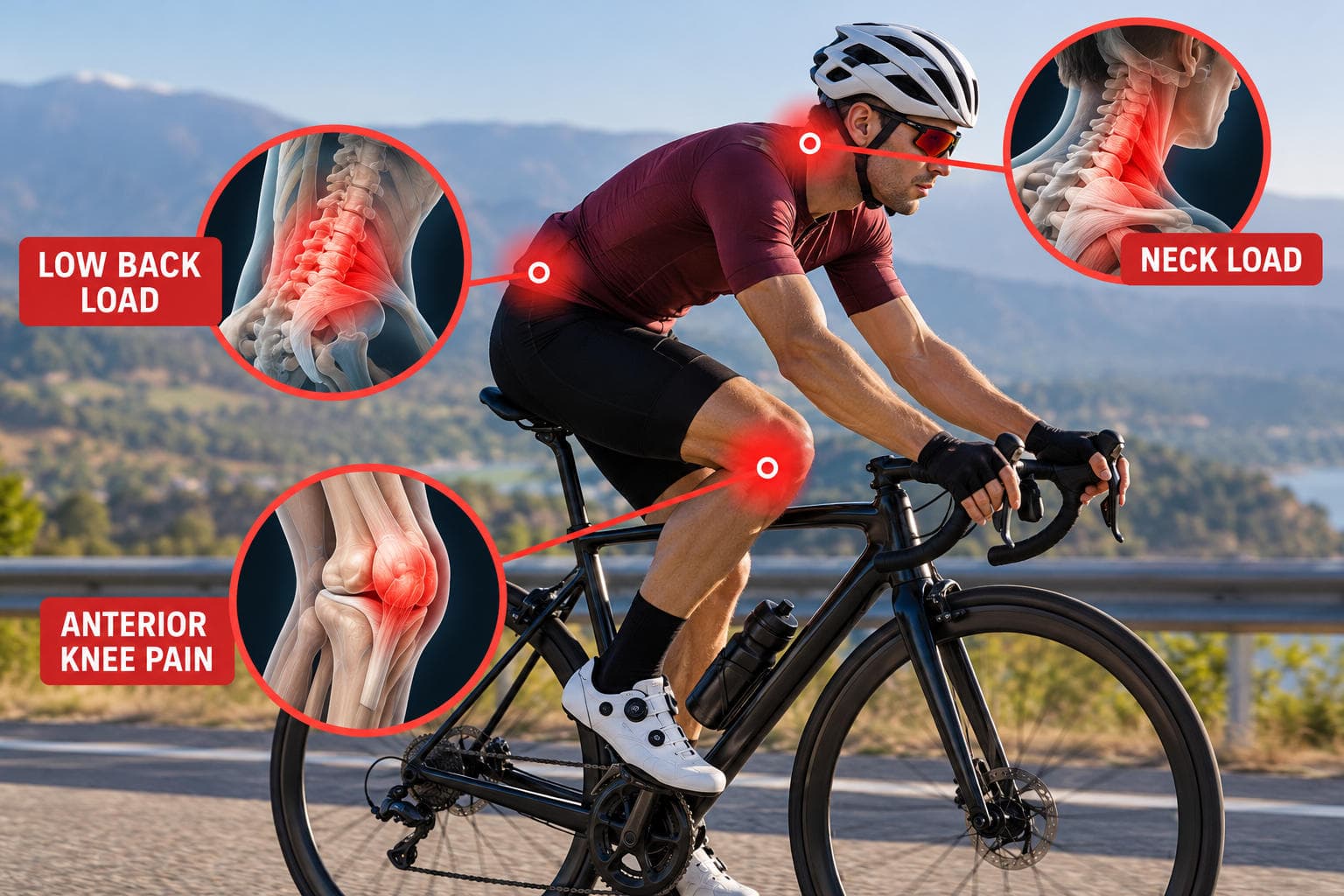
Cycling injuries are almost entirely of gradual onset, which makes them a load problem rather than an incident to reconstruct from a history. The saddle position holds the rider in one posture for hours, and the presentations follow from that. Three account for most of the physiotherapy caseload.
What are the Most Common Cycling Injuries?
A study of 109 professional road cyclists remains the clearest positional data, and the following are reported the most:
- Low back pain: The most prevalent overuse complaint. 58% of cyclists reported low back pain in the previous 12 months and 41% had sought medical attention for it, though only 6% had missed competition because of it
- Anterior knee pain: Reported by 36% in the previous 12 months, with 19% seeking medical attention. Less prevalent than low back pain but more likely to cause time loss, accounting for 57% of time-loss injuries against the low back's 22%
- Neck and shoulder pain: Consistently the third gradual onset presentation in competitive riders, and in recreational cohorts the neck has been reported as the single most common site at 48.8%
The pattern that matters clinically: low back pain generates the most functional impairment and medical attention, while knee pain generates the time off. They are not the same problem and should not be triaged the same way.
Anterior knee pain
Load-related pain around or behind the patella developing across sustained pedalling, associated with training volume at low cadence rather than with a discrete event.
Assessment
- Load history: Weekly volume, cadence, and any recent increase, since volume and low cadence carry the association
- Provocation: Reproduction during sustained seated effort, and on single-leg squat off the bike
- Capacity: Quadriceps and hip abductor strength, tested single leg
- Position: Saddle height and fore-aft, and cleat rotation, taken as one factor among several rather than the answer
- Differential: Patellar tendinopathy, which localises to the inferior pole, and iliotibial band irritation laterally
Physiotherapy management
- Reduce volume and raise cadence before altering anything else, since these are the variables with the supporting evidence
- Progressive quadriceps and hip loading off the bike, which cycling itself does not provide
- Rebuild sustained seated effort as a graded exposure rather than as a return to normal training
- Expect a timeline in weeks and set that expectation early
Tip: When a rider arrives convinced their bike fit caused this, the honest answer is that volume has better evidence behind it than set-up. That is a more useful conversation than a millimetre adjustment.
Low back pain
Sustained lumbar flexion with anterior pelvic tilt held for hours, aggravated by longer rides and by aggressive positions. Non-specific in the great majority of cases.
Assessment
- Symptom behaviour: Relationship to ride duration and position rather than to a single event
- Movement testing: Flexion tolerance and repeated movement response, with extension often relieving
- Capacity: Trunk extensor and abdominal endurance, tested to fatigue rather than for peak force
- Off-bike function: Whether symptoms occur off the bike, which changes the picture considerably
- Red flags: Screen before imaging, since routine early imaging does not improve outcomes
Physiotherapy management
- Break up sustained flexion within rides before changing the bike
- Build trunk extensor and abdominal endurance, since weakness in both has emerged as an associated factor
- Restore hip flexor and hamstring extensibility where limited, given the sustained flexed position
- Address ride duration and load progression as the primary variable
- Reassure and keep the rider riding where possible, since most non-specific low back pain settles without imaging and time loss from this presentation is low
Neck and shoulder load
Sustained cervical extension to maintain forward gaze in a flexed trunk position, compounded by upper limb weight-bearing through the bars.
Assessment
- Symptom behaviour: Onset by ride duration, and whether it resolves within hours of finishing
- Cervical examination: Upper cervical extension tolerance and segmental findings
- Reach and drop: Bar reach and drop, which alter cervical extension demand directly
- Upper limb: Handlebar loading, grip position variety, and any paraesthesia in the hands, which is common in this population and separately reported
- Neurological screen: Where paraesthesia is present, distinguish ulnar compression at the bar from cervical referral
Physiotherapy management
- Vary hand and trunk position within rides, which is the most immediately available intervention
- Build cervical and scapular endurance rather than strength, since this is a sustained-posture problem
- Reduce bar drop where cervical extension demand is clearly excessive
- Address handlebar loading and glove or bar tape padding where hand paraesthesia coexists
- Manage total ride duration, particularly around rapid increases in training load
Before you clear a rider
Cycling asks for one posture sustained for hours, so clearance rests on tolerating the intended ride duration in the intended position rather than on a strength test. Rebuild duration by increments, treat cadence and volume as the primary levers, and be careful not to promise that a bike fit will resolve a load problem.
References
- https://pubmed.ncbi.nlm.nih.gov/20847225/
- https://www.sciencedirect.com/science/article/abs/pii/S1440244021005594
- https://link.springer.com/article/10.1007/s42978-025-00335-x
- https://www.sciencedirect.com/science/article/abs/pii/S1466853X20304892
- https://www.dovepress.com/potential-factors-associated-with-knee-pain-in-cyclists-a-systematic-r-peer-reviewed-fulltext-article-OAJSM
- https://www.ncbi.nlm.nih.gov/pmc/articles/PMC11950058/