Return-to-Sport Testing: The Hop-Test Battery and Limb Symmetry Index
Hop testing is the most widely used functional measure in return-to-sport decisions, particularly after ACL reconstruction. The battery is quick and cheap to run. The limb symmetry index that summarizes it is also simple.
Hop testing is the most widely used functional measure in return-to-sport decisions, particularly after ACL reconstruction. The battery is quick and cheap to run. The limb symmetry index that summarizes it is also simple. However, that simplicity is the problem as a ratio can look reassuring while both limbs are underperforming.
What is in the Hop-Test Battery?
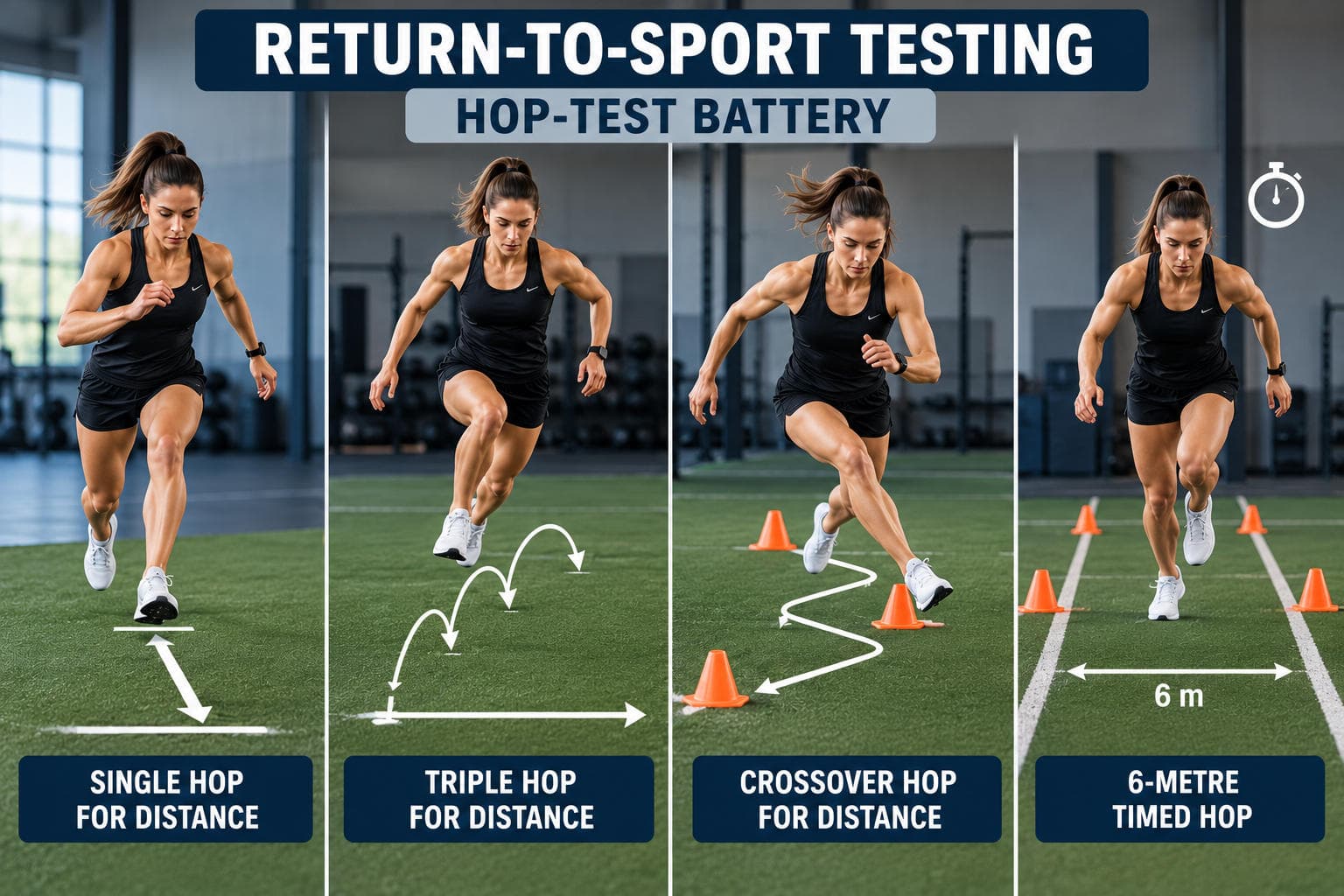
The standard battery uses four single-leg tests, the single, crossover and triple hops for distance and the 6 metre timed hop, and each asks something different of the limb:
- Single hop for distance: Horizontal power and a controlled single landing
- Triple hop for distance: Repeated absorption and reproduction of force
- Crossover hop for distance: Adds medial-lateral control across a line
- 6 metre timed hop: Speed of repeated hopping rather than distance
The limb symmetry index divides the involved limb's score by the uninvolved limb's score. A 90% threshold is common, with 85 to 90% used in other criteria.
The best-known supporting data comes from the Delaware-Oslo cohort, where 38.2% of patients who failed return-to-sport criteria were reinjured against 5.6% of those who passed, and reinjury risk fell by 51% for each month return was delayed up to 9 months after surgery.
A meta-analysis found only a nonsignificant 3% reduction in second ACL injury risk after passing criteria, with the evidence rated very low quality. The battery is useful, but it is not a pass or fail guarantee.
Limb symmetry indexes can overestimate knee function after anterior cruciate ligament injury.
Running the Battery
Assessment
- Readiness: No effusion, full extension, and quadriceps strength established before any hopping
- Familiarisation: Practice trials on each limb before recorded attempts, then average two or more valid trials
- Standardisation: Same footwear, surface and arm position each time, with the landing held for two seconds
- Quality: Watch the landing as well as the distance, looking for knee valgus, trunk lean and stiff landings
- Fatigue: Consider repeating the battery later in a session, since reinjury tends to happen when the athlete is tired
- Absolute values: Record distances and times, not just the ratio, so you can compare against normative data and the athlete's own baseline
What the Limb Symmetry Index Misses?
The index assumes the uninvolved limb is a fair reference. After injury and surgery, it usually is not, because the uninvolved limb deconditions too.
- Contralateral decline: In one cohort, 57.1% of patients reached 90% symmetry on quadriceps strength and all hop tests at 6 months, but only 28.6% reached 90% of the uninvolved limb's preinjury capacity. Preinjury-based estimates were also more sensitive in predicting second ACL injury.
- Test sensitivity: Hop tests can produce higher symmetry values than isokinetic strength and leg press testing, so passing the hop battery often does not mean strength has recovered.
- Compensation: Horizontal hops allow the hip and ankle to make up for a weak knee, and the single-leg vertical hop detects greater asymmetries than horizontal hop tests.
- Long-term drift: Symmetry has been shown to improve between one and five years after reconstruction mainly because the uninvolved limb gets worse.
Physiotherapy management
- Test the uninvolved limb at the first appointment, before it detrains, and use that as the reference
- Pair hop testing with quadriceps strength testing, since greater quadriceps strength symmetry before return to sport significantly reduces the risk of reinjury
- Add a vertical hop or reactive strength measure to catch knee-specific deficits
- Combine test results with time since surgery rather than using either alone
- Include a psychological readiness measure, since fear of reinjury affects both performance and return
Tip: Test both limbs at the first session after surgery, even if the involved limb can barely manage it. That baseline for the uninvolved side is the most useful number you will have nine months later.
Before You Clear an Athlete
The hop battery shows whether the limb can produce and absorb force in straight lines on a good day. It does not show whether the athlete can cut, react or perform while fatigued. Use it as one input alongside strength, time and sport-specific exposure, compare against preinjury capacity wherever you can, and be wary of any symmetry figure that looks better than the athlete moves.
References
- https://pubmed.ncbi.nlm.nih.gov/28355978/
- https://pubmed.ncbi.nlm.nih.gov/27162233/
- https://pubmed.ncbi.nlm.nih.gov/30501385/
- https://ijspt.scholasticahq.com/article/29595
- https://www.sciencedirect.com/science/article/abs/pii/S1466853X20300055
- https://pmc.ncbi.nlm.nih.gov/articles/PMC11064852/
- https://iaom-us.com/limb-symmetry-indexes-can-overestimate-knee-function-after-anterior-cruciate-ligament-injury
- https://pubmed.ncbi.nlm.nih.gov/27162233/