Muscle-Strain Grading: BAMIC Classification And Return-To-Play
The British Athletics Muscle Injury Classification (BAMIC) was built to fix that by describing both how extensive an injury is and where in the muscle it sits.
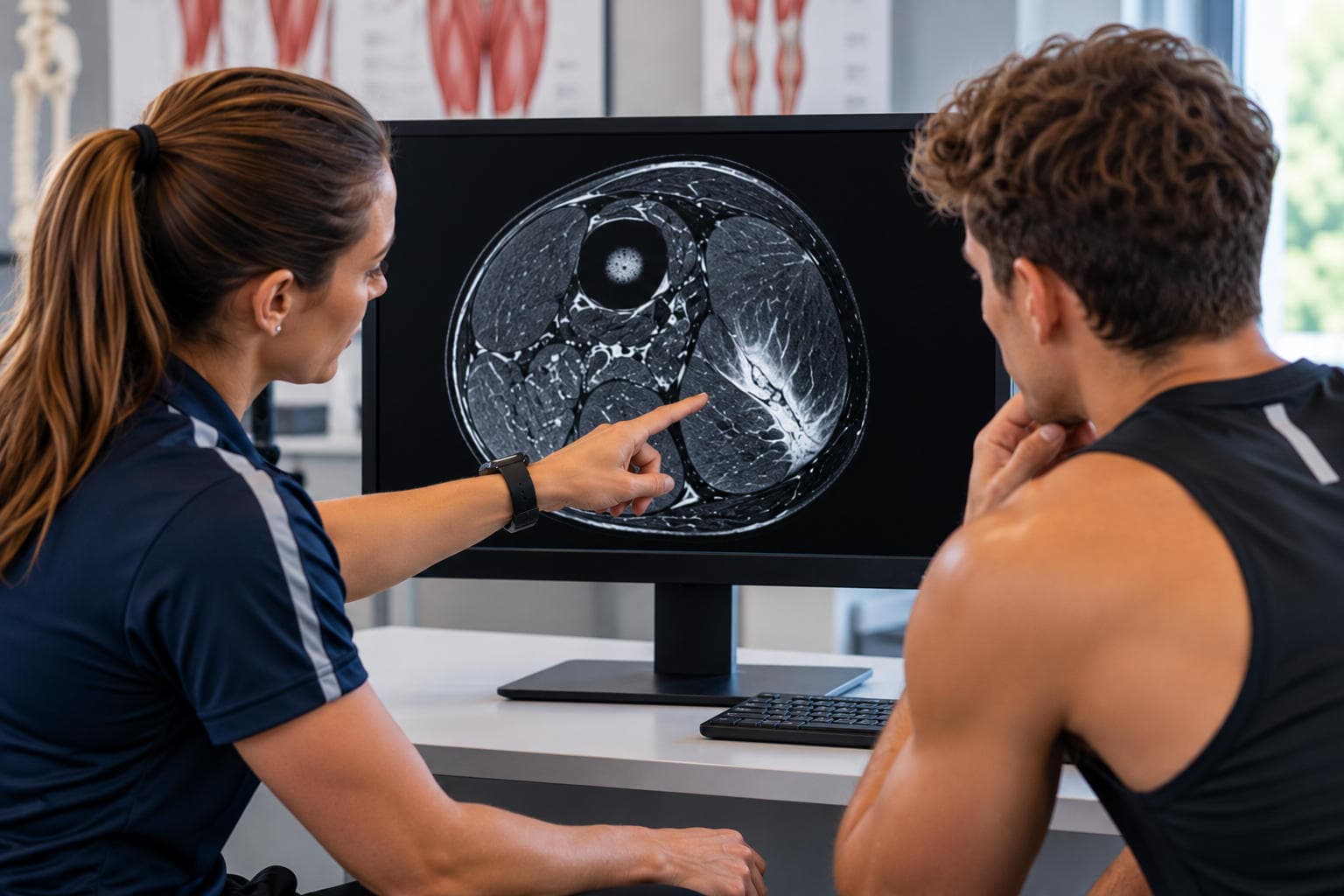
The traditional three-grade system (mild, moderate, complete) is easy to remember but tells you little about how long an athlete will take to return to play. Such systems lack diagnostic accuracy and give clinicians limited prognostic information. The British Athletics Muscle Injury Classification (BAMIC) was built to fix that by describing both how extensive an injury is and where in the muscle it sits.
How BAMIC Grades an Injury?
As per BAMIC, injuries are graded 0 to 4 on MRI features, and grades 1 to 4 carry a suffix of a, b or c depending on whether the injury is myofascial, musculotendinous or intratendinous.
- Grade 0: MRI negative. 0a is focal neuromuscular pain with a normal MRI; 0b is generalised soreness with a normal scan or findings typical of delayed-onset muscle soreness.
- Grade 1: Small injury, with high signal involving less than 10% of the muscle's cross-sectional area.
- Grade 2: Moderate injury, involving 10–50% of the cross-sectional area or a craniocaudal length of 5–15 cm.
- Grade 3: Extensive tear. The athlete usually has sudden-onset pain and may fall, and range of motion at 24 hours is usually markedly reduced, with pain on walking.
- Grade 4: Complete tear of the muscle or tendon.
The suffix describes the site:
- a: Injury sits at the muscle–fascia interface at the periphery
- b: Injury lies within the muscle belly or musculotendinous junction without tendon involvement.
- c: Injury extends into the tendon itself
Why Does Letter Matter?
The site suffix carries more prognostic weight than most clinicians expect.
- Original validation: In a research including 65 hamstring injuries in elite track and field athletes, athletes with grade 3 and 'c' injuries took significantly longer to return to full training, while those with grade 0 injuries took less time. Intratendinous injuries in that study had a reinjury rate of up to 63%.
- Classification-guided rehabilitation: Once British Athletics tailored rehabilitation to the classification, mean time to return to full training across the cohort was 18.6 days; 2c injuries averaged 34 days and 3c injuries 48 days. The overall reinjury rate was 2.9%, with no reinjuries in the intratendinous classes.
Note: Intratendinous injuries need not recur as the evidence suggests they are more likely to when rehabilitated like peripheral ones.
Assessment
- Clinical examination first: 'c' injuries are hard to detect clinically, but they were associated with more pain on walking and contraction, and athletes took longer to return to jogging and to regain pain-free knee extension.
- Milestones that track recovery: Time to pain-free jogging, full pain-free strength, a negative Askling H-test and full passive range were all associated with time to return to full training; pain-free palpation was not.
- Imaging timing: MRI within the first week, which is when the classification was validated.
- Who needs MRI: Elite athletes, suspected tendon involvement, stretch-type or proximal injuries, and recurrences.
Physiotherapy Management
- For 'a' injuries, progress quickly and reintroduce high-speed running early.
- For 'b' injuries, follow a standard progressive loading programme.
- For 'c' injuries, protect the tendon from heavy lengthening load early, progress end-range and maximal-velocity work more slowly, and set a longer expected timeline.
- For grade 4 and complete tendon injuries, get a surgical opinion early.
- Use the grade to set expectations, but progress by clinical milestones rather than by the calendar.
Tip: When you read the MRI report, don't stop at the number; check the letter. A 2c usually needs a longer, more careful plan than a 3b.
Before You Clear an Athlete
Return to full training is not return to competition, and a classification is not a clearance test. Use BAMIC to predict the likely course and shape the rehabilitation plan, then clear on milestones: pain-free maximal sprinting, full strength at long muscle lengths, and tolerance of the athlete's full training week. For intratendinous injuries especially, resist pressure to shorten the timeline just because the athlete feels ready.
References
- https://pubmed.ncbi.nlm.nih.gov/25031367/
- https://pubmed.ncbi.nlm.nih.gov/26888072/
- https://pubmed.ncbi.nlm.nih.gov/31300391/
- https://www.researchgate.net/publication/350881394_A_4-year_study_of_hamstring_injury_outcomes_in_elite_track_and_field_using_the_British_Athletics_rehabilitation_approach
- https://pmc.ncbi.nlm.nih.gov/articles/PMC8112435/
- https://pubmed.ncbi.nlm.nih.gov/40985316/