Track and Field Injuries: Hamstring, Quadriceps and Calf Strains
Sprinters and jumpers tear hamstrings, distance runners strain calves, and the rectus femoris sits between them in the acceleration and take-off events. Knowing the athlete's event tells you where to look before they describe a single symptom.
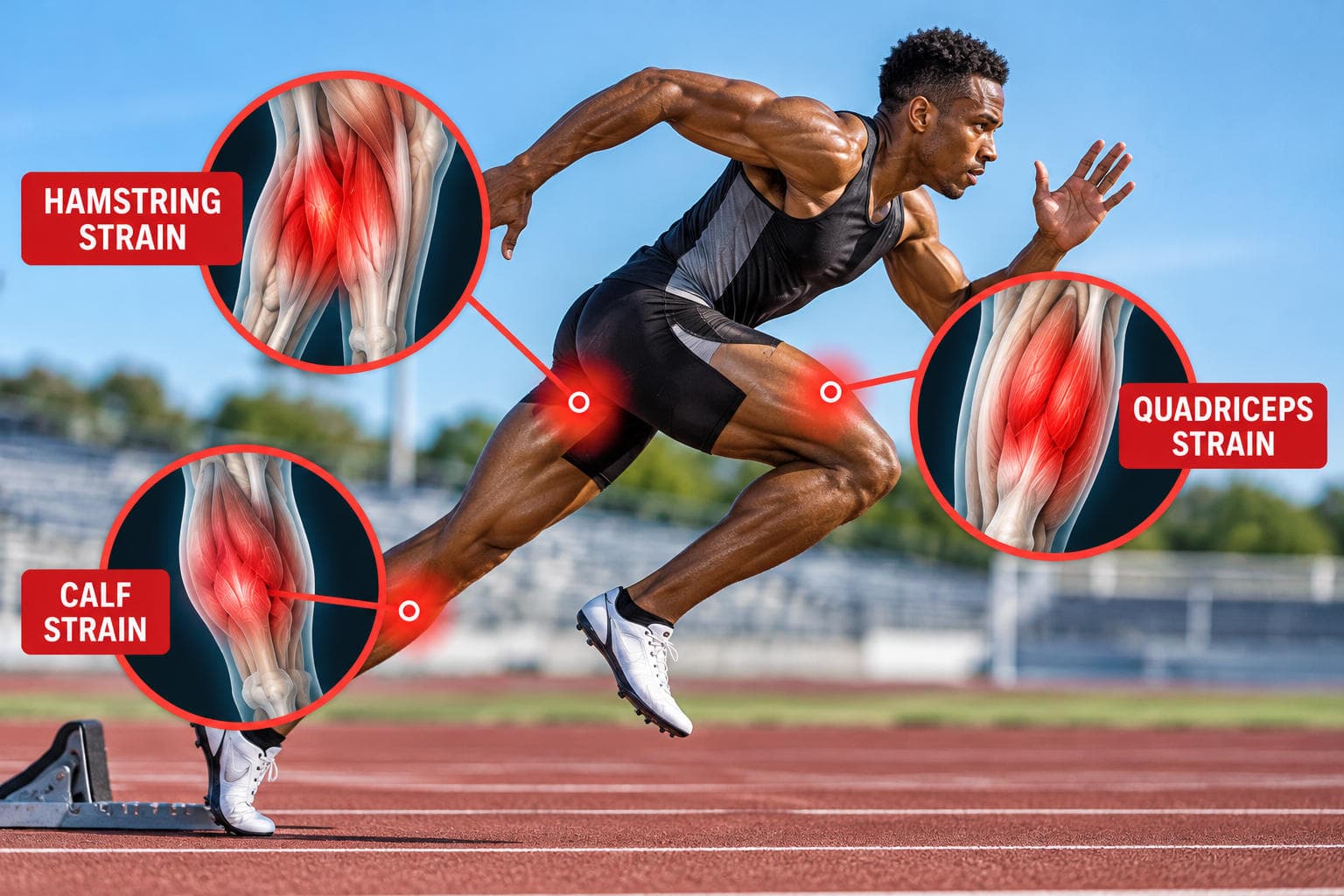
Track and field injuries are mostly muscle injuries, and which muscle gets injured depends largely on how fast the event is run. Sprinters and jumpers tear hamstrings, distance runners strain calves, and the rectus femoris sits between them in the acceleration and take-off events. Knowing the athlete's event tells you where to look before they describe a single symptom.
What are the Most Common Track and Field Injuries?
Surveillance data from international championships gives the clearest picture, and the following are reported the most:
- Hamstring strain: Across 16 major international athletics championships, muscle injuries made up 41% of all injuries, and hamstring injuries alone accounted for 17%. Hamstrings were the most frequently injured muscle group in sprints, hurdles, jumps, combined events and male middle distance runners, at 43 to 75% of lower limb muscle injuries.
- Calf strain: The posterior lower leg was the most commonly injured group in female middle distance, male long distance and female marathon runners, at 44 to 60%. British Athletics data places soleus injury among the three biggest time-loss injuries in the sport, alongside hamstring injury and Achilles tendinopathy.
- Rectus femoris strain: Less frequent, but consequential. In track and field, average return to training after quadriceps strain has been reported at 20.4 days, with a recurrence rate of 13.2%.
The pattern that matters clinically is speed. Hamstring injury burden generally rose with the running velocity a discipline demands, while posterior lower leg injuries dominated in the slower disciplines.
Hamstring Strain
Sudden posterior thigh pain during high-speed running, usually in the biceps femoris long head during late swing. A separate stretch-type injury occurs during slow, end-range movements, typically closer to the proximal tendon, and behaves differently.
Assessment
- Mechanism: Sprinting versus stretching, since stretch-type injuries near the proximal tendon usually take longer to recover
- Palpation: Site and length of tenderness, and distance from the ischial tuberosity
- Range: Reduced active knee extension range in hip flexion and greater side-to-side asymmetry are both associated with longer time to return to full training.
- Prodrome: Low back pain and hamstring cramping or tightness a week before injury often present in 30% of injuries.
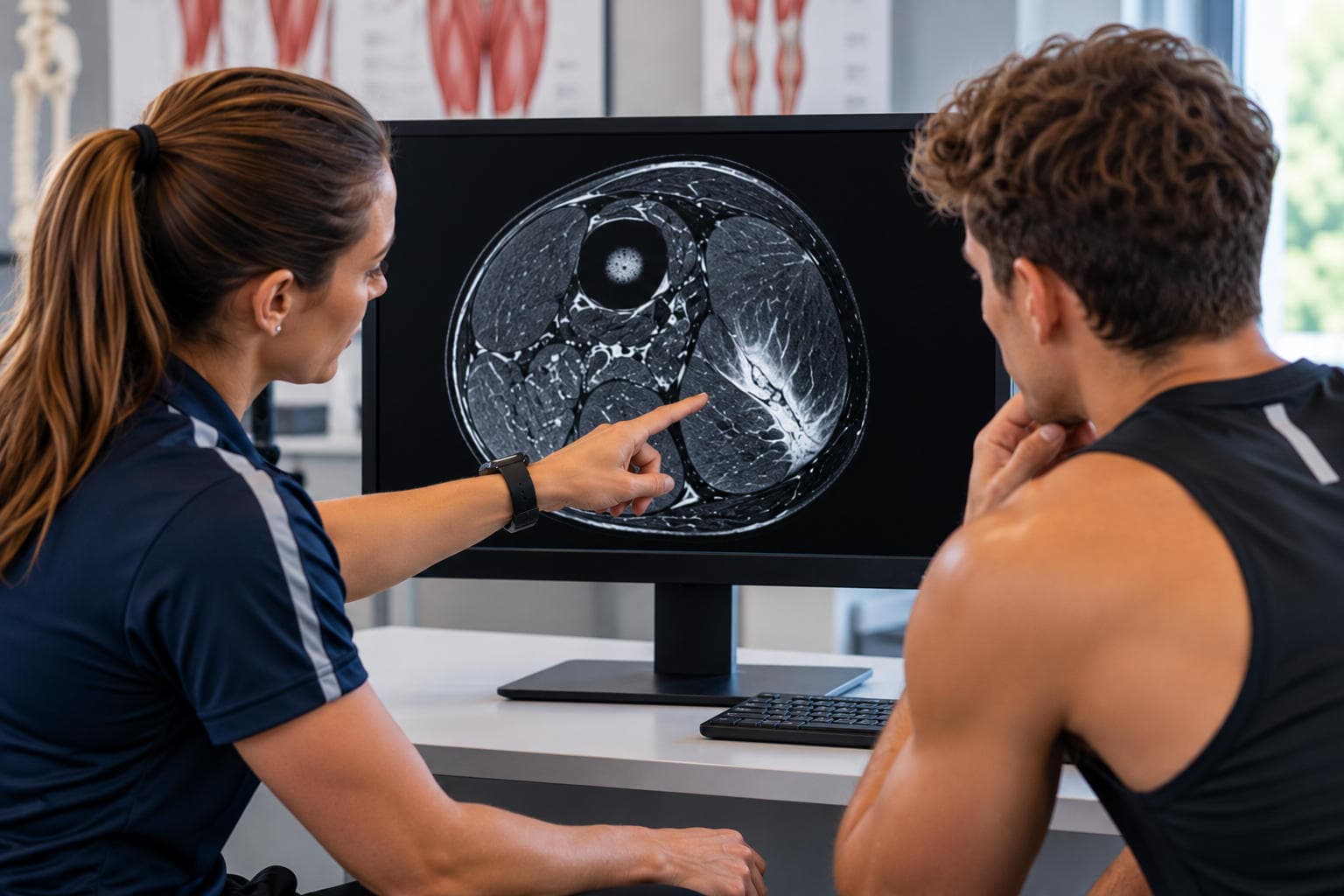
- Imaging: Consider MRI for elite athletes or where intratendinous injury is suspected, since these injuries are difficult to detect clinically, though higher pain scores and prolonged range restriction may point towards them.
Physiotherapy management
- Load early within pain limits rather than resting until pain settles
- Include lengthening exercises from the first week, since lengthening-focused protocols have returned athletes faster than conventional programmes in randomised trials
- Reintroduce high-speed running progressively as part of rehabilitation rather than saving it as a final test
- Build eccentric strength at long muscle lengths with Nordic curls and Romanian deadlift variations
- Expect a longer timeline where the intramuscular tendon is involved, and set that expectation at the first consultation
Tip: Ask what the hamstring felt like in the week before it went. Tightness, cramping or back pain in that window is common, and it tells you what to watch for next time.
Rectus Femoris Strain
Anterior thigh pain during acceleration, hurdle clearance or take-off. The rectus femoris crosses both hip and knee, and injuries around its deep central tendon behave very differently from peripheral ones.
Assessment
- Provocation: Resisted hip flexion and resisted knee extension, and pain on prone knee flexion
- Location: Proximal versus mid-belly, and whether tenderness is deep and central or peripheral
- Differential: Iliopsoas, adductor involvement, and anterior inferior iliac spine avulsion in adolescent athletes
- Imaging: Where timelines matter
Physiotherapy management
- Progress from isometric to eccentric loading of the knee extensors and hip flexors, including lengthened positions such as reverse Nordics
- Reintroduce acceleration and take-off drills gradually, since this is where the muscle takes the most load
- Do not compress the timeline for central tendon injuries, which consistently take longer
- Refer for surgical opinion only in complete free tendon ruptures, which are rare
Calf Strain
Posterior lower leg pain in distance runners and masters athletes, sometimes sudden, sometimes building across a session. Soleus involvement is more common in distance runners, medial gastrocnemius in explosive efforts.
Assessment
- Risk profile: Increasing age and a previous calf strain are the strongest predictors of future calf injury
- Differentiation: Bent-knee versus straight-knee calf raise, to separate soleus from gastrocnemius
- Capacity: Single-leg calf raise repetitions to fatigue, compared side to side
- Differential: Deep vein thrombosis, Achilles pathology and lumbar referral, since L5 radiculopathy has shown some association with calf strain
- Load history: Mileage spikes, track sessions in spikes, and recent changes to faster work
Physiotherapy management
- Load both bent-knee and straight-knee, covering heavy strength and endurance
- Reintroduce hopping and pogo work before running, since it rebuilds the calf's spring function
- Return to spikes and track sessions last, as a distinct stage
- Keep masters athletes on ongoing maintenance loading rather than discharging them
Before You Clear a Track Athlete
Clearance should match the event. A sprinter needs repeated exposure to maximal velocity, a distance runner needs tolerance of the intended weekly volume, and a jumper needs approach runs and take-offs at full intensity. Test the event rather than general strength, treat previous injury as the strongest risk factor you have, and remember that a hamstring that has tolerated jogging has not yet been tested.
References
- https://pubmed.ncbi.nlm.nih.gov/33632663/
- https://ijspt.scholasticahq.com/article/32589-injury-and-illness-in-elite-athletics-a-prospective-cohort-study-over-three-seasons
- https://pubmed.ncbi.nlm.nih.gov/40985316/
- https://pubmed.ncbi.nlm.nih.gov/42661294/
- https://pubmed.ncbi.nlm.nih.gov/28259848/
- https://pmc.ncbi.nlm.nih.gov/articles/PMC11469716/