Pregnancy-Related Carpal Tunnel Syndrome: Conservative Management
Learn the causes, assessment and conservative management of pregnancy-related carpal tunnel syndrome, including splinting, activity modification, nerve gliding and referral criteria.
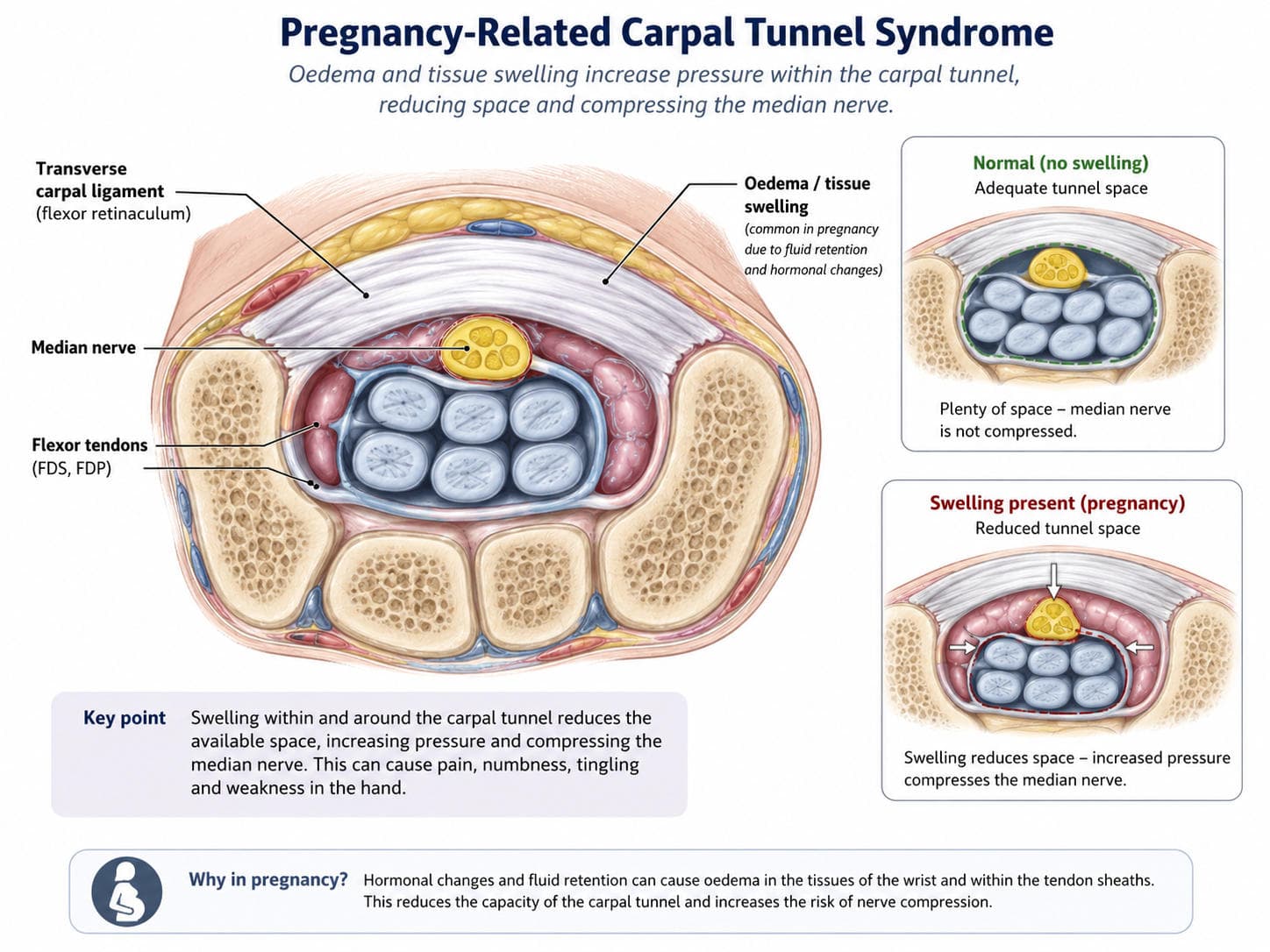
Pregnancy-related carpal tunnel syndrome (PRCTS) is compression of the median nerve within the carpal tunnel that begins or becomes symptomatic during pregnancy. It typically causes nocturnal tingling, numbness or burning pain in the thumb, index, middle and radial half of the ring finger, sometimes with reduced grip, clumsiness and disturbed sleep. Reported frequency varies because studies use different diagnostic criteria, but symptoms are especially common in later pregnancy and are often bilateral (Meems et al., 2015; Padua et al., 2010).
Why Pregnancy-Related Carpal Tunnel Syndrome Develops
The carpal tunnel is a rigid osteofibrous canal containing the median nerve and nine flexor tendons. During pregnancy, plasma-volume expansion, hormonal changes and fluid retention can increase pressure inside this limited space. Venous congestion and swelling around the flexor tendons further reduce the space available for the median nerve. Symptoms therefore tend to appear or worsen in the second or third trimester, when oedema is usually greater (Cîmpeanu et al., 2024; Georgiew et al., 2025).
Risk may be increased by excessive gestational weight gain, obesity, gestational diabetes, hypothyroidism or previously silent median-nerve compression. Postpartum symptoms may also be provoked by sustained wrist flexion while feeding, carrying or positioning the baby. The dominant mechanism is usually reversible fluid-related pressure combined with provocative wrist positions.
Clinical Presentation and Physiotherapy Assessment
The history should establish the onset, trimester, affected hand, nocturnal waking, distribution of paraesthesia, aggravating positions, weakness, dropping objects and effects on sleep or daily activity. Little-finger symptoms suggest ulnar involvement, while neck pain, widespread sensory change or reflex abnormalities require consideration of cervical radiculopathy or a more proximal neuropathy.
Examination should include observation for swelling or thenar wasting; light-touch comparison in the median-nerve distribution; thumb abduction and opposition strength; functional grip or pinch; wrist movement; and symptom reproduction with sustained wrist flexion, carpal compression or percussion over the median nerve. No single provocative test is definitive, so findings should be interpreted as a clinical pattern rather than relying on one positive test (Magee & Manske, 2021). The AAOS guideline similarly supports diagnosis through combined clinical findings, validated clinical tools, ultrasonography or electrodiagnostic testing where appropriate (American Academy of Orthopaedic Surgeons [AAOS], 2024).
Electrodiagnostic testing is not routinely required in a typical mild pregnancy-related presentation. It becomes more relevant when symptoms are atypical, constant or progressive; objective weakness or thenar wasting is present; symptoms persist postpartum; or injection or surgery is being considered. Ultrasound may provide a non-invasive assessment of median-nerve enlargement, although clinical findings remain central (Georgiew et al., 2025).
Sudden marked hand swelling accompanied by severe headache, visual disturbance, upper abdominal pain, breathlessness or raised blood pressure should not be treated as routine CTS. These features require prompt obstetric assessment because they may indicate pre-eclampsia, particularly after 20 weeks of pregnancy (World Health Organization [WHO], 2025).

First-Line Conservative Management
The principal aim is to reduce intracarpal pressure while preserving hand function. Education and neutral wrist positioning form the foundation of care.

Neutral wrist orthosis. A correctly fitted wrist splint is generally the first-line intervention. It should maintain the wrist near neutral, leave the fingers and thumb free and avoid excessive strap pressure. Night-time use is most important because many people sleep with the wrist flexed. Daytime use may be added during provoking tasks, but continuous immobilisation is usually unnecessary when symptoms are controlled.
A pregnancy-specific case series reported early improvements in symptoms, grip and pinch strength after splinting. Contemporary reviews continue to support neutral wrist immobilisation as a low-cost and well-tolerated treatment, although its primary role is symptom control rather than a guaranteed long-term cure (Courts, 1995; Georgiew et al., 2025).
Activity modification. The patient should reduce prolonged wrist flexion or extension, forceful gripping, repetitive squeezing and sustained pressure through the palm. Useful adaptations include:
- Using a phone stand instead of holding the phone with the wrist flexed.
- Keeping the wrist straight during typing and household tasks.
- Alternating hands and taking short movement breaks.
- Using both hands to lift heavier objects.
- Supporting the baby with pillows during feeding rather than holding the wrist in prolonged flexion.
These modifications reduce repeated increases in carpal-tunnel pressure without requiring complete avoidance of normal hand activity (Cîmpeanu et al., 2024; Georgiew et al., 2025).

Oedema management. Gentle hand elevation, regular finger opening and closing, comfortable active wrist movement and avoidance of tight jewellery or constrictive straps may reduce local congestion. Diuretics or dietary restriction should not be recommended independently by the physiotherapist for routine pregnancy oedema.
Medication requires obstetric or medical advice. Pregnant patients should particularly be discouraged from self-medicating with non-steroidal anti-inflammatory drugs. The US Food and Drug Administration advises avoiding NSAIDs from approximately 20 weeks of pregnancy unless specifically directed by a healthcare professional because of potential foetal renal complications and reduced amniotic fluid (Food and Drug Administration [FDA], 2020).
Exercise and Hands-On Physiotherapy
Exercise is an adjunct to splinting and education, not a forceful attempt to “stretch the nerve". The objective is to produce a gentle excursion of the flexor tendons and median nerve without increasing paraesthesia.
A suitable clinical starting point is one set of five slow repetitions, once or twice daily, with the wrist maintained close to neutral. The dose is adjusted according to the immediate and next-day response.

Tendon-gliding sequence
- Straight hand
- Hook fist
- Full fist
- Tabletop position
- Straight fist
Median-nerve slider
The exercise may begin with the elbow beside the body and the wrist and fingers relaxed. The patient gradually opens the elbow while extending the fingers and wrist only through a comfortable range, then returns to the starting position. It should remain a gentle sliding movement rather than an end-range neural tension exercise. Prolonged holds and repeated reproduction of numbness should be avoided.

Evidence for nerve and tendon gliding is mixed. Some short-term studies report symptomatic or functional improvement, while other trials show little additional benefit over splinting alone. The 2024 AAOS guideline also found that exercise has not demonstrated dependable long-term improvement in general CTS. Gliding exercises should therefore remain low-load, individually monitored and retained only when they improve comfort or hand function (AAOS, 2024).
Gentle soft-tissue work to the forearm flexors or carpal-region mobilisation may be used for short-term symptom relief, but aggressive pressure directly over an irritable median nerve is inappropriate. Kinesiology tape is an optional alternative when a splint is poorly tolerated, although evidence is inconsistent and pregnancy-related skin sensitivity must be considered.
Therapeutic ultrasound, laser and other machine-based interventions should not be routine choices. Pregnancy-specific precautions apply to some physical agents, while the AAOS guideline reports that therapeutic ultrasound does not provide reliable long-term improvement in CTS generally (AAOS, 2024; Georgiew et al., 2025).
Escalation, Postpartum Care and Prognosis
Medical review is appropriate when symptoms remain severe despite splinting and activity modification, repeatedly disturb sleep, impair essential hand use or demonstrate neurological progression.
A local corticosteroid injection may be considered by an appropriately trained clinician following obstetric and medical review, particularly for severe late-pregnancy symptoms. A small 2025 retrospective cohort involving pregnant women in their third trimester found greater short-term improvement when ultrasound-guided steroid injection was combined with splinting than when either intervention was used alone. However, the sample was small, and larger randomised trials are required (Turan et al., 2025).
General CTS evidence indicates that corticosteroid injections may provide short-term symptom relief but do not offer dependable long-term resolution. Injection should therefore be presented as a temporary symptom-management option rather than a permanent cure (AAOS, 2024).
Surgery is rarely required during pregnancy. It is generally reserved for:
- Severe or progressive motor weakness.
- Thenar muscle wasting.
- Marked electrodiagnostic nerve compression.
- Persistent disabling symptoms despite appropriate conservative care.
The decision should involve the obstetric, hand-surgery and anaesthetic teams (Cîmpeanu et al., 2024; Georgiew et al., 2025).
Most cases improve as pregnancy-related fluid retention resolves after delivery, but recovery is not always immediate. Feeding and infant-care positions should be reviewed postpartum, and the night splint may be continued during early recovery. Persistent numbness, weakness or pain beyond the early postpartum months warrants reassessment rather than indefinite reassurance. Prospective follow-up evidence indicates that although symptoms reduce substantially following childbirth, a small minority remain symptomatic at 12 months postpartum (Meems et al., 2017).
Viva-Ready Summary
Pregnancy-related carpal tunnel syndrome is a median-nerve entrapment caused mainly by pregnancy-associated oedema and increased pressure within the carpal tunnel. It commonly presents during later pregnancy with bilateral nocturnal paraesthesia affecting the thumb, index, middle and radial half of the ring finger.
Diagnosis is usually clinical, but constant numbness, objective weakness, thenar wasting, atypical neurological findings or persistent postpartum symptoms require further investigation. First-line treatment consists of a neutral wrist splint, education, activity modification and gentle oedema management. Tendon and median-nerve gliding may be added as symptom-limited adjuncts. Steroid injection is a specialist option for severe refractory cases, while surgery is uncommon.
One-line recall point: Pregnancy-related CTS is managed first by reducing carpal tunnel pressure—neutral night splinting, wrist-position education and gentle symptom-guided movement.
References
American Academy of Orthopaedic Surgeons. (2024). Management of carpal tunnel syndrome: Evidence-based clinical practice guideline.
Cîmpeanu, M.-C., Roman, N., Grigorescu, S., Grigorescu, O.-D., & Miclăuș, R. S. (2024). Management of “de novo” carpal tunnel syndrome in pregnancy: A narrative review. Journal of Personalized Medicine, 14(3), 240. doi:10.3390/jpm14030240
Courts, R. B. (1995). Splinting for symptoms of carpal tunnel syndrome during pregnancy. Journal of Hand Therapy, 8(1), 31–34. doi:10.1016/S0894-1130(12)80154-2
Food and Drug Administration. (2020). FDA recommends avoiding use of NSAIDs in pregnancy at 20 weeks or later because they can result in low amniotic fluid.
Georgiew, F., Florek, J., Bębenek, A., Florek, P., & Sobanski, G. (2025). Pregnancy-related carpal tunnel syndrome. Cureus, 17(10), e94652. doi:10.7759/cureus.94652
Magee, D. J., & Manske, R. C. (2021). Orthopedic physical assessment (7th ed.). Elsevier.
Meems, M., Truijens, S. E. M., Spek, V., Visser, L. H., & Pop, V. J. M. (2015). Prevalence, course and determinants of carpal tunnel syndrome symptoms during pregnancy: A prospective study. BJOG: An International Journal of Obstetrics & Gynaecology, 122(8), 1112–1118. doi:10.1111/1471-0528.13360
Meems, M., Truijens, S. E. M., Spek, V. R. M., Visser, L. H., & Pop, V. J. M. (2017). Follow-up of pregnancy-related carpal tunnel syndrome symptoms at 12 months postpartum: A prospective study. European Journal of Obstetrics & Gynecology and Reproductive Biology, 211, 231–232. doi:10.1016/j.ejogrb.2017.02.030
Padua, L., Di Pasquale, A., Pazzaglia, C., Liotta, G. A., Librante, A., & Mondelli, M. (2010). Systematic review of pregnancy-related carpal tunnel syndrome. Muscle & Nerve, 42(5), 697–702. doi:10.1002/mus.21910
Turan, S. A., Bütün, Z., Kayapınar, M., & Turan, H. (2025). Can ultrasound-guided steroid injection lead to an improvement in the symptoms of pregnancy-related carpal tunnel syndrome? With splint or alone? Journal of Back and Musculoskeletal Rehabilitation, 38(5). doi:10.1177/10538127251323323
World Health Organization. (2025). Pre-eclampsia.