Tennis Injuries: Tennis Elbow, Rotator Cuff and Tennis Leg
Tennis puts a lot of repeated stress on the shoulder and elbow, because a player swings their arm hundreds of times in a match. Meanwhile, the legs take the strain of sprinting, stopping, and changing direction between shots.
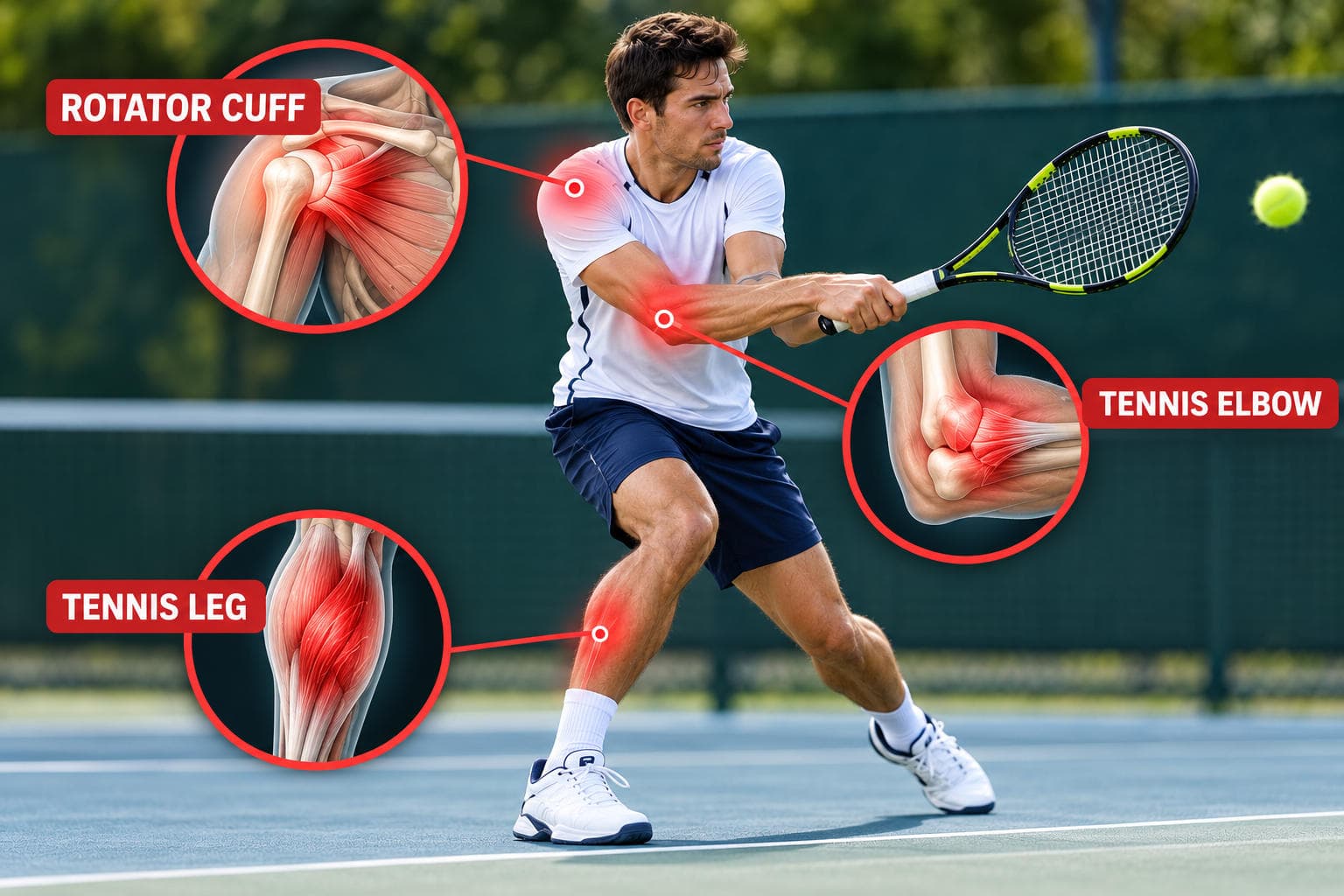
Tennis puts a lot of repeated stress on the shoulder and elbow, because a player swings their arm hundreds of times in a match. Meanwhile, the legs take the strain of sprinting, stopping, and changing direction between shots. This creates a clear pattern. Sudden injuries, like ankle sprains or calf tears, usually happen in the legs. Slow-building overuse injuries, like tennis elbow or shoulder pain, usually happen in the arm. Three common problems make up most of the tennis injuries seen in physiotherapy practice.
What are the Most Common Tennis Injuries?
A 2025 systematic review of high-performance players gives the clearest recent picture, and the following are reported the most:
- Lateral epicondylalgia: Common enough to be named after the sport, though the association runs the other way than most people assume. Tennis players make up only around 5% of the lateral epicondylalgia seen in clinical practice, while 40 to 50% of racket sport players will be diagnosed with it at some point. The dominant arm is affected in roughly 75% of cases
- Rotator cuff and shoulder overuse: The serve is the most strenuous stroke, producing the highest peak muscle activity at the shoulder and forearm. Shoulder overuse follows lumbar complaints in frequency, with reduced glenohumeral internal rotation and scapular dyskinesis the recurring intrinsic findings
- Tennis leg: Acute medial calf injury. Partial rupture of the medial head of gastrocnemius accounted for 66.7% of cases in a series of 141 presentations, with fluid collection between the gastrocnemius and soleus aponeuroses in a further 21.3%
Overall incidence ran 2.1 to 3.5 injuries per 1000 hours in juniors and 1.25 to 56.6 per 1000 hours in adults, a spread wide enough to say little on its own. Seasonal prevalence was 46 to 54% in juniors and 30 to 54% in professionals, with lower limb trauma accounting for 48 to 56% of injuries and lumbar complaints 12 to 39%.
Lateral epicondylalgia
Load-related pain at the lateral elbow, usually from repeated eccentric wrist extensor loading on the backhand, and more common in less experienced players than in elite ones.
Assessment
- Provocation: Resisted wrist extension and resisted third finger extension, with pain localised to the common extensor origin
- Grip: Pain-free grip strength as an objective marker you can re-measure
- Cervical and neural screen: Radial nerve sensitivity and cervical referral, both of which mimic and coexist
- Equipment: Grip size, string tension and racket weight, since grip size personalisation halved lateral epicondylalgia in the pooled prevention data
- Technique: Backhand mechanics, particularly a leading elbow and wrist extension at impact
Physiotherapy management
- Progressive loading of the wrist extensors as the primary intervention, starting isometric if irritable
- Do not use corticosteroid injection, which relieves pain short-term but worsens one-year outcomes
- Address the whole kinetic chain, since core stability plus eccentric work reduced overuse injury by 26% in the pooled prevention data
- Change the grip size before changing the technique, as it is the cheaper intervention with the better evidence
- Set expectations honestly, since typical episode duration runs 6 to 24 months
Tip: Ask what the player's racket grip size is and measure it. It is the single most modifiable variable in this presentation and almost nobody checks.
Rotator cuff and shoulder overuse
Cumulative load from serving and overhead play, presenting as pain that builds across a season rather than arriving in one session.
Assessment
- Range: Glenohumeral internal rotation deficit and total rotational arc, compared side to side
- Scapular control: Dyskinesis under load and through repeated elevation rather than at rest
- Cuff strength: External rotation at end of range, and the external to internal rotation ratio
- Load history: Serve volume and any recent spike, since an acute to chronic workload ratio at or above 1.3 in juniors and 1.5 in adults was the strongest extrinsic predictor of injury
- Trunk: Core endurance, which appeared consistently as an intrinsic contributor
Physiotherapy management
- Progressive cuff and scapular loading through range, not low-level activation work
- Eccentric rotator cuff training combined with core stability, which is the combination the prevention data supports
- Restore internal rotation range where it is limited, without forcing end range in an irritable shoulder
- Manage serve volume as the primary load variable and ramp it over four weeks rather than in one step
- Avoid subacromial decompression expectations, since it was no better than placebo surgery at 10 years
Tennis leg
Sudden posterior calf pain during push-off or a lunge, typically in a player over 40, often described as a blow or a snap.
Assessment
- Differential first: Deep vein thrombosis, which has appeared in around 5% of tennis leg presentations alongside another finding and as the sole finding in a smaller proportion. This is the one that matters
- Palpation: Medial gastrocnemius musculotendinous junction, which is the usual site, not the plantaris
- Achilles integrity: Calf squeeze test and prone knee flexion, since a complete Achilles rupture must be excluded
- Function: Ability to perform a single-leg heel raise, and pain on resisted plantarflexion
Physiotherapy management
- Exclude deep vein thrombosis before loading anything, particularly where swelling is disproportionate to the mechanism
- Early protected loading and range rather than immobilisation
- Progressive calf loading, restoring endurance as well as strength, since the sport is an endurance task for the calf
- Rebuild push-off and lunge tolerance in all court directions before return
- Do not attribute the injury to plantaris rupture, which is only rarely involved despite the historical description
Before you clear a player
Tennis asks for repeated overhead loading under fatigue, explosive push-off and deceleration, and the ability to lunge and recover in every court direction. Test all three rather than general strength. For the two overuse presentations, look at serve volume and grip size before looking at technique, since both are easier to change and both carry better supporting evidence.