Gym and Strength Training Injuries: Sciatica and Low Back & Shoulder Injuries
Strength training has a lower injury rate than most sports, and traditional resistance training is the safest of the weight-training methods. That matters, because many lifters believe lifting is inherently dangerous.
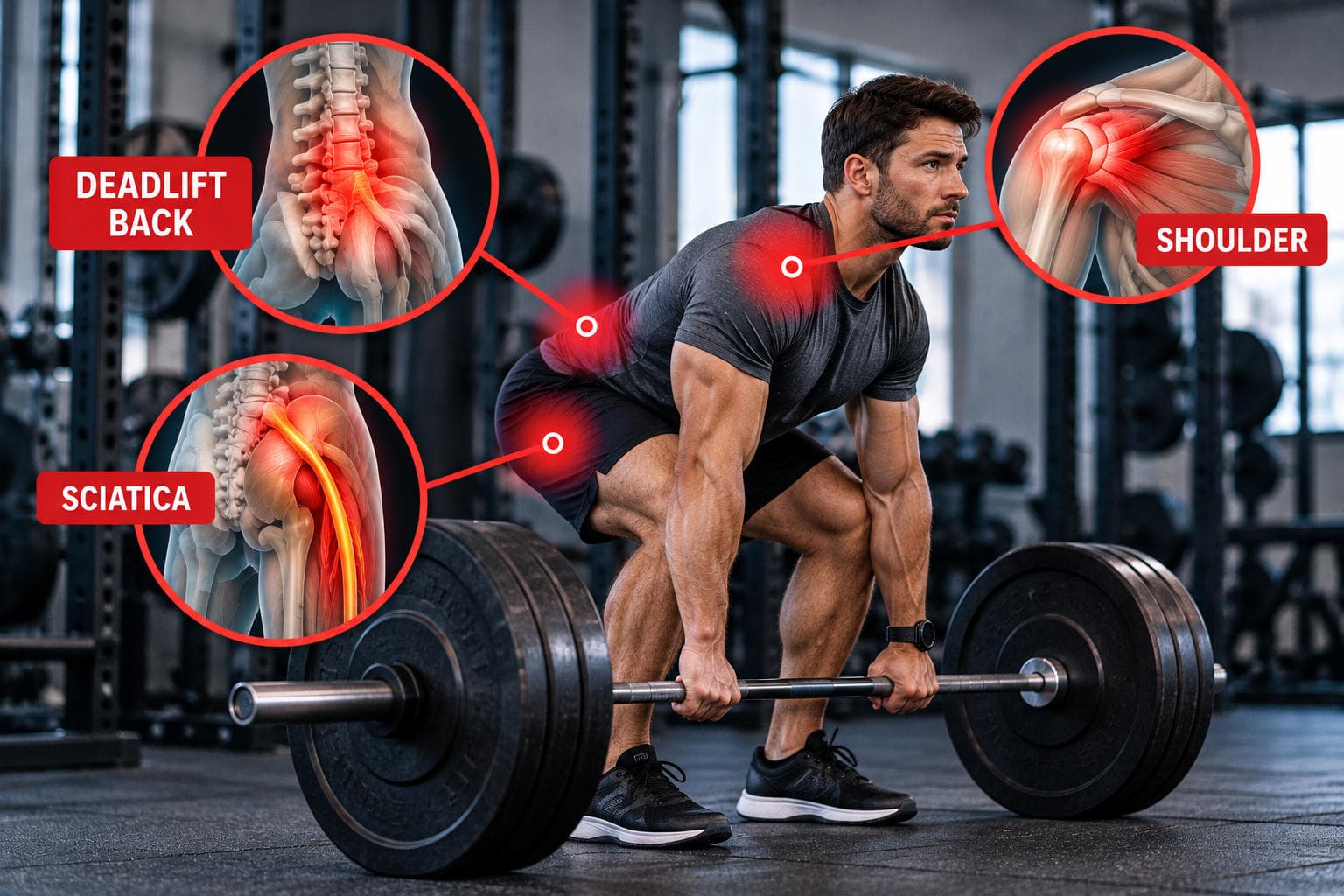
Strength training has a lower injury rate than most sports, and traditional resistance training is the safest of the weight-training methods. That matters, because many lifters believe lifting is inherently dangerous. This belief shapes their recovery as much as the injury does. It must be noted, the low back and shoulder account for most of the physiotherapy caseload.
What are the Most Common Strength Training Injuries?
A review across resistance training methods reported the following as the most common strength training injuries:
- Low back: The most commonly reported site of pain in resistance training practitioners, and the region most associated with heavy hinge patterns
- Shoulder: Consistently among the top sites across weightlifting, powerlifting and mixed-modality training. Anterior instability and overuse injuries were the most common types in a scoping review of weight-lifting athletes
- Knee: The third recurring site across methods
Reported figures vary enormously by method and definition. Incidence ranged from 0.21 to 18.9 injuries per 1000 hours and prevalence from 10% to 82% across 28 studies. In mixed-modality training specifically, mean prevalence was 35.3%, with the shoulder affected in 26%, spine in 24% and knee in 18%. Traditional strength training was the safest method reviewed and strongman the least safe. Any single headline figure here is close to meaningless without its method and definition attached.
Low Back Pain in the Lifter
Load-related pain associated with heavy hinge patterns are most often reported around the deadlift. Usually due to a load or capacity mismatch rather than a discrete tissue failure, and rarely as serious as the lifter fears.
Assessment
- Load history: Recent changes in volume, intensity and frequency, since a spike is more informative than absolute load
- Symptom behaviour: Whether pain is limited to the lift, present in daily activities, or present at rest
- Movement testing: Hinge pattern under load and unloaded, and flexion and extension tolerance
- Technique: Bar path and spinal position under fatigue rather than on the first repetition
- Red flags: Screen before imaging, since routine early imaging does not improve outcomes and can drive overtreatment
Physiotherapy management
- Modify the lift rather than removing it, adjusting range, load or variation to find a tolerable entry point
- Rebuild hinge capacity progressively, since deloading indefinitely does not address the mismatch
- Address volume and rate of progression, which are the variables the evidence actually supports
- Reassure that most episodes settle, and keep them training around the problem
Sciatica and Radicular Presentations
True radicular pain in a lifter, which needs separating from referred lumbar pain early because the prognosis and plan differ.
Assessment
- Distribution: Dermatomal pattern rather than diffuse buttock or thigh referral
- Neurological examination: Power, reflexes and sensation, repeated rather than assumed from one visit
- Straight leg raise and slump: For neural mechanosensitivity
- Symptom behaviour: Response to flexion and to sustained sitting, and whether leg pain dominates back pain
- Imaging: Only with red flags, since disc herniations frequently regress without intervention
Physiotherapy management
- Explain the natural history, since half to two-thirds of lumbar disc herniations regress on repeat imaging and the larger extruded and sequestered herniations resorb the most
- Maintain training in modified form, avoiding the specific provocative loading rather than avoiding the gym
- Progressive loading as symptoms allow, guided by leg symptoms rather than back pain
- Be clear that epidural steroid injection offers short-term relief and works as a bridge to rehabilitation, not as a fix
- Expect a longer course than for non-specific low back pain and set that expectation at the first consultation
Shoulder in the Lifter
Overhead pressing, bench pressing at end range, and receiving positions in the clean and snatch. Anterior instability and overuse both features, and the distinction changes the plan.
Assessment
- Establish the pattern: Instability versus load-related tendinopathy, since apprehension in the overhead receiving position points somewhere different from pain that builds across a training block
- Instability testing: Apprehension, relocation and load-and-shift where the history suggests it
- Range: Overhead position quality, and whether limitation is thoracic, scapular or glenohumeral
- Cuff strength: External rotation at end of range
- Exposure: Overhead and bench volume specifically, and bench grip width and range
Physiotherapy management
- Progressive cuff and scapular loading through range, not low-level activation work
- Modify the provocative lift by range or variation rather than removing all pressing
- Build external rotation strength at end of range, where the receiving position loads it
- For instability presentations in younger athletes, raise surgical opinion early rather than after repeated events
Before You Clear a Lifter
Strength training asks for repeated near-maximal loading in specific positions, so clearance rests on tolerating the intended lift at the intended load and range rather than on a general test. Rebuild from the last tolerated load rather than the target, treat programme design as the primary intervention, and check the language you have used, since a lifter who leaves believing their spine is damaged will lose more training than the injury cost them.