Golf Injuries: Low Back Pain, Sciatica and Lead-Elbow Tendinopathy
Golf carries one of the lowest injury rates per hour of any sport and one of the highest lifetime injury prevalence, because players accumulate exposure over decades. The swing loads the lumbar spine in combined rotation and extension, and the lead arm takes the impact.
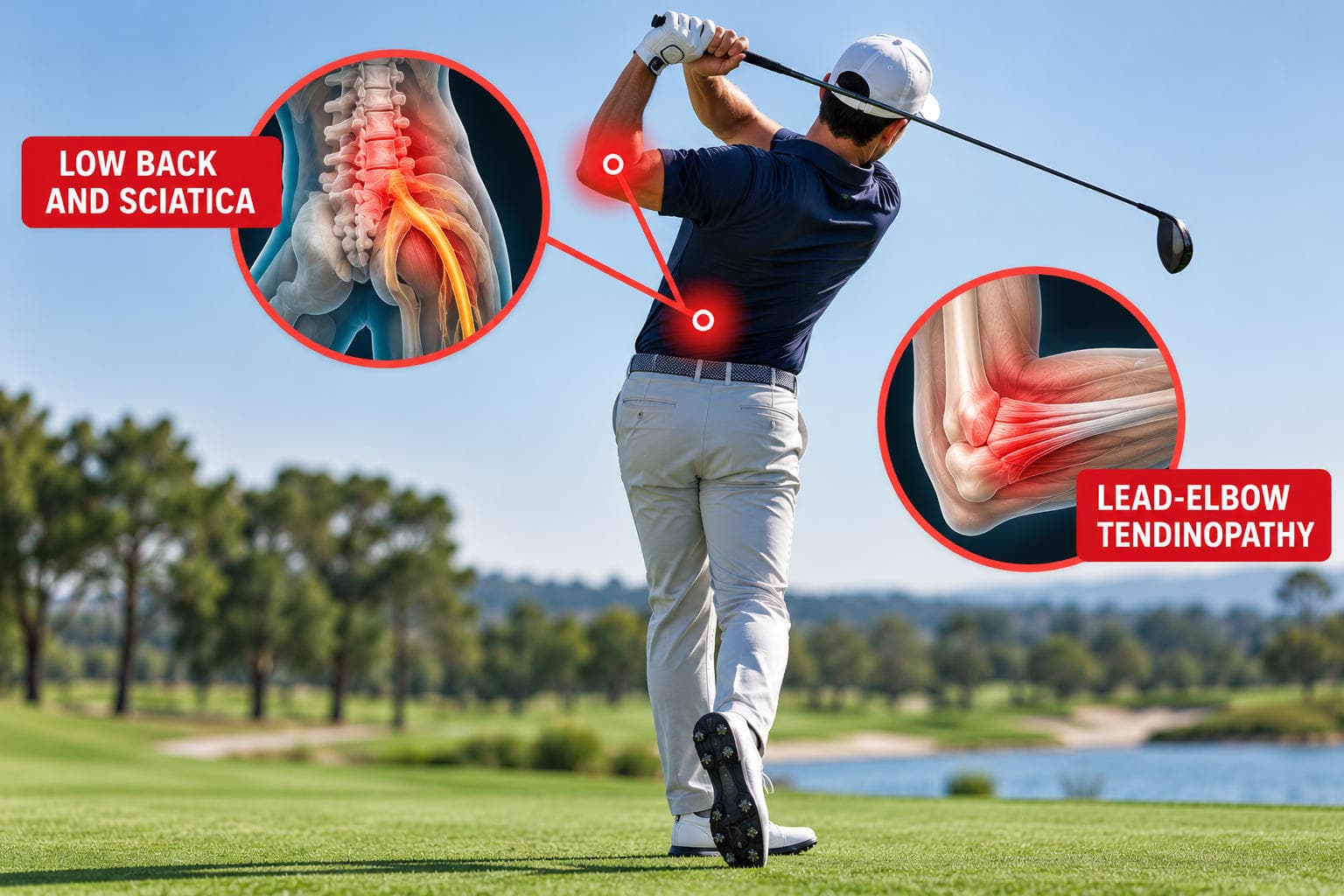
Golf carries one of the lowest injury rates per hour of any sport and one of the highest lifetime injury prevalence, because players accumulate exposure over decades. The swing loads the lumbar spine in combined rotation and extension, and the lead arm takes the impact. These are the two regions that account for most of the physiotherapy caseload.
What are the Most Common Golf Injuries?
Prevalence data spans professional and amateur populations with markedly different exposures, and the following are reported the most:
- Low back pain: The most frequently injured area in both professional and amateur male golfers, accounting for up to 34% of all golf injuries. Lifetime musculoskeletal injury risk has been reported at 73.5% in professionals and 56.6% in amateurs.
- Elbow tendinopathy: The second most common presentation, and more common in amateurs than professionals. Elbow injuries made up around 10% of professional injuries against 24.9% of amateur injuries
- Shoulder and wrist: The next most common sites, with the lead shoulder more often affected than the trail
Injury rate per hour is genuinely low, at 0.28 to 0.60 injuries per 1000 hours in amateur players. Annual prevalence figures vary widely by cohort, from roughly 25% to 62% in amateurs and higher in professionals, so pin any figure you quote to its population.
Low back pain and sciatica
Repeated combined rotation, lateral flexion and extension through the downswing and follow-through, accumulated over high practice volumes results in such kind of pain. Usually non-specific, however the sciatica presentations need separating out.
Assessment
- Symptom behaviour: Relationship to practice volume and to range sessions specifically, which load the spine more repetitively than play
- Distinguish referred from radicular pain: Dermatomal distribution, neurological deficit and straight leg raise, since non-specific low back pain with buttock referral and true radiculopathy carry different prognoses and plans
- Movement testing: Rotation and extension tolerance, and combined movement response
- Hip mobility and strength: Hip rotation range and hip strength, both associated with low back pain in this population
- Trunk: Trunk muscle activation and pelvis-trunk sequencing through the swing
- Red flags: Screen before imaging, since routine early imaging does not improve outcomes
Physiotherapy management
- Manage practice volume first, particularly range sessions, before altering technique
- Restore hip rotation range and hip strength, since limitation there transfers demand to the lumbar spine
- Build trunk control through rotation rather than training static bracing
- For radicular presentations, expect a longer course and be clear that epidural steroid injection gives short-term relief only, useful as a bridge to rehabilitation rather than a solution
- Address weight shift and pelvis sequencing with the coach where technique is contributing, as a shared conversation rather than a physiotherapy prescription
- Reassure and keep the golfer playing in reduced volume where possible
Tip: Ask how many balls they hit on the range in a week, separately from how many rounds they play. The range is where the volume accumulates and it rarely gets counted.
Lead-elbow tendinopathy
Load-related elbow pain in the leading arm, typically from repeated impact at ball contact or from taking a heavy divot.
Assessment
- Establish which side of the elbow: In right-handed golfers, lateral epicondylalgia more commonly affects the lead arm while medial epicondylalgia develops more often in the trail arm. In amateurs, lateral epicondylalgia is the more prevalent of the two despite the sport's association with golfer's elbow
- Provocation: Resisted wrist extension for lateral presentations, resisted wrist flexion and forearm pronation for medial
- Neurological screen: Ulnar nerve irritation in medial presentations, which coexists and changes management
- Grip strength: Pain-free grip as an objective marker you can re-measure
- Exposure: Rounds and range sessions per week, since incidence rises above roughly two to three rounds weekly
- Technique and equipment: Divot depth, grip size, and ground contact quality
Physiotherapy management
- Progressive loading of the relevant muscle group as the primary intervention, starting isometric if irritable
- Do not use corticosteroid injection, which relieves pain short-term but worsens one-year outcomes
- Reduce and then rebuild range volume rather than stopping play entirely
- Review grip size and address heavy ground contact with the coach
- Set expectations honestly, since these tendinopathies commonly run for months
Before you clear a golfer
Golf asks for repeated rotational loading at volume rather than peak effort, so clearance rests on tolerating the intended weekly practice and playing load rather than on a single test. Separate range volume from rounds played when you set that load, check hip rotation range has actually improved rather than assuming it, and be explicit about which elbow structure you have been treating, because the sport's naming conventions mislead more often than they help.
References
- https://pmc.ncbi.nlm.nih.gov/articles/PMC9219256/
- https://pmc.ncbi.nlm.nih.gov/articles/PMC10069570/
- https://www.ncbi.nlm.nih.gov/pmc/articles/PMC11346012/
- https://orthoinfo.aaos.org/en/staying-healthy/golf-injury-prevention/
- https://www.ncbi.nlm.nih.gov/books/NBK519000/
- https://www.sciencedirect.com/science/article/pii/S2666337620300068