Achilles Tendinopathy: A Heavy-Slow-Resistance Loading Protocol
Learn the presentation and assessment of mid-portion Achilles tendinopathy, sets out a heavy-slow-resistance loading protocol, compares it with eccentric training, and notes how insertional disease alters the approach.
Achilles tendinopathy is a common load-related condition, particularly among runners and other active individuals, and its management is firmly rooted in progressive tendon loading. While eccentric exercise has the longest track record, heavy-slow-resistance training has emerged as an equally effective and often better-tolerated alternative. This article describes the presentation and assessment of mid-portion Achilles tendinopathy, sets out a heavy-slow-resistance loading protocol, compares it with eccentric training, and notes how insertional disease alters the approach.
What Is Achilles Tendinopathy?
Achilles tendinopathy is a load-related disorder of the Achilles tendon, characterised by pain, stiffness, and impaired capacity to load. It is most usefully divided by location:
- Mid-portion tendinopathy affects the tendon a few centimetres above its insertion. It is the more common type and the more straightforward to load.
- Insertional tendinopathy affects the region where the tendon attaches to the calcaneus. It behaves differently, particularly in its response to positions that compress the tendon against the bone.
The underlying tissue change is degenerative rather than primarily inflammatory. That is why the condition is termed a tendinopathy, and why loading is central to management and not just rest or anti-inflammatory treatment alone.
How is Achilles Tendinopathy Assessed?
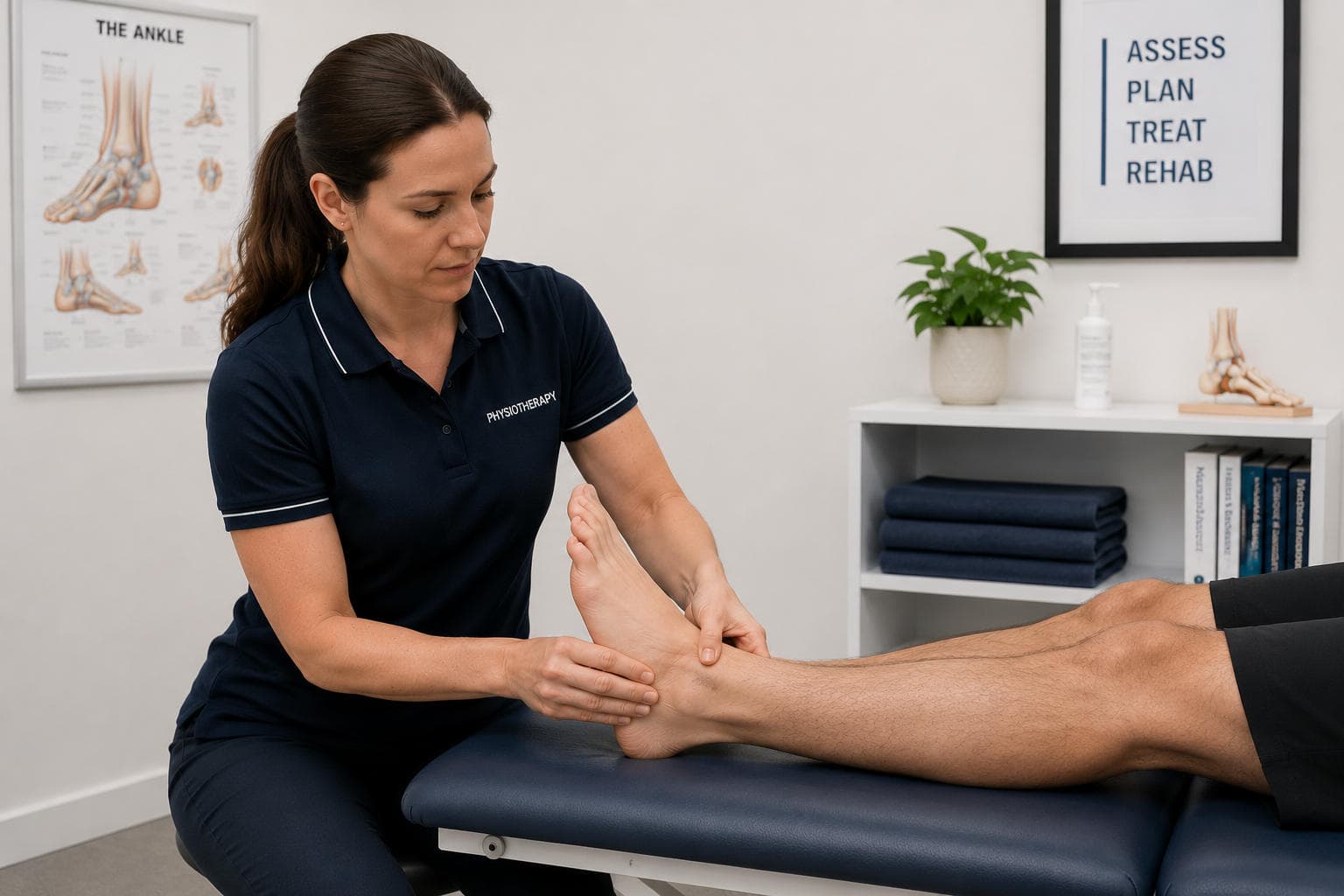
The typical presentation is load-related pain and morning stiffness localised to the tendon, often with a palpably thickened and tender segment in the mid-portion. Pain is provoked by activities that load the tendon, such as running, hopping, and stair work, and characteristically eases with warm-up before returning afterward.
Assessment covers several tasks:
- Confirming the location of tenderness and thickening
- Examining calf strength and the patient's capacity to perform single-leg heel raises
- Screening for differential diagnoses
- Distinguishing mid-portion from insertional disease, because this directly shapes the loading programme
Imaging is not required for diagnosis. As with other tendinopathies, structural findings correlate poorly with symptoms, so the diagnosis is clinical.
What Is the Heavy-Slow-Resistance Protocol for Achilles Tendinopathy?
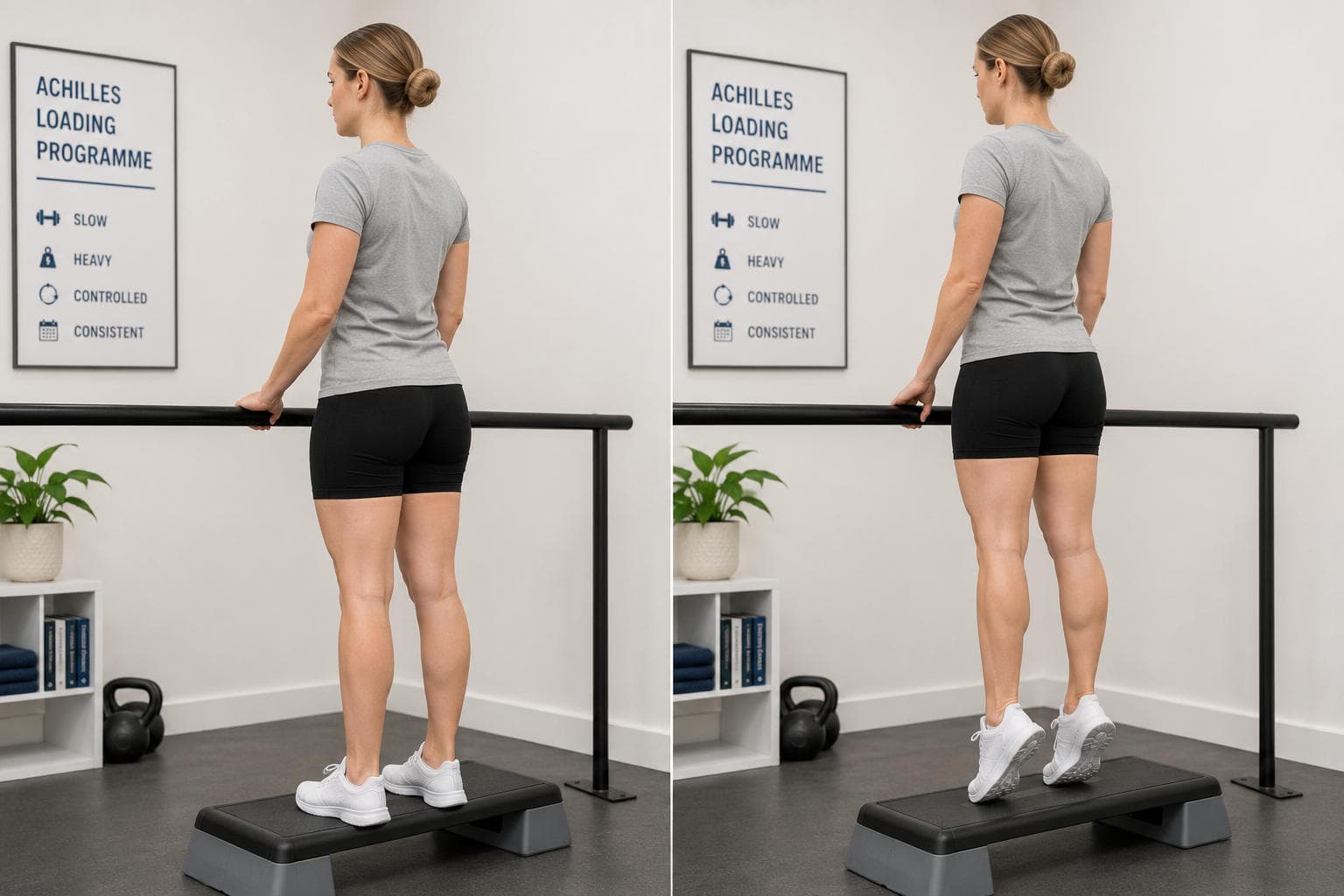
Heavy-slow-resistance training loads the tendon with high resistance, performed slowly through the full range. A representative protocol uses three bilateral, full-range heel-raise exercises, each performed at a cadence of around six seconds per repetition, commonly three seconds to raise and three to lower:
- A seated calf raise with the knee flexed
- A standing heel raise with the knee extended and load across the shoulders
- A heel raise on a leg press, with the calf loaded through extended-knee positions
The programme runs over twelve weeks and progresses by increasing the load while reducing the repetitions. It begins at around three sets of fifteen repetitions and advances through three sets of twelve, then four sets of ten, four sets of eight, and finally four sets of six as resistance climbs. Sessions are performed about three times per week. The defining principle is high tensile load applied slowly, with progression driven by the patient's capacity and an acceptable symptom response.
How Does Heavy-Slow-Resistance Protocol Compare With Eccentric Training?
Eccentric training, in which the heel is lowered under load through repeated daily sets with the knee both straight and bent, has been the traditional first-line loading approach and has good supporting evidence. A randomised controlled trial comparing heavy-slow-resistance training with eccentric training found that both produced significant and equally good improvements in tendon-specific symptoms and pain, sustained at one year, with comparable structural changes in the tendon.
The notable differences were in adherence and satisfaction. The heavy-slow-resistance group trained more consistently and tended to report greater satisfaction. The practical reading is that both approaches work, and that heavy-slow-resistance offers an effective option many patients find easier to sustain, with its lower daily time burden a plausible contributor to better adherence. The principle of progressive tendon loading is shared across tendinopathies; our companion article on loading for lateral epicondylalgia (tennis elbow) discusses the same approach at the elbow.
How Does Insertional Disease Change the Approach?
Insertional Achilles tendinopathy requires modification because the tendon is compressed against the calcaneus in positions of dorsiflexion. Loading that takes the ankle into end-range dorsiflexion, such as heel raises performed off the edge of a step that allow the heel to drop below horizontal, can aggravate insertional disease, whereas the same movement is appropriate for mid-portion disease.
For insertional presentations, loading is therefore typically performed without the heel dropping into dorsiflexion, for instance, on a flat surface, and progression is managed with attention to avoiding provocative compression. Recognising which type is present before prescribing the programme prevents a common error: applying a mid-portion protocol to an insertional problem and worsening symptoms.
Why Does Loading Work, and How Is Pain Monitored?
Progressive loading is the core of management because the tendon adapts to the mechanical demand placed on it. Controlled, progressive tensile load stimulates the tendon and the calf musculature to rebuild capacity, which is why a graded loading programme outperforms rest. An unloaded tendon does not recover its tolerance, and a sudden return to full activity without rebuilt capacity tends to provoke recurrence. The clinician's task is to apply enough load to drive adaptation without overwhelming the tendon, and to progress that load as capacity improves over the months the process requires.
Because some discomfort during tendon loading is expected and acceptable, pain is used as a guide rather than as a signal to stop. A practical approach permits loading that produces no more than an acceptable level of pain during and immediately after exercise, provided two conditions hold:
- Tendon settles within around twenty-four hours
- Morning stiffness does not worsen over the following days
A tendon-specific outcome measure, completed at intervals, provides an objective anchor for tracking change. The patient is taught to judge progression by the tendon's response over the day after loading, rather than by the sensation during the exercise alone.
Eccentric training remains a well-evidenced alternative to heavy-slow resistance and is worth understanding. The traditional eccentric protocol has the patient lower the heel under load through repeated daily sets, performed with the knee both straight and bent to target the gastrocnemius and soleus, respectively, typically over a twelve-week period.
It is effective but demanding in time and frequency, which is one plausible reason that heavy-slow resistance, performed roughly three times per week, tends to achieve better adherence for comparable results. In the earlier, more painful phase, isometric calf loading can be used to load the tendon while providing a degree of analgesia, before progressing to the heavier isotonic work. The choice between protocols can therefore be tailored to the individual's symptoms, preferences, and capacity to commit to a daily versus an alternate-day routine.
When Should Achilles Pain Require Further Assessment?
Certain features should prompt further assessment rather than continued loading:
- A sudden, sharp pain with a sense of a snap, weakness in push-off, and a palpable gap, which raises the possibility of tendon rupture and requires urgent assessment
- Systemic features, bilateral spontaneous tendinopathy, or a relevant medication history, which may point to an inflammatory or drug-related cause
- Pain that fails to respond to a well-delivered loading programme
What Is the Prognosis of Achilles Tendinopathy?
The prognosis with progressive loading is good, with clinically meaningful improvement in symptoms and function that is maintained at one year in the majority. Recovery is measured in months rather than weeks, and the most important determinants of a durable result are the patient's adherence to the loading programme and the appropriate progression of load over time.
Since the benefit depends on sustained, accurately dosed loading, the clinician's role is to set realistic expectations, ensure the protocol matches the type of tendinopathy, and progress the load as capacity improves, equipping the patient to continue loading and manage future flares independently. Brief flares in response to a temporary increase in load are common even during a successful programme and do not signify failure. Teaching the patient to briefly reduce load and then resume, rather than stop altogether, prevents these episodes from derailing the overall trajectory.
KineticFlow for Achilles Tendinopathy
KineticFlow helps you:
- Distinguish the type: Whether the presentation is mid-portion or insertional is recorded, so the loading programme is matched to the correct type and compression-provoking positions are avoided where appropriate.
- Structure the loading protocol: The heavy-slow-resistance progression—load, sets, repetitions, and cadence across the weeks—is tracked, so the current stage and the criteria for advancing are explicit.
- Track outcomes against baseline: A tendon-specific symptom score and a pain score are stored at each visit, demonstrating whether the loading programme is producing meaningful change over the months it requires.
- Surface red flags early: Documented prompts for features such as suspected rupture support timely onward assessment.
Try KineticFlow for your next patient assessment!
References
https://www.jospt.org/doi/10.2519/jospt.2018.0302
https://pubmed.ncbi.nlm.nih.gov/26018970/
https://my.clevelandclinic.org/health/diseases/21553-achilles-tendinitis